Rain barrel stand DIY guide: how high to raise a barrel and what to build it from
Two concrete blocks turn a barrel you can't use into one that fills a watering can. The trick is a base that stays level under 460 pounds.
In this article
For a rain barrel stand DIY build, use concrete blocks, bricks or sturdy timber on firm, level ground, and raise the barrel high enough to fit a watering can or bucket under the spigot. The base has to carry real weight: a full 55-gallon barrel weighs about 460 pounds. Level it side to side and front to back, keep it low and wide, and anchor the barrel if children play nearby.
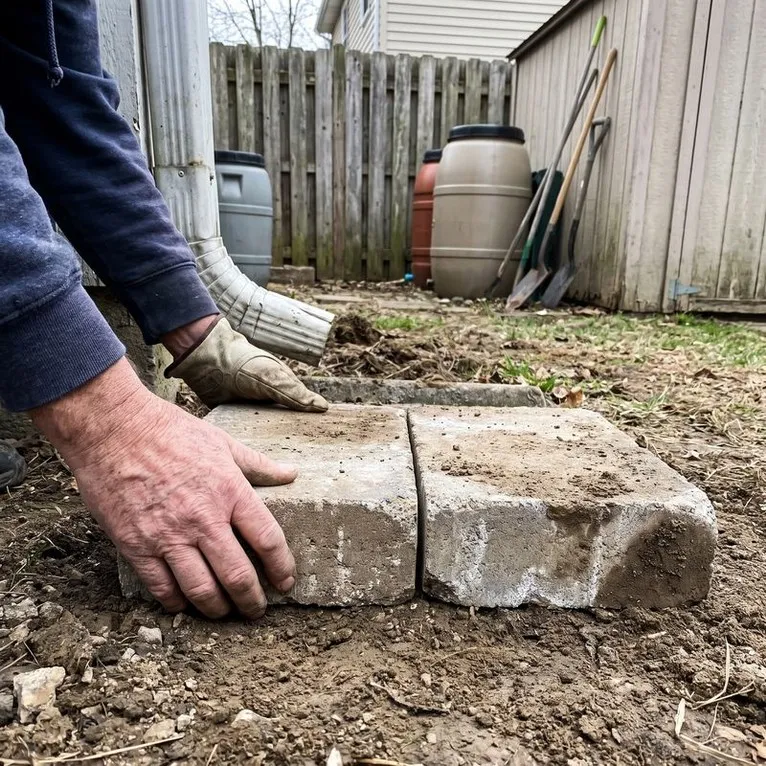
The Off-Grid Handbook starts its very first project, The Gravity Rain Barrel, with this step: two concrete blocks on level ground under a downspout. The whole build takes about 45 minutes and $60 in materials, per the book.
What a rain barrel stand has to hold
Water weighs about 8.3 pounds per gallon, a figure the Handbook gives in its siphon project, so 55 gallons comes to roughly 460 pounds. Rutgers Cooperative Extension gives the same number. That weight sits on a small footprint, so any soft spot or tilt in the ground shows up fast.
Rutgers' instructions for the platform are simple: check it with a level from side to side and from front to back so the barrel sits evenly and securely, and add crushed stone or gravel under the base if the ground needs leveling. University of Wisconsin Extension adds that barrels should go only on level surfaces, with a secure base to prevent tipping.
How high should a rain barrel be?
A gravity barrel has no pump, so height is your water pressure. The Handbook's rule: every foot of height adds roughly 0.43 psi.
| Height of the water above the spigot | Pressure |
|---|---|
| 1 foot | About 0.4 psi |
| 2 feet | About 0.9 psi |
| 3 feet | About 1.3 psi |
| 4 feet | About 1.7 psi |
None of these numbers is large, so the practical test matters more: can you fit your watering can or bucket under the spigot? The book's field note says the most common first-build mistake is putting the barrel on the ground. A barrel at ground level can't fill a watering can, and two blocks of elevation make the whole system usable.
To set the height, put your watering can or bucket on the ground where the spigot will be and measure to just above its rim. The spigot sits 3 to 4 inches above the barrel's bottom in the Handbook's build, so subtract that, and the rest is the height your stand needs.
Going much higher brings diminishing returns. A taller stand adds a little pressure but makes a 460-pound barrel easier to tip. If you want real pressure for a hose or drip line, a sturdy elevated stand is a different build, covered in our DIY water tank stand guide, and drip lines are covered in rain barrel drip irrigation.
Rain barrel stand DIY options compared
Rutgers lists cinder blocks, bricks or wood for the platform, and Wisconsin mentions concrete or cinder blocks or a sturdy wooden stand. Each has its place:
| Stand | Pros | Cons |
|---|---|---|
| Concrete blocks on a gravel pad | Cheap, strong, quick; the Handbook's choice | Plain looking; blocks must sit tight together |
| Bricks or pavers | Neat, low, easy to level | Little height unless stacked, and tall stacks shift |
| Timber stand | Can match a deck or fence; room for a shelf | Must be overbuilt for 460 pounds or more; wood weathers |
| Long block base for a chain | Holds two or three linked barrels at one level | Needs a level line along its whole length |
If you build in wood, use pressure-treated lumber and build for well over the barrel's full weight, with legs braced so the frame can't rack, meaning lean sideways under load. Check bolts and screws each spring.
How to build a block stand, step by step
- Clear the spot under the downspout down to firm soil. Remove sod, mulch and loose fill, which settle under load.
- Level the ground. Add crushed stone or gravel and tamp it firm, as Rutgers suggests.
- Set the blocks tight together so the barrel never straddles a gap.
- Check level side to side and front to back, and adjust the gravel, not the blocks.
- Place the barrel and connect the diverter, then fill-test and check for any rocking.
The Handbook's Project 9 adds the rule for more than one barrel: level is everything, with all barrels on one continuous, level base of blocks. Base-linked barrels settle to one water line, so a barrel set lower than its neighbors overflows first. See how to connect rain barrels for the full chain, and rain barrel spigot for fitting the tap at the right height.
Rain barrel stand ideas for awkward spots
- On a slope: dig the high side down to make a level pad rather than propping up the low side with stacked blocks.
- On soft or wet soil: a wider gravel pad spreads the load. Make sure overflow drains away from the base, not under it.
- Against siding: leave a little room behind the barrel for air and for getting at the spigot and lid.
- Where you want more height: raise the spot itself on firm ground, or move up to a braced stand, instead of stacking loose blocks high.
Keep it from tipping
A tipped barrel is 460 pounds of water and plastic. Nebraska Extension recommends anchoring rain barrels to a building or another secure object for stability, and secure covers so children can't climb inside. University of Wisconsin Extension warns that a barrel can tip if children try to climb on it.
An empty barrel is the opposite problem: light enough to blow over. Rutgers advises draining and disconnecting barrels for winter, storing them indoors or upside down outside, and tying them down so they don't blow around in a winter storm.
A strap around the barrel, fixed to the wall framing or a post, is an easy anchor. Keep lids screwed or clipped down, and don't build steps or ledges that invite climbing. For the rest of the setup, from spigot to screens, see how to set up a rain barrel, and for running barrels into a full gravity line, the gravity-fed water system.
Frequently asked questions
How high should a rain barrel stand be?
High enough to fit your watering can or bucket under the spigot. The Off-Grid Handbook uses two concrete blocks and says every foot of height adds about 0.43 psi. Much higher adds little pressure but makes a 460-pound barrel easier to tip.
What can I use for a rain barrel stand?
Rutgers Cooperative Extension suggests cinder blocks, bricks or wood, and Wisconsin Extension concrete blocks or a sturdy wooden stand. Whatever you use must hold about 460 pounds, sit level side to side and front to back, and not shift on soft ground.
How much does a full rain barrel weigh?
About 460 pounds for a 55-gallon barrel, according to Rutgers Cooperative Extension. Water weighs roughly 8.3 pounds per gallon, the figure The Off-Grid Handbook uses, so a chain of three barrels puts close to 1,400 pounds on its base.
Should a rain barrel be anchored?
Nebraska Extension recommends anchoring rain barrels to a building or other secure object, and secure covers so children can't crawl inside. Wisconsin Extension warns a barrel can tip if children climb on it. A strap to wall framing or a post works.
Sources
- The Off-Grid Handbook, Garrett Dalton, Project 1
- Rutgers Cooperative Extension: Rain Barrels Part II, Installation and Use (FS1118)
- Nebraska Extension: Rainwater Harvesting with Rain Barrels (G2220)
- University of Wisconsin-Madison Extension: Rain Barrels
Safety guidance changes. Check the agency pages above for the current version, and follow your local code and manufacturer instructions.