DIY water tank stand: how high to build it, how strong, and when to get it checked
Height buys water pressure, but every extra foot also adds leverage on the frame. The weight of the water decides the design.
In this article
A DIY water tank stand has one job: hold a heavy tank of water up in the air, steadily, for years. Water weighs about 8.34 pounds per gallon, so a full 65-gallon tank weighs roughly 540 pounds, and The Off-Grid Handbook says to build the stand for 700 pounds or more. Build 6 to 8 feet high, brace all four faces, anchor it, and fill it in stages the first time. If the design goes beyond simple framing, have it checked.
That is Project 14 of the Handbook, Elevated Tank Gravity Feed, a half-day build for about $150 in materials, per the book. This guide is about the stand itself. For how the tank fits into a full rain-to-tap line, see our guide to the gravity-fed water system.
Start with the weight
Every decision about a stand follows from how heavy the water is. The USGS puts water at 8.34 pounds per gallon. Here is what common containers weigh when full, water only:
| Container | Water weight when full |
|---|---|
| 55-gallon barrel | About 459 lb |
| 65-gallon tank (the Handbook's build) | About 542 lb |
| 100-gallon tank | About 834 lb |
| 275-gallon tote | About 2,294 lb |
Add the tank, the fittings and the platform itself on top of that. The Handbook's margin is deliberate: a 65-gallon tank is about 540 pounds, and the stand is built for 700 or more. The Texas Manual on Rainwater Harvesting adds a warning that applies at any size: a leaning tank may collapse, so it has to sit on a stable, level base.
How high to raise a water tank for pressure
Height is what pushes water out of the tap. Each foot of height adds about 0.43 psi, or 1 psi for every 2.31 feet of rise, the figure both the Texas manual and UC Cooperative Extension use. Measure from the water surface in the tank down to the tap you use.
| Height of water above the tap | Pressure | What it will do |
|---|---|---|
| 2 feet | About 0.9 psi | Fill a bucket slowly |
| 6 feet | About 2.6 psi | A real gravity tap and low-pressure drip lines, per the Handbook |
| 8 feet | About 3.5 psi | The same, a little faster |
| 46 feet | About 20 psi | The low end of what many appliances need |
| Over 90 feet | About 40 psi | Ordinary town water pressure |
The Texas manual notes that clothes washers, dishwashers and on-demand water heaters need 20 to 30 psi, and that standard town water runs at 40 to 60 psi. No backyard stand gets there, which is why the Handbook stops at 6 to 8 feet. Its field note: 8 feet is plenty, and chasing 20 feet of head with amateur framing trades a convenience for a hazard. Garden drip is in between: Utah State University Extension notes that most drip systems run at 10 to 30 psi, so a gravity tank needs drip parts made for low pressure. If you need house pressure, that is a pump job; see do rain barrels need a pump.
The cheapest height is free height. The Handbook's first step is to site the stand uphill from where you use the water if you can, so the slope does some of the lifting.
The base under an elevated water tank stand
The ground carries everything. The Texas manual says a stable bed with a layer of sand or pea gravel can be enough for a small tank, sand or pea gravel over well-compacted soil works in some areas, and otherwise a concrete pad should be built. When the condition of the soil is unknown, it suggests a structural engineer.
For a stand on posts, that means each post bears down on something solid and level, not on soft soil, mulch or a slope that is washing away. Keep the tank's overflow pointed well away from the base, because the Texas manual warns that overflow and runoff can undermine a pad. Check the footing after heavy rain.
Framing the stand: the Handbook's method
The materials list is short: pressure-treated 4x4 posts and 2x6 framing, a 65-gallon tank rated for the job, a 3/4-inch outlet with a valve and food-grade supply line, and anchors or ground screws. Tools are a saw, drill/driver, level and wrench.
- Site it. Uphill if possible, or build to 6 to 8 feet.
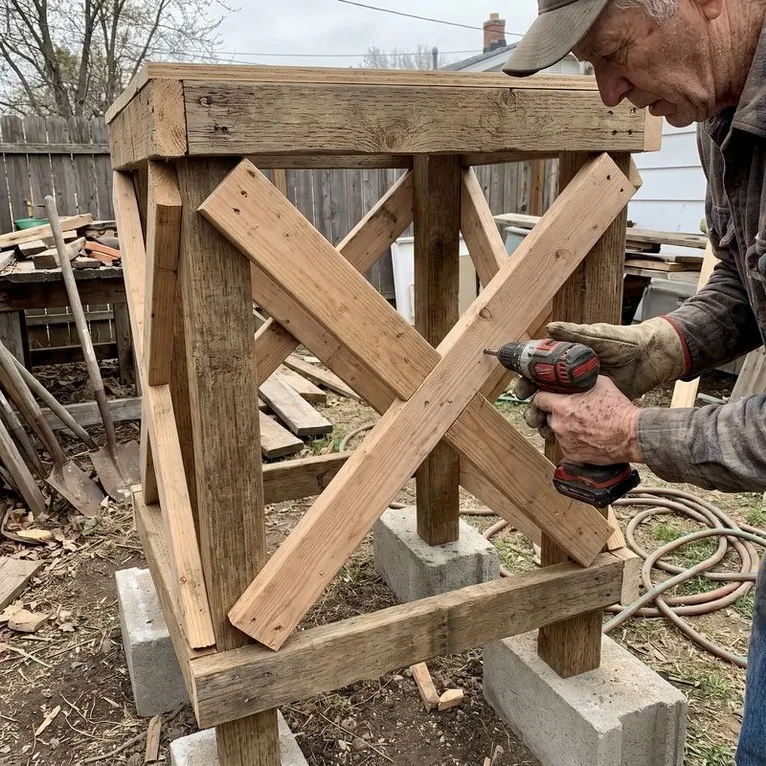
- Brace all four faces. Diagonal cross-bracing on every side keeps the frame from racking, which means leaning into a parallelogram under load. The book's instruction is to overbuild deliberately.
- Anchor it. The book's reason: wind load on an empty tank platform is real. An empty tank catches wind like a sail.
- Plumb the outlet. A shutoff at the tank and a tap at the point of use.
- Fill in stages. On the first test, stop at a quarter, half and full, and check the structure each time.
Give the tank a flat, solid deck to sit on and follow the tank maker's instructions on support. During each fill stop, check that the deck is still level, that no joint has opened or sagged, and that no post has sunk. If anything moves, drain it and fix it before going on.
When to have a DIY water tank stand checked
The Handbook's safety box is direct: water weight is the hazard, and 65 gallons is over 540 pounds overhead. If the stand design goes beyond simple framing, or it sits near buildings or near people, have it checked by someone qualified, and follow local codes for structures and setbacks. Some towns require a permit for raised structures; ask before you build.
A few practical limits keep the risk low:
- Keep it at 8 feet or under, as the book advises.
- Don't build it where people walk, park or play, or tight against the house.
- Keep children off it. A braced frame looks like a climbing frame.
- Re-check bolts, braces and anchors each season, and before the first freeze, when the tank should be drained as in how to winterize a rain barrel.
For smaller loads, a single barrel needs only a low platform; see our rain barrel stand guide. To fill the tank from your roof, start with connecting rain barrels. Remember that stored rainwater is not drinking water until it has been filtered and disinfected; can you drink rain water explains why.
Frequently asked questions
How strong does a water tank stand need to be?
Strong enough for the full weight with a margin. Water weighs about 8.34 pounds per gallon, so a full 65-gallon tank is about 540 pounds, and The Off-Grid Handbook builds its stand for 700 pounds or more, with cross-bracing on all four faces and anchors.
How high should a water tank be for good pressure?
Each foot of height adds about 0.43 psi. The Off-Grid Handbook builds to 6 to 8 feet, about 2.6 to 3.5 psi, enough for a gravity tap and low-pressure drip lines. Appliances need 20 to 30 psi, which would take a tank 46 to 69 feet up, so use a pump for that.
Do I need a permit for a water tank stand?
It depends on where you live. The Off-Grid Handbook says to follow local codes for structures and setbacks and to have any design beyond simple framing, or near buildings and people, checked by someone qualified. Ask your local building department before you build.
What should a water tank stand sit on?
A stable, level base. The Texas Manual on Rainwater Harvesting says sand or pea gravel over compacted soil can work for a small tank, a concrete pad otherwise, and a structural engineer when the soil is unknown. Keep overflow away so it can't undermine the base.
Sources
- The Off-Grid Handbook, Garrett Dalton, Project 14
- Texas Water Development Board: The Texas Manual on Rainwater Harvesting
- USGS: A Million Gallons of Water, How Much Is It?
- UC Cooperative Extension: Energy and Cost Required to Lift or Pressurize Water
- Utah State University Extension: Drip Irrigation for Trees
Safety guidance changes. Check the agency pages above for the current version, and follow your local code and manufacturer instructions.