Do rain barrels need a pump? When gravity is enough and when a rain barrel pump helps
A gravity barrel works in a blackout because it has nothing to switch on. Here is what that low pressure can and cannot do.
In this article
Most rain barrels do not need a pump. Gravity is enough to fill a watering can, run a low-pressure soaker hose or feed a short gravity drip line, and a gravity barrel keeps working when the power is out. A rain barrel pump earns its place only when you want something gravity cannot do: run a sprinkler, push water uphill, or move it a long way through a hose.
Project 1 of The Off-Grid Handbook is built on that idea: one downspout, one barrel, one spigot, and in the book's words, no pump, no power, nothing to switch on.
Do you need a pump for a rain barrel? Usually not
Ask what the water is for. If the answer is watering cans, a soaker hose along a flower bed, rinsing tools or filling buckets to flush toilets during an outage, gravity does the job. The barrel just needs to sit high enough. The book's field note says the most common first-build mistake is putting the barrel on the ground, where it cannot fill a watering can; two blocks of elevation make the whole system usable.
Without a pump there is nothing to break, no cord across the yard and no outlet near water. For a household that wants water during a blackout, that simplicity is the point. Our guide on water during a power outage explains why a rain barrel is one of the few water sources that does not care whether the grid is up.
Rain barrel water pressure, in numbers
Pressure from a barrel comes only from height: about 0.43 psi for every foot between the water surface and the hose end, as the Handbook says. A full barrel on blocks gives roughly 1 to 2 psi at ground level. Here is how that compares with what different jobs need:
| Job | Pressure it needs | Gravity enough? |
|---|---|---|
| Filling a watering can or bucket | Any flow at all | Yes |
| Low-pressure soaker hose | Very low | Usually, per Nebraska Extension |
| Gravity drip line | About 1 to 3.5 psi | Yes, with height and gravity-rated parts |
| Standard drip kit | Some need 20 psi | No |
| Lawn sprinkler | Far more than a barrel gives | No |
| House faucets | City water runs 40 to 60 psi | No |
The Texas Water Development Board puts the gap in perspective: water gains 1 psi for every 2.31 feet of rise, so matching 40 psi by gravity alone would take a tank more than 90 feet above the house. Nebraska Extension says plainly that flow from a rain barrel is much lower than from an outdoor faucet, generally making sprinklers ineffective.
How to get more pressure without a pump
- Raise the barrel. Every foot counts. A sturdy rain barrel stand beats a pile of loose blocks.
- Use the water below the barrel. Beds and buckets lower than the spigot fill faster. Uphill is where gravity stops.
- Shorten the hose. Friction in a long hose eats the little pressure you have. A short hose, or a watering can filled at the barrel, moves more water.
- Keep the barrel full. Pressure drops as the level drops, so the last few inches come out slowly.
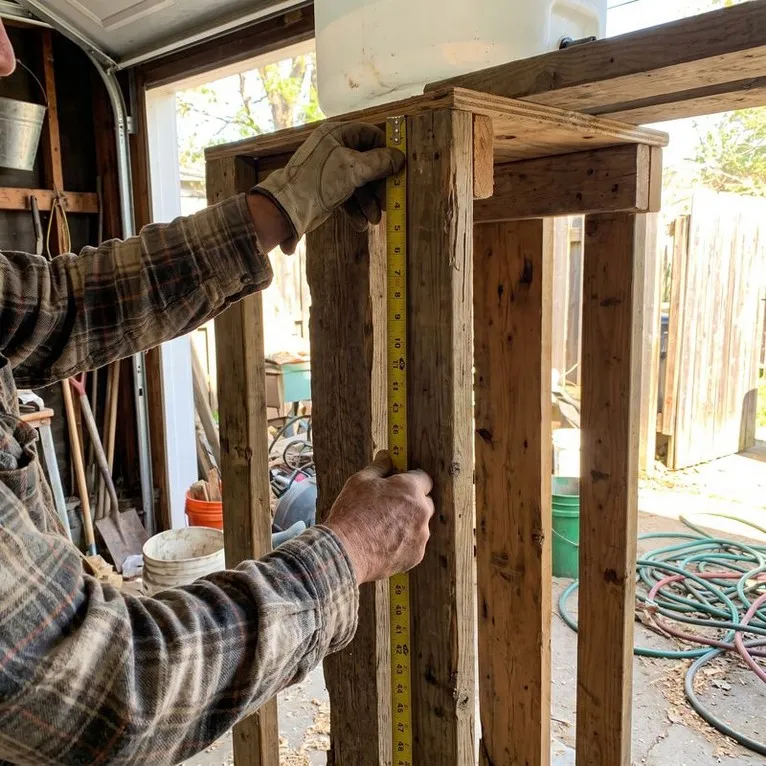
- Go higher with a tank. Project 14 of the Handbook raises a 65-gallon tank on a braced stand to 6 to 8 feet for roughly 2.6 to 3.5 psi, enough for a real gravity tap and drip lines. Its field note: 8 feet is plenty, and chasing more height with amateur framing trades a convenience for a hazard. See the gravity-fed water system guide.
When a rain barrel pump makes sense
A pump is worth considering if you want to:
- Run a sprinkler or a spray nozzle.
- Water a bed that sits uphill from the barrel.
- Send water through a long hose to the far side of the yard.
- Move water from a large, low tank or a chain of barrels to where you need it.
Small pumps sold for rain barrels come in two broad kinds: submersible pumps that sit in the barrel, and inline pumps that connect to the spigot outside it. Some run on rechargeable batteries; others plug into a household outlet.
Choosing and running a pump safely
Water and household current are a dangerous pair. A few rules keep it safe:
- Battery or 12-volt pumps keep you in low-voltage territory, the same level the Handbook's power projects stay at.
- Plug-in pumps go only into a GFCI-protected outdoor outlet. CPSC explains that a GFCI cuts power when it detects a current leak as small as 0.006 amperes, fast enough to prevent a lethal shock. Press its test button before the season starts.
- Do not add outdoor wiring yourself. If there is no GFCI outlet near the barrel, have a licensed electrician install one rather than running a new circuit.
- Use only cords rated for outdoor use, and keep connections off the wet ground.
- Follow the pump's manual on running dry and on intake screens. Roof grit wears pumps, so keep the barrel's screens clean.
Think about outages too. A plug-in pump stops when the power does, and a battery pump runs only as long as its last charge. If the barrel is part of your outage plan, set it up so gravity alone can fill a bucket, and treat the pump as a convenience for good days, not the thing your water depends on. That way a dead battery never stands between you and the water you saved.
Before buying a pump to empty a barrel, try a siphon: it moves water downhill with no power at all. See how to start a siphon.
A pump does not make rain water drinkable
Pressure changes how water moves, not what is in it. The Handbook's Project 1 safety box says rainwater from a roof is not drinking water as collected, and untreated rainwater is for gardens, flushing and washing only. For any drinking use, read can you drink rain water and filter, then disinfect, as in our DIY gravity water filter guide. And if your next step is watering a garden by gravity, start with rain barrel drip irrigation.
Frequently asked questions
Can you get water pressure from a rain barrel without a pump?
Yes, a little. Each foot of height between the water surface and the hose end adds about 0.43 psi, so a full barrel on blocks gives roughly 1 to 2 psi. That fills watering cans and runs low-pressure soaker hoses or gravity drip lines, but not sprinklers.
Will a sprinkler work on a rain barrel?
Generally not without a pump. Nebraska Extension notes that flow from a rain barrel is much lower than from an outdoor faucet, making sprinklers ineffective. City water runs at 40 to 60 psi, far beyond what a barrel gives by gravity.
Is it safe to use an electric pump in a rain barrel?
Only with care. Plug it into a GFCI-protected outdoor outlet, use an outdoor-rated cord, and follow the manual. A battery or 12-volt pump avoids household current near water. If there is no GFCI outlet nearby, have a licensed electrician add one.
How high should a rain barrel be to get good pressure?
Two concrete blocks are the minimum that makes a barrel usable. Higher means more pressure, about 0.43 psi per foot. The Off-Grid Handbook's elevated tank stand goes to 6 to 8 feet for roughly 2.6 to 3.5 psi and says 8 feet is plenty.
Sources
- The Off-Grid Handbook, Garrett Dalton, Project 1
- Texas Water Development Board: The Texas Manual on Rainwater Harvesting
- Nebraska Extension: Rainwater Harvesting with Rain Barrels (G2220)
- New Mexico State University: Low-Pressure Drip Irrigation for Small Plots and Urban Landscapes (RR773)
- CPSC: What Is a GFCI? (Fact Sheet 99)
- University of Wisconsin-Madison Extension: Rain Barrels
Safety guidance changes. Check the agency pages above for the current version, and follow your local code and manufacturer instructions.