How to start a siphon without your mouth: three clean methods
Water weighs 8.3 pounds a gallon. A six-foot hose and a two-dollar bulb move it from barrel to bucket without lifting, and without putting your mouth on the line.
In this article
Here is how to start a siphon without mouth suction: put one end of a food-grade hose in the full container, hold the other end lower than the water level, and squeeze a hand-pump siphon bulb until water flows. If you have no bulb, fill the whole hose with water first, cap one end with your thumb, lower it below the source and let go. Gravity does the rest.
That is Project 11 of The Off-Grid Handbook, the Siphon & Transfer Kit: 30 minutes and about $20, per the book. Its field note is blunt: mouth-siphoning stored water is how people make themselves sick from their own supply.
How a siphon works
A siphon is a hose full of water running from a higher container to a lower one. Once the hose is full and the outlet sits below the surface of the water in the source, the weight of the water in the longer, lower leg keeps pulling water over the rim. No pump runs once it starts.
Two rules make it work:
- The hose must be full of water, with no big air pockets. Air breaks the flow.
- The outlet must stay lower than the water surface in the source. Raise the outlet above it and the flow stops.
The flow also stops when the water in the source drops below the intake end. Hold that end near the bottom, but not in the sludge, to drain as much as possible.
How to start a siphon without mouth suction: three methods
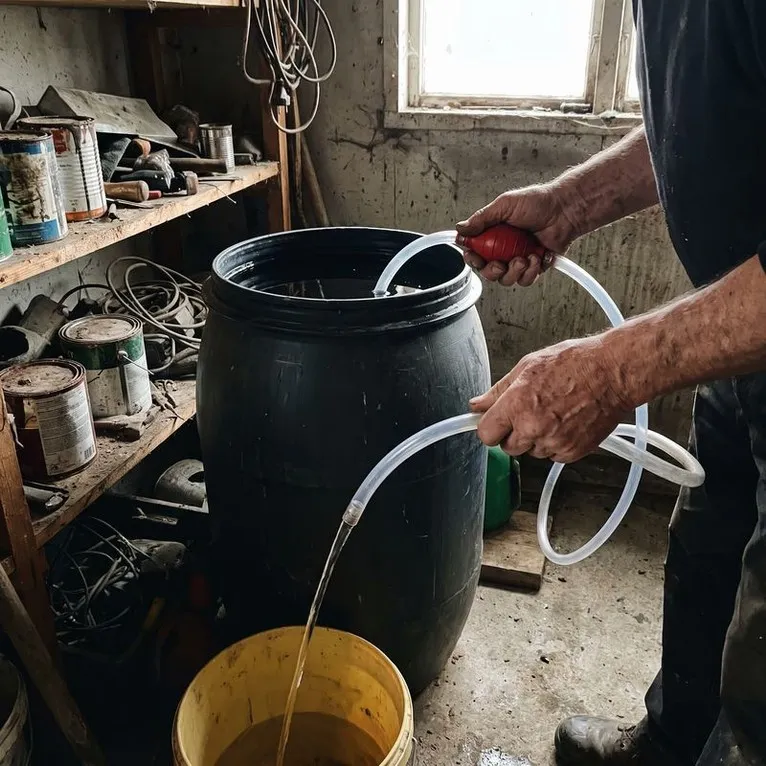
1. The squeeze bulb (the book's method)
- Push the bulb onto one end of the tubing. The book calls this the whole build.
- Put the source end in the full container.
- Hold the bulb end over the receiving bucket or jug, lower than the source.
- Squeeze the bulb a few times until water flows, then let it run.
2. Fill the tube first
- Submerge the whole hose in the source container, or fill it from a faucet, until no bubbles come out.
- Cover one end tightly with your thumb or a cap.
- Keep the other end under water, lift the capped end out and lower it into the receiving container, below the source water level.
- Uncover the end. Water flows.
This works with no parts at all, but it means putting the hose and your hands into the stored water. Wash your hands first, and use this method on water you plan to disinfect anyway.
3. The jiggle valve
A jiggle siphon has a check valve on the intake end. Shake that end up and down in the source and each stroke pushes water up the hose until it starts flowing. The Handbook lists it as an alternative to the bulb.
When a siphon will not start
Most failed siphons come down to one of four things:
- The outlet is too high. The receiving end must sit below the water surface in the source. Put the bucket on the floor, not on a step.
- Air in the line. A kink, a loose bulb or an intake that pops above the water lets air in. Push the intake deeper and squeeze again.
- The hose is too long or too narrow. Six feet of 1/2-inch tubing, as the book specifies, is easy to prime. A long, thin hose is slow to start and slow to run.
- The source is nearly empty. When the water level falls to the intake, the flow ends. Tip the container slightly, if it is safe to do so, or finish with a cup.
Practice once on an ordinary day, as the book's step 2 says, so the first time is not in the dark during an outage.
Siphon hose for water: what to buy
The book's parts list is short: 6 feet of 1/2-inch food-grade vinyl tubing, a hand-pump siphon starter bulb or a jiggle-valve starter, and a labeled bag to keep it in. Food-grade matters, since this hose touches drinking water.
Two habits from the book keep the kit clean:
- Mark the source end with tape, so the same end always goes into the clean water. The other end touches buckets and floors.
- Stow the kit with your water gear, not in the garage junk drawer, where it picks up oil and dirt.
Never use your water hose for fuel, or a fuel hose for water. Poison control centers warn that siphoning gasoline by mouth can pull fuel into the lungs and cause a serious pneumonia. A labeled water-only kit takes that mistake off the table.
How to siphon water from a rain barrel
A rain barrel set up on blocks, as in how to set up a rain barrel, already sits above the ground, which makes it a natural siphon source. Put the marked end in the barrel, the bulb end in a watering can on the ground, and squeeze.
This is handy when the spigot clogs, when you want to empty the barrel below the spigot, or when you winterize the barrel in the fall.
Remember what is in the barrel. CDC says collected rainwater is not necessarily safe to drink, because dirt, germs and bird droppings wash off the roof. Use it for plants you do not eat, flushing and washing. For drinking, it has to be filtered and disinfected first, as in the two-bucket gravity filter.
Moving stored water without lifting
Water weighs 8.3 pounds per gallon, the book notes, so a 5-gallon jug is about 42 pounds and a full drum is far beyond anyone's back. A siphon lets you move water downhill from a drum on a stand to jugs on the floor, or from a jug on the counter into a pot in the sink, without tipping anything.
It also works for refilling. In an outage, a siphon can move water from a barrel into the bathtub, or from the bathtub into buckets for flushing. The kit's last step adds a bathtub liner, covered in emergency water storage in the bathtub.
Keep a few safety points in mind:
- Never leave a bucket of water unattended where small children can reach it. CPSC warns that young children can drown in a 5-gallon bucket.
- Siphon only water. Never siphon fuel, cleaners or anything else with the water kit.
- Rinse and dry the hose after use, then bag it.
For how much water to keep on hand in the first place, see how much water per person per day.
Frequently asked questions
How do you start a siphon without sucking on the hose?
Use a hand-pump siphon bulb: put one end in the full container, hold the bulb end lower, and squeeze until water flows. You can also fill the whole hose with water, cap one end with your thumb, lower it below the source level and release, or use a jiggle-valve siphon.
Why is siphoning by mouth a bad idea?
With water, your mouth puts germs straight into the line and the stored supply, which the Off-Grid Handbook calls how people make themselves sick from their own water. With gasoline, poison control centers warn that fuel can get into the lungs and cause a serious pneumonia.
Why did my siphon stop?
Usually because air got into the hose, the outlet was lifted above the water level in the source, or the water level fell below the intake end. Lower the outlet, push the intake deeper and restart it with the bulb.
What kind of hose should I use to siphon drinking water?
Food-grade vinyl tubing. The Off-Grid Handbook uses 6 feet of 1/2-inch food-grade tubing with a starter bulb on one end. Mark the end that goes in the clean water, keep the kit in a labeled bag, and never use it for fuel.
Sources
- The Off-Grid Handbook, Garrett Dalton, Project 11
- Poison Control: Gasoline siphoning can cause pneumonia
- CDC: Collecting Rainwater and Your Health
- CDC: How to Create an Emergency Water Supply
- CPSC: In-Home Drowning Safety Information Center
Safety guidance changes. Check the agency pages above for the current version, and follow your local code and manufacturer instructions.