Rain barrel diverter kit: how it works and how to install one
A diverter is the part that makes a rain barrel tidy: it fills the barrel, then quietly hands the rest of the storm back to the downspout.
In this article
- What a rain barrel diverter kit does
- Diverter, open downspout or overflow hose?
- Before you cut: choosing the downspout and the kit
- How to install a rain barrel diverter, step by step
- The height rule that decides how full the barrel gets
- Common diverter problems and fixes
- Keeping a diverter working
- A diverter is not a first flush diverter
- Frequently asked questions
A rain barrel diverter kit is a fitting that goes into a cut section of your downspout. It sends rainwater through a short hose into the barrel until the barrel is full, then lets the rest continue down the downspout as it always did. The height you mount it at decides how full the barrel gets, so set the barrel in its final place before you cut anything.
This is step 3 of Project 1 in The Off-Grid Handbook: cut the downspout, install the diverter per the kit instructions, and route overflow back to the downspout. The whole barrel takes about 45 minutes, per the book.
What a rain barrel diverter kit does
A barrel fills faster than most people expect. The Handbook's threshold box puts it in numbers: one inch of rain on 1,000 square feet of roof yields roughly 600 gallons, and a single 55-gallon barrel fills in minutes in a real storm. Plan overflow from day one, the book says.
A diverter is the simplest way to do that. Water and the barrel find the same level: once the barrel fills up to the height of the diverter's outlet, water backs up in the hose, and the rest of the storm passes straight down the spout. No overflow hose, no puddle at the foundation.
Diverter, open downspout or overflow hose?
There are three common ways to feed a barrel. Each one handles a full barrel differently.
| Setup | How it fills | When it is full | Watch out for |
|---|---|---|---|
| Diverter kit | Hose from a fitting in the downspout | Water continues down the downspout | Mounting height; clogs in the fitting |
| Downspout into the lid | Downspout cut short, elbow into a screened inlet | Barrel spills through its overflow port | Overflow hose must lead well away from the house |
| Overflow to a second barrel | Either of the above | Next barrel fills | Last barrel still needs an overflow path |
If you skip the diverter, Rutgers Cooperative Extension says to send the overflow to a lawn or planting bed at least 6 feet from the foundation with a basement, and at least 2 feet with a crawl space. Nebraska Extension adds that the overflow opening should be about the same size as the downspout feeding the barrel. Our guide to rain barrel overflow covers those setups.
Before you cut: choosing the downspout and the kit
- Pick a downspout that drains a good share of roof and ends on level ground where the barrel can sit. The rainwater harvesting calculator shows how much each section of roof can collect.
- Match the kit to the downspout. Kits are sized for common rectangular or round downspouts; measure yours before buying.
- Check the barrel. The kit's hose connects to a hole in the barrel; some kits include the hole saw size or a fitting for it.
- Gather tools. The book's list for Project 1 covers it: a hacksaw, a drill with a hole saw, an adjustable wrench and a level.
How to install a rain barrel diverter, step by step
- Set the barrel first. Put it on two level concrete blocks under the downspout, as in step 1 of Project 1. Everything else is measured from here.
- Mark the downspout at the height the kit's instructions give, measured against the top of the barrel.
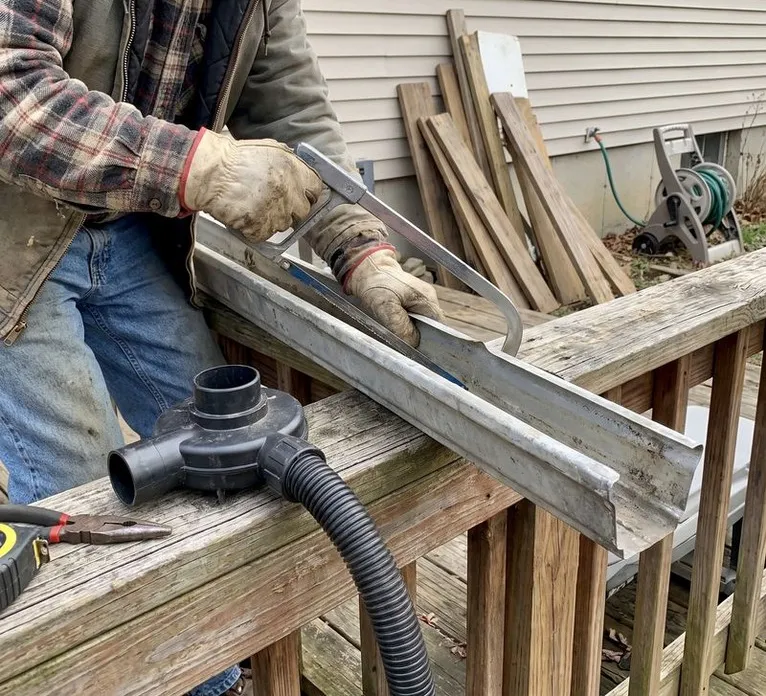
- Cut with a hacksaw and file off burrs. Downspout work at barrel height can be done from the ground; nothing here needs a ladder.
- Fit the diverter into the gap and reattach the lower section of downspout, so overflow returns to its usual path.
- Drill the barrel for the hose fitting, attach the hose, and keep it level or sloping down toward the barrel.
- Screen every opening with fine mesh, as step 4 of the project says, then wait for rain and check the first fill for leaks.
The height rule that decides how full the barrel gets
Because water finds its own level, the barrel can only fill to the height of the diverter's outlet. Mount the diverter too low and you store half a barrel. Mount it at the height the kit calls for, usually close to the level of the barrel's inlet near the top, and you fill it. Mount it well above the barrel and a sealed barrel can push water out through its lid or overflow port instead.
The Texas Water Development Board applies the same principle to downspout filters: they are cut into the downspout at the same height or slightly higher than the highest water level in the tank. If you later raise the barrel on a taller stand, the diverter has to move up with it.
Common diverter problems and fixes
| Problem | Likely cause | Fix |
|---|---|---|
| Barrel never gets full | Diverter mounted too low | Raise the diverter, or lower the barrel base |
| Barrel fills slowly in heavy rain | Leaves or seeds in the fitting or hose | Clear the fitting; screen the gutters |
| Water spills out of the barrel lid | Diverter well above the barrel | Lower it to the kit's height |
| Leak at the downspout joint | Lower section not seated | Reseat and fasten it to the wall |
| Puddle at the barrel | Hose fitting loose at the barrel | Tighten or reseal the fitting |
Keeping a diverter working
- Clear it after leaf drop. Leaves and seeds collect in the fitting. Screened gutters and a leaf strainer upstream prevent most of it; see gutter screens vs gutter guards.
- Check the hose for kinks and for sagging spots that hold water.
- Disconnect for winter. Project 12, winterizing the water system, says to disconnect and drain diverters and reroute downspouts to their winter path before the first hard freeze. The full checklist is in how to winterize a rain barrel.
A diverter is not a first flush diverter
The names sound alike, but the jobs differ. A rain barrel diverter handles the end of the storm, when the barrel is full. A first flush diverter handles the start, sending the dirtiest first runoff off the roof away from the barrel. Many systems use both. For the rest of the setup, from blocks to screens, see how to set up a rain barrel.
Frequently asked questions
How does a rain barrel diverter work?
It sits in a cut section of the downspout and sends water through a hose into the barrel. When the barrel fills to the level of the diverter's outlet, water backs up in the hose and the rest of the rain continues down the downspout as usual.
How high should a rain barrel diverter be installed?
Follow the kit's instructions, measured against the top of the barrel in its final position. The barrel can only fill to the height of the diverter outlet, so a diverter mounted too low leaves the barrel partly empty. Set the barrel on its blocks before marking the cut.
Do I need a diverter for a rain barrel?
You need some plan for overflow, because one inch of rain on 1,000 square feet of roof yields about 600 gallons. A diverter is the simplest. Without one, run an overflow hose to a lawn or bed at least 6 feet from a basement foundation, as Rutgers recommends.
Should I remove the rain barrel diverter in winter?
Disconnect and drain it before the first hard freeze, as the Off-Grid Handbook's winterizing project says, and reroute the downspout to its winter path so water drains away from the house.
Sources
- The Off-Grid Handbook, Garrett Dalton, Project 1
- Rutgers Cooperative Extension: Rain Barrels Part II, Installation and Use (FS1118)
- Nebraska Extension: Rainwater Harvesting with Rain Barrels (G2220)
- Texas Water Development Board: The Texas Manual on Rainwater Harvesting
- University of Wisconsin-Madison Extension: Rain Barrels
- U.S. Department of Energy, Building Science Education: Stormwater, Gutters and Downspouts
Safety guidance changes. Check the agency pages above for the current version, and follow your local code and manufacturer instructions.