Rain barrel overflow: where the extra water goes and how to route it safely
A barrel fills in minutes in a real storm. Where the next gallon goes matters as much as the barrel itself.
In this article
Rain barrel overflow is the water that keeps arriving after the barrel is full, and every barrel needs a planned path for it. Fit an overflow outlet about the same size as the downspout that feeds the barrel, keep it screened, and send the water at least 6 feet from the foundation if you have a basement, or 2 feet if you have a crawl space, toward a lawn, a planted bed or another barrel. Never aim it at a neighbor's yard, a driveway or a septic field.
The Off-Grid Handbook puts it in five words: plan overflow from day one. This guide covers why, the three common overflow setups, where the water should go, and how to keep the outlet from becoming a mosquito nursery.
Why rain barrel overflow needs a plan
Most people underestimate how fast a barrel fills. The threshold note in the Handbook's Project 1: one inch of rain on 1,000 square feet of roof yields roughly 600 gallons. A 55-gallon barrel under that roof is full after about a tenth of an inch of rain, and the book warns that a single barrel fills in minutes in a real storm.
Everything after that point has to go somewhere. If the overflow is missing, too small or blocked, water backs up the downspout, spills over the lid, or pours out at the base of the barrel, right beside the house. Over a season that can soak the soil against the foundation and wash out the blocks the barrel stands on.
The Texas Manual on Rainwater Harvesting makes the same point for bigger tanks: overflow should be routed so it does not undermine the tank's base or affect the foundation of any structure. A barrel is just a small tank.
Rain barrel overflow kit: the three common setups
An overflow kit is the set of parts that carries the extra water away. Most fall into one of three types:
| Setup | How it works | Best for | Watch out for |
|---|---|---|---|
| Diverter that returns overflow to the downspout | The diverter fills the barrel; once it is full, water carries on down the downspout as before | The simplest setup, with no hose to manage | Only as good as the downspout's own outlet |
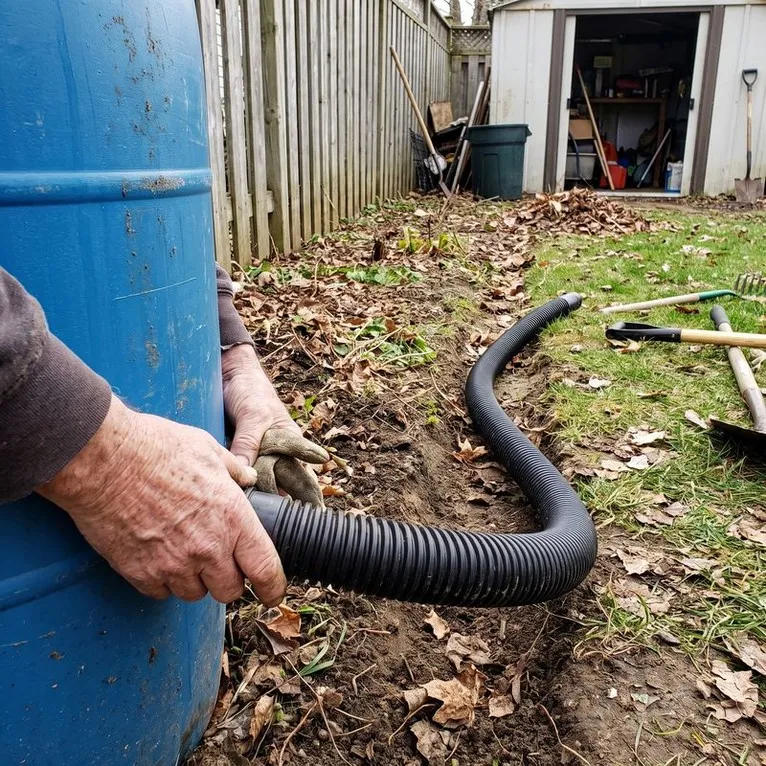
| Overflow port and hose | A fitting near the top of the barrel feeds a hose that carries water to a spot you choose | Sending water to a bed, lawn or rain garden | The hose must stay attached and reach far enough |
| Linked barrel | The overflow, or a link near the base, feeds a second barrel | More storage from the same downspout | The last barrel still needs its own overflow |
Size matters with the port-and-hose type. Nebraska Extension says the overflow opening should be approximately the same size as the downspout emptying into the barrel, so it can keep up in heavy rain. A thin garden-hose fitting on a big roof can't.
The Handbook's Project 1 uses the first setup: the downspout diverter routes overflow back to the downspout. Project 9, which links three barrels into one 165-gallon tank in about two hours for roughly $120 per the book, puts an overflow kit on the final barrel. Our guides to the rain barrel diverter and to connecting rain barrels cover those parts in detail.
Where should rain barrel overflow go?
Distance from the house is the first rule. Rutgers Cooperative Extension says overflow should be directed at least 6 feet from the foundation if there is a basement and at least 2 feet if there is a crawl space. The Handbook's Project 9 uses the same 6-foot figure for the end of a barrel chain: route the final barrel's overflow away from the foundation, at least 6 feet.
Then think about where the water ends up. Nebraska Extension lists the places to avoid:
- Building foundations, yours or anyone else's
- Neighboring property
- Septic systems
- Hard surfaces such as driveways, where the water simply runs off
The best destinations soak water in: a lawn that slopes away from the house, a mulched planting bed, or a rain garden. Stand at the end of the hose and check that the ground falls away from the house, not back toward it. Local rules on where runoff may go vary, so check with your town if you are unsure.
Rain barrel overflow ideas that work
- Send it back down the downspout. If your downspout already discharges well away from the house, a diverter that returns the overflow is the least work.
- Add a second barrel. Nebraska Extension suggests sending overflow to more linked barrels. Link them near the base, as the Handbook does, so one spigot drains them all.
- Feed a rain garden. A rain garden is a shallow planted dip that lets water soak into the ground. Wisconsin's rain garden guide, from the state Department of Natural Resources, says to place one at least 10 feet from the house, so the water is less likely to seep into the foundation.
- Water shrubs or a flower bed. Run the hose to plants that can take a soaking. Some extension services advise against barrel water on vegetables; read rain barrel water for a vegetable garden before using it on food plants.
- Put a splash block at the outlet. A concrete or plastic splash block under the end of the hose spreads the flow so it doesn't dig a hole.
Keep the overflow from breeding mosquitoes
An open overflow port is an open door for mosquitoes, which lay eggs in standing water. Rutgers says to keep a screen on every opening at all times and a hose attached to the overflow at all times, so insects can't get in that way.
The Handbook's Project 1 asks for fine mesh over every opening for the same three reasons: debris, leaves and mosquitoes. Check that mesh whenever you clean the gutters. A clogged overflow screen sends water over the top of the barrel instead. A first flush diverter upstream keeps much of the grit out to begin with, and how to keep mosquitoes out of a rain barrel covers the rest.
After big storms and before winter
Walk the overflow path after the first heavy rain. Look for:
- Water pooling at the base of the barrel or against the house
- Soil washed out from under the blocks or stand
- A hose that has kinked, slipped off, or been moved by the mower
- A splash zone that is turning into a puddle
The Texas manual recommends checking a tank's base after intense rainfall, and the same habit protects a barrel. A full 55-gallon barrel weighs about 460 pounds, per Rutgers, so a base that is washing out is a tipping risk.
Before freezing weather, Rutgers advises draining the barrel and disconnecting it from the downspout. If you use a diverter, set it so the water goes straight down the downspout for the winter. Full steps are in how to winterize a rain barrel, and the first-time setup is in how to set up a rain barrel.
Frequently asked questions
How big should a rain barrel overflow be?
Nebraska Extension says the overflow opening should be approximately the same size as the downspout that empties into the barrel, so it can keep up in heavy rain. A small garden-hose fitting on a large roof can be overwhelmed, and the water then spills over the top.
How far should rain barrel overflow be from the house?
Rutgers Cooperative Extension says at least 6 feet from the foundation if there is a basement and at least 2 feet if there is a crawl space. The Off-Grid Handbook uses the 6-foot figure for the last barrel in a chain. Wisconsin's rain garden guide puts a rain garden at least 10 feet from the house.
Can I just let my rain barrel overflow over the top?
It is better not to. Water spilling over the lid lands at the base of the barrel, beside the house, where it can soak the foundation soil and wash out the blocks under a barrel that weighs about 460 pounds full. Give it a proper outlet or a diverter.
Do linked rain barrels need an overflow?
Yes. Nebraska Extension notes that the last barrel in a chain still needs to be equipped to handle overflow. The Off-Grid Handbook's three-barrel chain puts an overflow kit on the final barrel and routes it at least 6 feet from the foundation.
Sources
- The Off-Grid Handbook, Garrett Dalton, Project 9
- Rutgers Cooperative Extension: Rain Barrels Part II, Installation and Use (FS1118)
- Nebraska Extension: Rainwater Harvesting with Rain Barrels (G2220)
- University of Wisconsin-Madison Extension: Rain Barrels
- Wisconsin DNR and Standards Oversight Council: Rain Gardens, A Guide for Homeowners and Landscapers (2018, PDF)
- Texas Water Development Board: The Texas Manual on Rainwater Harvesting
Safety guidance changes. Check the agency pages above for the current version, and follow your local code and manufacturer instructions.