Gutter screens vs gutter guards: the difference, and which one your house needs
In the store the words overlap. What matters is the opening size, the material, and how often you are willing to brush them off.
In this article
- Gutter screens vs gutter guards, side by side
- Do you even need them?
- Gutter screen mesh for a rain barrel
- The downspout leaf strainer: the cheapest filter on the house
- Which one to choose: a quick guide
- In wildfire country, choose metal
- Install them safely, or have them installed
- Frequently asked questions
Gutter screens vs gutter guards is mostly a question of words. A gutter screen is a simple mesh or perforated panel that lies over or snaps into the gutter. "Gutter guard" is the umbrella term for every product that keeps debris out, including screens, fine micro-mesh panels and solid hoods that let water curl in while leaves slide off. Screens are cheaper and easy to fit yourself; hooded and micro-mesh guards cost more and are often professionally installed.
For a house that collects rain, The Off-Grid Handbook's answer is simple: mesh screening on every run that feeds a barrel, plus a leaf strainer in the downspout. That is Project 8, gutter screening and roof prep, about an hour and $30, per the book.
Gutter screens vs gutter guards, side by side
| Type | How it works | Keeps out | Upkeep |
|---|---|---|---|
| Mesh screen | Wire or plastic mesh over the gutter | Leaves, twigs | Brush off debris on top |
| Perforated panel | Metal or plastic sheet with holes | Leaves, larger debris | Brush off; holes can clog with seeds |
| Micro-mesh guard | Very fine mesh on a rigid frame | Leaves, needles, much of the grit | Rinse or brush the surface |
| Hood or reverse curve | Solid cover; water follows the curve in | Most leaves slide off | Check the entry slot |
| Downspout leaf strainer | Wire basket in the downspout opening | Leaves at the downspout | Empty after storms in leaf season |
The Texas Water Development Board describes the classic leaf guard as 1/4-inch mesh in a wire frame fitted along the gutter, and notes that guards with profiles that let leaf litter slide off are also available. Brush and foam inserts that sit inside the gutter are sold too.
Do you even need them?
Maybe not. The Texas manual says leaf guards and screens are usually necessary only in locations with tree overhang. A house in the open may do fine with a cleaning each fall.
Under trees, they help in three ways: fewer clogged downspouts, less standing water in the gutter, and cleaner water in any barrel below. EPA lists clogged rain gutters among the places mosquitoes breed. Watch your gutters through one fall before deciding: if they fill with leaves after every windy day, guards will pay you back in ladder trips you no longer have to make.
No guard is maintenance-free. The same manual warns that leaf screens must be regularly cleaned; if not, they clog, stop water from reaching the tank, and the built-up debris can harbor bacteria and products of leaf decay. Plan on brushing them off, and on a real gutter cleaning before the first screen goes on.
Gutter screen mesh for a rain barrel
In the Handbook, the roof is the catchment surface for the whole rain system, and the project's intro says an hour of screening upstream saves endless filter maintenance downstream. Its steps:
- Clear the gutters completely and flush the runs with a hose.
- Fit mesh screening along every run that feeds a collection downspout.
- Drop a leaf strainer into the downspout head.
- Inspect the roof: no crumbling shingles, no moss mats, no overhanging deadwood.
- Recheck each fall before the wet season.
On mesh size, the Texas manual is practical: homeowners may need to experiment, from insect screen to hardware cloth. Finer mesh stops more grit but holds debris on top; coarser mesh drains freely but lets small debris through. A first flush diverter downstream catches much of what any screen misses, and fine mesh on the barrel itself keeps mosquitoes out, as covered in how to keep mosquitoes out of a rain barrel.
The downspout leaf strainer: the cheapest filter on the house
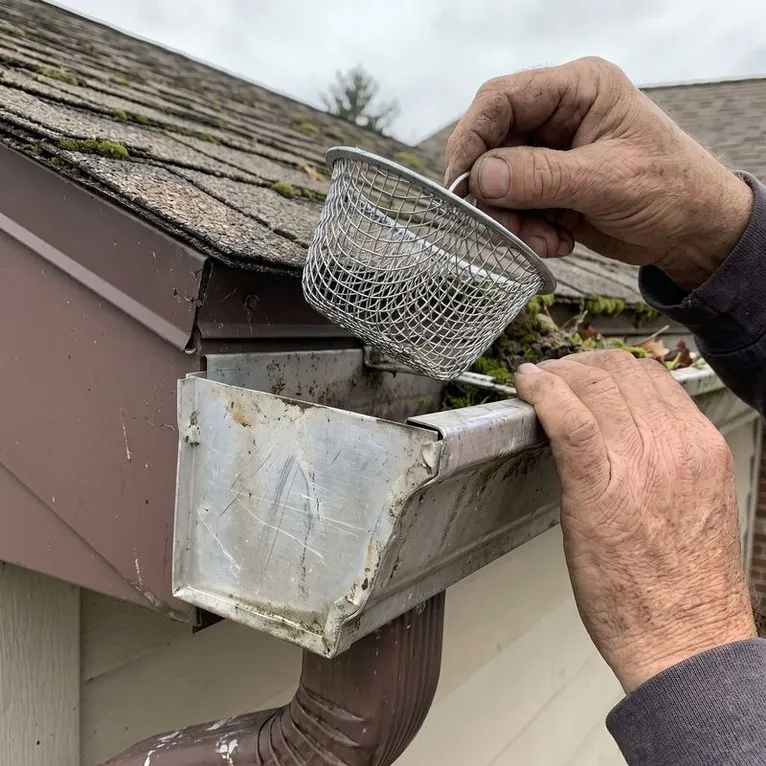
A strainer basket is a small wire cage that sits in the opening where the gutter drains into the downspout. The Texas manual describes these strainers as cage-like baskets that slip into the drop outlet, with rolled cylinders of screen as an alternative.
It stops leaves exactly where clogs start: at the top of the downspout, where they are hardest to clear later. If you only do one thing this fall, do this one. Check and empty the basket after storms in leaf season, since a full basket sends water over the gutter's edge instead. A clean downspout also protects a rain barrel diverter from clogging.
Which one to choose: a quick guide
- No trees near the roof: you may not need anything beyond a fall cleaning, as the Texas manual suggests.
- Broad leaves from maples or oaks: a mesh screen or perforated panel catches them, and a hood lets them slide off.
- Pine needles and seeds: they slip through coarse mesh, so a finer mesh or micro-mesh guard works better.
- A gutter feeding a rain barrel: mesh screening on every run plus a downspout strainer, as in Project 8.
- Wildfire risk: metal only, as below.
- No ladder work for you: a hired installer, and a guard type that suits how often they can come back to clean it.
In wildfire country, choose metal
If you live where wildfire is a risk, material matters more than style. FEMA advises gutters and downspouts of noncombustible materials such as galvanized steel, copper or aluminum, with metal mesh screens or metal hoods fitted to them, because dry leaves trapped in a gutter can be lit by embers. Plastic screens and foam inserts are not a good match for that risk.
Install them safely, or have them installed
The Handbook's safety box for this project is its most important line: ladder work causes more household injuries than any project in the book. Use a stabilizer, keep three points of contact, and never work a roof edge alone or in wind. OSHA adds that the ladder base should sit one foot out from the wall for every four feet of height.
A two-story roof, a steep pitch, power lines near the gutter or a feeling of unsteadiness are all good reasons to hire the job out, especially for hooded or micro-mesh guards, which are usually fastened under the shingle edge. Our guide to setting up a rain barrel shows where the screened water goes next.
Frequently asked questions
What is the difference between gutter screens and gutter guards?
A gutter screen is a simple mesh or perforated panel over the gutter. Gutter guard is the broader term for any product that keeps debris out, including screens, fine micro-mesh panels and solid hoods that let water curl in while leaves slide off.
Are gutter screens good enough for a rain barrel?
Yes. The Off-Grid Handbook fits mesh screening on every run that feeds a barrel and adds a leaf strainer in the downspout head. A first flush diverter and fine mesh on the barrel itself handle what the screens miss.
Do gutter guards stop all cleaning?
No. The Texas Water Development Board warns that leaf screens must be cleaned regularly or they clog and stop water flowing. Debris collects on top of most guards and needs brushing off, though downspout clogs become much rarer.
What gutter guards are best in wildfire areas?
Metal. FEMA advises noncombustible gutters and downspouts, such as galvanized steel, copper or aluminum, with metal mesh screens or metal hoods, because dry leaves trapped in gutters can be ignited by embers.
Sources
- The Off-Grid Handbook, Garrett Dalton, Project 8
- Texas Water Development Board: The Texas Manual on Rainwater Harvesting
- FEMA: Reducing Wildfire Risk to Your Home
- EPA: Success in Mosquito Control, an Integrated Approach
- OSHA: Portable Ladder Safety QuickCard
- Rutgers Cooperative Extension: Rain Barrels Part II, Installation and Use (FS1118)
Safety guidance changes. Check the agency pages above for the current version, and follow your local code and manufacturer instructions.