Rainwater harvesting calculator: how much water your roof can collect
One multiplication tells you how much water your roof sheds. The answer is usually far more than a barrel can hold.
In this article
- Rainwater harvesting calculator: the formula, step by step
- How much water can I collect from my roof?
- A worked example from start to finish
- Measuring your roof the right way
- How much rain to fill a rain barrel?
- From one storm to a whole year
- How much storage do you actually need?
- Plan for overflow before the first storm
- Frequently asked questions
A rainwater harvesting calculator comes down to one formula: roof area in square feet x inches of rain x 0.62 = gallons. The Texas Manual on Rainwater Harvesting gives 0.62 gallons per square foot per inch of rain as the theoretical yield, and says most installers then assume 75% to 90% collection efficiency to allow for splash, evaporation, first flush and overflow.
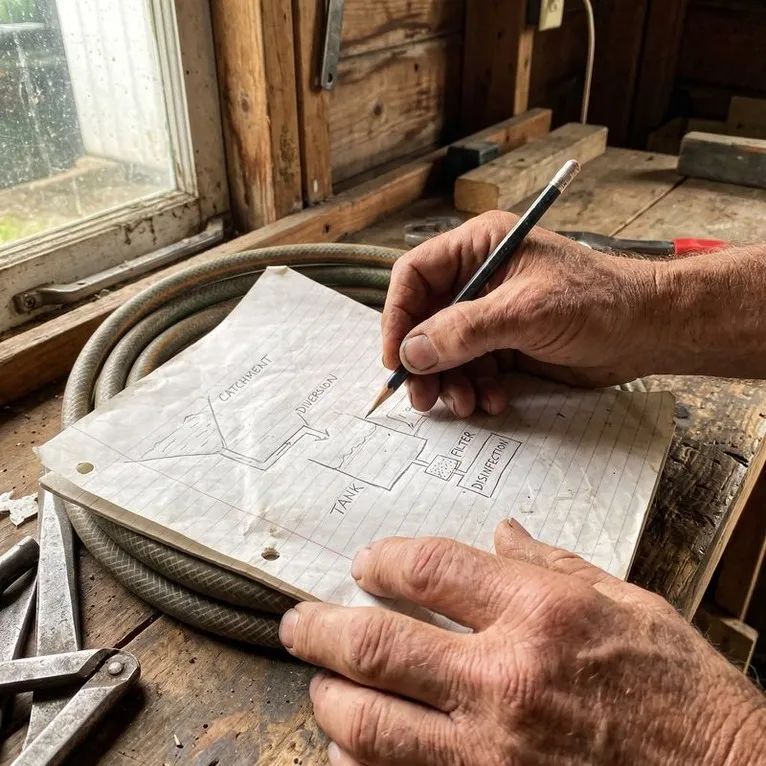
The Off-Grid Handbook rounds it the same way in the threshold box of Project 1: one inch of rain on 1,000 square feet of roof yields roughly 600 gallons, so a single 55-gallon barrel fills in minutes in a real storm. That is why Project 15 starts on paper, with catchment area, diversion volume, chain capacity and tank height worked out before anything is cut.
Rainwater harvesting calculator: the formula, step by step
- Find the catchment area that drains to the downspout you will use, in square feet (see the next section).
- Multiply by the rainfall in inches: one storm, one month or a year.
- Multiply by 0.62 to convert to gallons.
- Multiply by your efficiency, 0.75 to 0.9. Use 0.85 if unsure, the figure the Texas manual uses in its worked example.
Example: 600 square feet of roof, 1 inch of rain. 600 x 1 x 0.62 = 372 gallons in theory, or about 316 gallons at 85% efficiency. That is nearly six full rain barrels from one ordinary storm.
How much water can I collect from my roof?
The table uses the formula above at 85% efficiency, rounded. Remember that each downspout only drains part of the roof.
| Roof area draining to the barrel | Per 1/4 inch of rain | Per 1 inch of rain |
|---|---|---|
| 250 sq ft | about 33 gallons | about 130 gallons |
| 500 sq ft | about 66 gallons | about 265 gallons |
| 1,000 sq ft | about 130 gallons | about 525 gallons |
| 1,500 sq ft | about 200 gallons | about 790 gallons |
| 2,000 sq ft | about 265 gallons | about 1,050 gallons |
The Handbook's "roughly 600 gallons" per inch on 1,000 square feet sits between the theoretical 620 and the 85% figure of about 525. Any of these numbers leads to the same conclusion: overflow has to be planned from day one.
A worked example from start to finish
Take a one-story house with a 40 by 30 foot footprint and 1-foot overhangs. With the overhangs, the roof footprint is 42 by 32 feet, or 1,344 square feet. If the back half drains to the downspout you plan to use, that downspout carries about 672 square feet.
A half-inch storm on that half of the roof: 672 x 0.5 x 0.62 x 0.85 = about 177 gallons. That is more than three barrels, enough to nearly fill a 165-gallon chain from one modest rain.
A first flush diverter takes a little off the top. A common rule of thumb is 10 gallons per 1,000 square feet of roof, so this downspout would divert about 7 gallons per storm; sizing is covered in first flush diverter.
Measuring your roof the right way
Measure the roof's footprint, not its sloped surface. The Texas manual says the collection surface is the length times the width of the roof from eave to eave and front to back, whatever the pitch. A steep roof does not catch more rain than a flat one with the same footprint.
- Use the ground. Measure the house walls and add the overhangs. No ladder needed.
- Count only what drains to your downspout. If a roof has four downspouts, each one usually carries a quarter to a half of the total. Watch where the water runs in a storm.
- Add the small roofs. A shed or garage roof is catchment too, and often easier to collect from.
Roof surface matters for efficiency. The Texas manual estimates about a 10% loss on composite shingle or clay tile roofs compared with smooth metal.
How much rain to fill a rain barrel?
Turn the formula around: inches of rain needed = barrel gallons divided by (roof area x 0.62 x 0.85).
| Roof area to the downspout | Rain to fill one 55-gallon barrel | Rain to fill a 165-gallon chain |
|---|---|---|
| 100 sq ft | about 1 inch | about 3.1 inches |
| 250 sq ft | about 0.4 inch | about 1.3 inches |
| 500 sq ft | about 0.2 inch | about 0.6 inch |
| 1,000 sq ft | about 0.1 inch | about 0.3 inch |
For most homes, a barrel fills in the first light rain. A three-barrel chain like the one in how to connect rain barrels together, the Handbook's Project 9, holds 165 gallons and still fills in well under an inch of rain from a typical downspout.
From one storm to a whole year
For a yearly estimate, use your area's average annual rainfall. NOAA publishes U.S. Climate Normals, and the National Weather Service's NOWData tool shows monthly and yearly averages for local stations.
Example: 500 square feet draining to one downspout in a place that gets 40 inches a year. 500 x 40 x 0.62 x 0.85 = about 10,500 gallons a year. Even a small house roof sheds thousands of gallons.
Look at the monthly figures, not only the total. The Texas manual sizes storage month by month, because rain that falls when tanks are already full is lost as overflow.
How much storage do you actually need?
Size storage to your use, not your roof. For a garden barrel, enough to bridge the dry days between storms is plenty, and the setup is in how to set up a rain barrel.
For backup household water, the Handbook ties every water project to its Project 5 threshold: 1 gallon per person per day, which is 56 gallons for four people for two weeks. Project 15's threshold asks whether storage plus realistic catchment covers that two-week figure with margin. Rainwater counts toward that only after filtering, disinfection and testing, as in a rainwater collection system for drinking water. If you are weighing a bigger tank, compare options in rain barrel vs cistern, and check your state's rules first; the Department of Energy keeps a state-by-state map.
Plan for overflow before the first storm
The calculator's real lesson is that the barrel will overflow often. A diverter that sends extra water back down the downspout is the simplest fix. Otherwise, route overflow at least 6 feet from the foundation, as the Handbook specifies for its barrel chain, and make sure it never drains into a septic field, as the Texas manual warns.
Frequently asked questions
How do you calculate rainwater harvesting?
Multiply the roof's footprint in square feet by the rainfall in inches and by 0.62 to get gallons. Then multiply by a collection efficiency of 0.75 to 0.9 to allow for losses. For example, 1,000 square feet x 1 inch x 0.62 x 0.85 is about 525 gallons.
How much water can I collect from my roof?
About 0.62 gallons per square foot per inch of rain in theory, or roughly 0.5 gallons after typical losses. One inch of rain on 1,000 square feet yields roughly 525 to 620 gallons. Only count the roof area that drains to the downspout feeding your barrel.
How much rain does it take to fill a rain barrel?
Very little. With 250 square feet of roof draining to the downspout, about 0.4 inch of rain fills a 55-gallon barrel. With 500 square feet, about 0.2 inch does it. That is why every barrel needs a diverter or an overflow route.
Do I measure the sloped roof or the footprint?
The footprint. The Texas Manual on Rainwater Harvesting says the collection area is the roof's length times width from eave to eave, regardless of pitch. You can measure it from the ground by measuring the walls and adding the overhangs.
Sources
- The Off-Grid Handbook, Garrett Dalton, Project 15
- Texas Water Development Board: The Texas Manual on Rainwater Harvesting
- NOAA National Centers for Environmental Information: U.S. Climate Normals
- National Weather Service: Climate Data (NOWData)
- U.S. Department of Energy: Rainwater Harvesting Regulations Map
- CDC: Collecting Rainwater and Your Health
Safety guidance changes. Check the agency pages above for the current version, and follow your local code and manufacturer instructions.