Rain barrel vs cistern: which one fits your home and your rain
A barrel is a weekend project. A cistern is a small water utility. Between them sits a chain of barrels that suits most backyards.
In this article
Rain barrel vs cistern comes down to scale. A rain barrel holds about 55 gallons, sits under one downspout and costs about $60 to set up, per The Off-Grid Handbook. A cistern is a large tank, above or below ground, that holds hundreds or thousands of gallons and usually needs a prepared pad, more plumbing, and sometimes a permit. For garden watering and backup wash water, barrels are usually enough. A cistern makes sense when you want to store a large share of what your roof collects.
EPA describes cisterns simply as rainwater storage with a greater capacity, located above or below ground. The Handbook builds up in steps instead: one barrel in Project 1, a three-barrel chain in Project 9, an elevated tank in Project 14, and the full rain-to-tap line in Project 15.
Rain barrel vs cistern at a glance
| Rain barrel | Linked barrel chain | Cistern | |
|---|---|---|---|
| Typical capacity | 55 gallons | 165 gallons for three barrels | Hundreds to thousands of gallons |
| Cost in the Handbook | ~$60 (Project 1) | ~$120 more (Project 9) | Not a book project; get local quotes |
| Build time | 45 minutes | 2 hours | Site work plus installation |
| Full weight | About 460 lb | About 1,400 lb | Several tons and up |
| Base | Two concrete blocks | One continuous level block base | Prepared pad; sometimes an engineer |
| Permits | Rarely | Rarely | Check state and local rules |
Weights come from water at 8.34 pounds per gallon (USGS) and Rutgers' figure of about 460 pounds for a full 55-gallon barrel.
When rain barrels are enough
Barrels win on cost, speed and simplicity. Project 1 of the Handbook is a 45-minute build with a food-grade barrel, a brass spigot, a diverter kit and two concrete blocks. There is no pump, no power and nothing to switch on.
They are enough when you water a modest garden, want backup water for flushing and washing, or are just learning how your roof behaves in a storm. Small also has a hidden advantage: Alabama Cooperative Extension suggests not letting barrel water sit more than a week, and a barrel you empty often stays fresher. See how long you can keep rainwater in a barrel.
The limit is capacity. Our rainwater harvesting calculator shows that half an inch of rain on 250 square feet of roof yields about 66 gallons, more than one barrel holds, so a single barrel overflows in most real storms.
The middle path: a chain of barrels
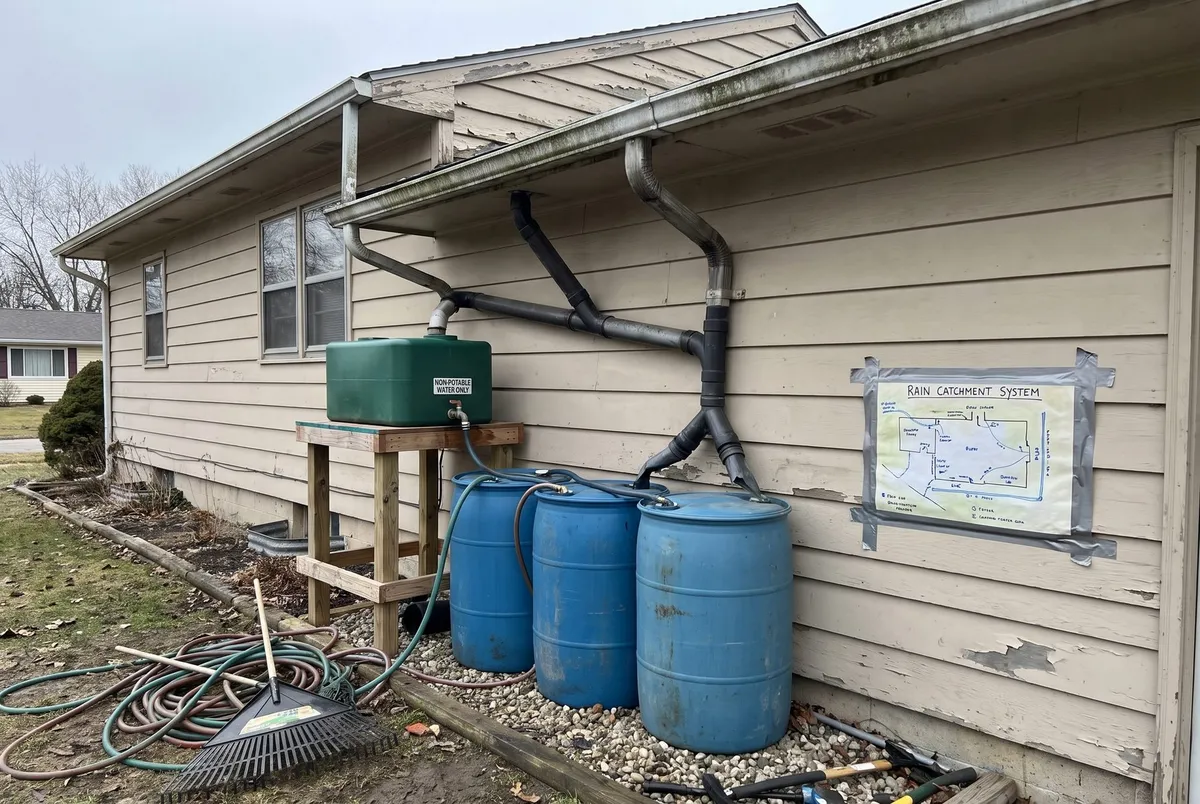
Before you price a cistern, consider linking barrels. In Project 9, three barrels on one continuous, level base are joined near the bottom with bulkhead fittings so they fill and drain as one 165-gallon tank with a single spigot. The book prices it at about $120 for the two extra barrels and fittings, in about two hours.
The book's field note explains the key detail: base-linked barrels equalize automatically, while top-linked chains strand the bottom half of every barrel. The overflow from the last barrel goes at least 6 feet from the foundation. Step-by-step instructions are in how to connect rain barrels together.
A chain grows one barrel at a time, fits along a wall, and every piece can be carried by one person. For many homes it does a cistern's job at a fraction of the effort.
When a cistern makes sense
A cistern earns its cost when you want to store weeks of rain, irrigate a large garden through dry spells, or supply a household system. The Texas Manual on Rainwater Harvesting sizes storage month by month, because cistern capacity has to carry you through the longest expected stretch without rain.
Tank material matters. The Texas manual says storage tanks must be opaque to stop algae, covered with screened vents against mosquitoes, and accessible for cleaning. Tanks for drinking water need a food-grade lining and must never have held toxic materials.
A middle step is height rather than volume. The Handbook's Project 14 raises a 65-gallon tank 6 to 8 feet on a braced stand, which gives roughly 2.6 to 3.5 psi at a tap with no pump; see gravity fed water system.
Weight, siting and permits
Water is heavy, and big tanks are very heavy. The Texas manual notes that even a 1,500-gallon tank weighs about 12,400 pounds. It says to set tanks on a stable, level pad, and to bring in a structural engineer when the soil is unknown. Keep overflow away from foundations and septic drainfields, and site underground tanks well away from animal pens.
The Handbook's Project 14 safety box makes the same point at small scale: 65 gallons overhead is over 540 pounds, so have the stand checked by someone qualified if it goes beyond simple framing or sits near people, and follow local codes for structures and setbacks.
Rules also vary. CDC notes that some states regulate rainwater collection, and the Department of Energy keeps a state-by-state map. A large tank may also need a building or zoning permit, so call your local building office before you buy.
Questions to ask before you choose
- What is the water for? Flowers and flushing need far less storage than a vegetable garden through August.
- How much roof drains to the spot? Run the numbers in the calculator before buying anything.
- How much room do you have? Barrels fit along a wall; a cistern needs a pad and access for cleaning.
- Who will maintain it? Screens, gutters, cleaning and winter draining fall to someone. A small system that gets checked beats a big one that does not.
- Can you start small? One barrel this season and two more next year costs little and teaches you how your roof behaves.
What about drinking water?
Neither a barrel nor a cistern makes rainwater drinkable. CDC says rainwater is not necessarily safe to drink without removing germs and chemicals first. The Handbook compares its 165-gallon chain with a household's two-week water figure, but that is a comparison of volume. As drinking water, any stored rain still needs filtering, disinfection and a certified lab test, as laid out in a rainwater collection system for drinking water. For drinking, stored tap water remains the simplest reserve.
Frequently asked questions
What is the difference between a rain barrel and a cistern?
Size and installation. A rain barrel typically holds about 55 gallons and sits on blocks under one downspout. A cistern is a large tank, above or below ground, holding hundreds or thousands of gallons, and usually needs a prepared pad, more plumbing and sometimes a permit.
Is a cistern better than rain barrels?
Only if you need the storage. Barrels are cheaper, faster to install and easier to keep fresh. A cistern suits large gardens, long dry spells or a household water system. Linking three barrels at the base gives 165 gallons with one spigot, which covers many homes.
How much does a full cistern weigh?
Water weighs about 8.34 pounds per gallon, so a 1,500-gallon tank weighs roughly 12,400 pounds when full, according to the Texas Manual on Rainwater Harvesting. Large tanks need a stable, level pad, and an engineer's advice when soil conditions are unknown.
Do you need a permit for a cistern?
Sometimes. Rainwater rules vary by state, and a large tank may need a building or zoning permit. Check the Department of Energy's state rainwater map and call your local building office before buying.
Sources
- The Off-Grid Handbook, Garrett Dalton, Project 14
- EPA: Soak Up the Rain, Rain Barrels
- Texas Water Development Board: The Texas Manual on Rainwater Harvesting
- Rutgers Cooperative Extension: Rain Barrels Part II, Installation and Use (FS1118)
- USGS: A Million Gallons of Water, How Much Is It?
- CDC: Collecting Rainwater and Your Health
- U.S. Department of Energy: Rainwater Harvesting Regulations Map
Safety guidance changes. Check the agency pages above for the current version, and follow your local code and manufacturer instructions.