How to store water long term: fill, date, store dark and rotate
Water does not spoil the way food does, but stored water still needs a system. Five steps and one date on the calendar keep it ready.
In this article
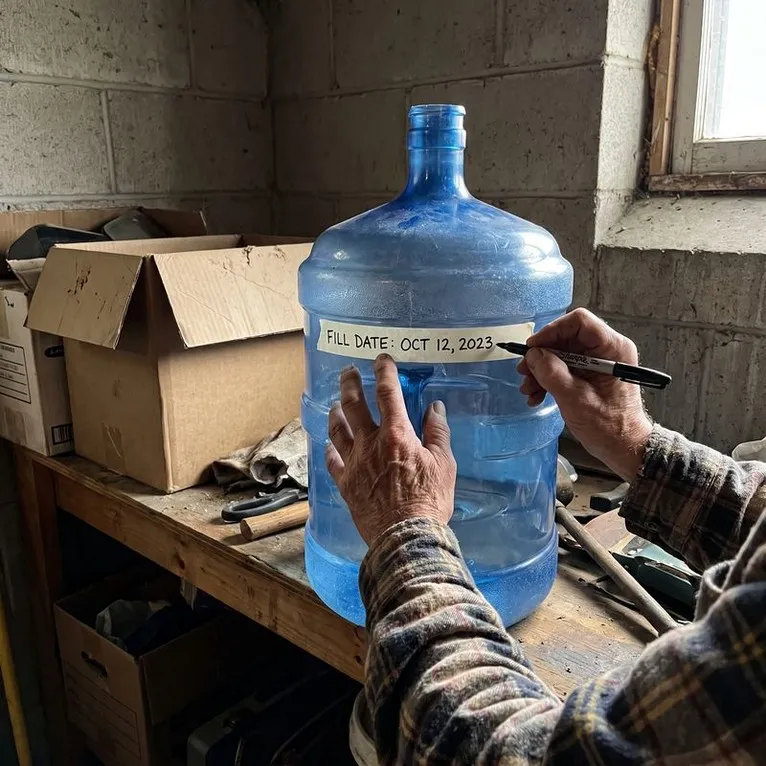
How to store water long term comes down to a few habits: fill clean, food-grade containers with tap water, cap them tightly, label each one with the fill date, and keep them somewhere cool, dark and away from chemicals. Then replace water you bottled yourself every six months, which is the schedule CDC and Ready.gov both give. Store-bought bottled water stays sealed in its original container until its date.
That routine is Project 5 of The Off-Grid Handbook, Household Water Storage & Rotation: about an hour of work and $40 to $100 in containers, per the book. This guide is about the system that keeps the water fresh. For how many gallons your household needs, start with how much water per person per day.
How to store water long term, step by step
The book's five steps line up closely with CDC's instructions for an emergency water supply:
- Know your number. One gallon per person per day, at least three days, two weeks if you have room. Our emergency supply calculator does the math.
- Sanitize every container, even new ones. CDC's solution is 1 teaspoon of plain, unscented bleach in 1 quart of water. The full method is in how to sanitize water storage containers.
- Fill from the tap and cap tightly. Try not to touch the inside of the cap or the rim.
- Label and date. CDC says to mark each container "drinking water" with the storage date.
- Rotate. Every six months, use the old water, refill, and write the new date.
How long can you store water?
Safe water does not go bad on a set day, but water you store yourself is not sterile. Utah State University Extension explains that the few microorganisms in tap or well water can multiply during storage, and plastic lets some vapors through over time. So the agencies set a simple rule instead of a shelf life.
| Type of stored water | How long to keep it |
|---|---|
| Commercially bottled, unopened | Until the date on the package (CDC) |
| Tap water you bottled yourself | Replace every six months (CDC, Ready.gov) |
| Any container that is cracked, leaking or cloudy | Replace now |
CDC calls unopened, commercially bottled water the safest and most reliable source of water in an emergency. Many households keep both: cases of bottled water for drinking and larger refillable containers for cooking, washing and backup.
Tap water or well water: what goes in the container
The book's rule is short: municipal tap water stores as it comes out of the faucet, because it already carries a small amount of disinfectant from the treatment plant. Ready.gov's instructions are written for filling containers with chlorinated water.
Well water is different. It usually has no disinfectant in it, so the book says to treat it before storage, following EPA household guidance. In practice that means the same bleach dose you would use in an emergency, measured for your bleach's strength, as laid out in how to purify water with bleach. If you are not sure your well water is safe in the first place, have it tested first; how to test well water walks through it.
Never store water from a stream, pond or rain barrel as drinking water. Those sources need filtering and disinfecting, and are best treated when you need them, not months ahead.
Long term water storage: where to keep it
Location decides how well stored water keeps. CDC recommends a spot that stays between 50°F and 70°F, out of direct sunlight and away from toxic substances.
- Cool and dark. A closet, a basement corner or under a bed works. Oregon State University Extension notes some food-safety concern with plastic stored above 95°F, so a hot attic or a summer garage is a poor choice.
- Away from fuel and chemicals. USU Extension warns that plastic is permeable to some vapors and should not sit near gasoline, kerosene or pesticides.
- Off the floor. The Handbook stores containers off bare concrete, and USU Extension recommends keeping water off the ground. A shelf, a pallet or a few boards does the job.
- Spread out if you can. A few containers in two places means one leak or one flooded room does not take everything.
Freezer space counts too. USU Extension suggests a few containers of water in the freezer, with 2 to 3 inches of headspace for expansion; they double as ice packs if the power goes out.
Rotating stored water every six months
Rotation is where most home water storage quietly fails. The water gets bought, put away and forgotten, and two years later nobody knows how old it is. The book's fix is the fill date on every container and a six-month cycle: water the garden with the old water, refill, redate.
Pick two dates that are easy to remember and put them on the household calendar. Many families tie it to the clock changes in spring and fall, the same weekend they test smoke and carbon monoxide alarms. The Handbook's Project 72 builds a full seasonal calendar, and water checks fit into its autumn and spring blocks.
At each check, look over every container:
- Caps tight, no damp spots underneath.
- No cracks, bulges or chalky, brittle plastic.
- Water clear, with no film, floaters or odd smell.
Old water is not wasted. Use it for plants, for washing, or to flush a toilet as described in how to flush a toilet without water.
Choosing containers for the long haul
Buy containers made for drinking water. CDC recommends FDA-approved food-grade containers with tight lids, made of durable material that will not break, ideally with a narrow opening for pouring. Do not reuse containers that held chemicals such as bleach or pesticides.
The book's field note favors stacked 5-gallon containers over one big drum for most homes: they fit in closets, one person can carry them, and one failed container costs five gallons instead of fifty-five. Our guide to emergency water storage containers compares the options side by side.
Keep a little unscented bleach and a funnel with the containers, and the whole store can be refreshed in an afternoon. Stored water also feeds the rest of your plan: it backs up the bathtub you fill in an outage, the disinfection station in Project 6, and the first hour described in does water work during a power outage.
Frequently asked questions
How long can you store tap water?
CDC and Ready.gov say to replace water you bottle yourself every six months. Tap water is not sterile, and over time the small number of microorganisms in it can grow, especially if the container was not sanitized. Label each container with the fill date so you know when it is due.
Does stored water expire?
Water itself does not spoil on a fixed date, but stored water can pick up germs, tastes and odors. Keep unopened commercially bottled water until the date on the package, and replace self-filled containers every six months. Replace any container that is cracked, leaking or cloudy right away.
Do I need to add bleach to stored tap water?
Not to city tap water, which already contains a small amount of disinfectant. The Off-Grid Handbook says well water should be treated before storage. Either way, sanitize the empty containers first with 1 teaspoon of unscented bleach in 1 quart of water, as CDC recommends.
Where is the best place to store emergency water?
A cool, dark place between about 50°F and 70°F, away from sunlight, gasoline, paint and pesticides, and off the floor on a shelf or pallet. Avoid hot attics and garages in summer. Splitting your supply between two spots protects you if one area floods or a container leaks.
Sources
- The Off-Grid Handbook, Garrett Dalton, Project 5
- CDC: How to Create an Emergency Water Supply
- Ready.gov: Water
- Utah State University Extension: Water Storage and Emergency Use
- Oregon State University Extension: Soda bottles for emergency water storage?
- EPA: Emergency Disinfection of Drinking Water
Safety guidance changes. Check the agency pages above for the current version, and follow your local code and manufacturer instructions.