Prepping on a budget: the free projects, the first $250 and the par rule
The steps that protect a household most are mostly paper, habits and a few cheap items. The expensive gear can wait, and some of it never needs buying.
In this article
Prepping on a budget works because the steps that protect a household most are the cheapest ones: a written plan, a job for every person, water in clean containers, battery lights and food you already eat, bought a few extra items at a time. The Off-Grid Handbook prices its entire first phase at under $250 all-in, and several of its readiness projects cost nothing at all.
What saves money is the order and a restocking rule, not a big shopping trip. Here is how to spend the first dollars, and where not to save.
Prepping on a budget: start with the free projects
A surprising share of the Handbook's readiness chapter is free or nearly free. These are the printed costs from each project's opening card:
| Project | What it gives you | Cost in the book |
|---|---|---|
| 75 · The Master Build Order | The order to do everything in | $0, one evening |
| 62 · Household Roles | A named job for every person | $0, one evening |
| 65 · Threshold Tables | A restock number for every supply | $0, one evening |
| 71 · The Power-Down Drill | A test run of the whole plan | $0, one evening per quarter |
| 61 · The First-Hour Checklist | What to do in the first 20 minutes | About $10 |
| 63 · Communications Plan | Who calls whom, on paper | About $20 |
Ready.gov's low-cost list adds more free steps: learn which disasters are most common where you live, sign up for local emergency alerts, fill in a family communication plan, and keep important phone numbers somewhere besides your cell phone.
Prepping for beginners on a budget: where the first $250 goes
Project 75 puts six projects in its first phase, the ones it says retire the most risk in 48 hours. Their printed costs:
- CO and smoke alarm grid (Project 52): about $90.
- Household water storage (Project 5): $40 to $100, depending on the containers.
- Emergency disinfection station (Project 6): about $15.
- Blackout lighting kit (Project 29): about $50.
- First-hour checklist (Project 61): about $10.
- Household roles (Project 62): $0.
The book's estimate for the whole phase is under $250 all-in, roughly one family dinner out per project. Its field note points out how little hardware that phase contains: capability starts as organization, becomes habit, and only then becomes equipment.
One way to trim the alarm line: Ready.gov suggests asking your local fire department about free detector programs. If they provide smoke alarms, ask about carbon monoxide alarms too, and buy battery-backed ones if they don't. For the rest of the phase order, see prepping for beginners.
The par rule: supplies built on normal grocery runs
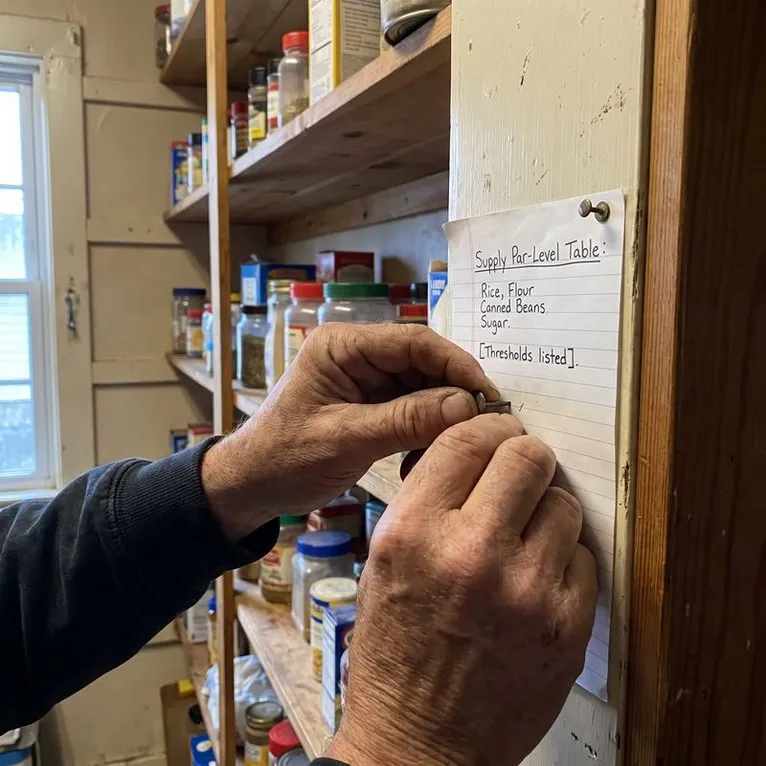
Project 65 gives every consumable in the house a number, the level below which it gets restocked, "no debate, no drift." You audit what you have once, honestly, by counting and weighing. The gap between the table and the shelf becomes your shopping plan.
Then the book's par rule does the work: touching a threshold puts the item on the next normal shopping trip. In the book's words, resilience by grocery run, not by panic. A few of its two-week numbers for a household of four:
- Water: 56 gallons (one gallon per person per day).
- Lighting: one headlamp per person plus 3 lanterns.
- Cooking fuel: one to two 20-pound propane tanks, used outdoors only.
- Prescriptions: a two-week margin per person where prescribers allow.
The field note explains why this matters on a budget: households fail at maintenance, not acquisition. Money spent once and then left to expire is the most expensive prepping there is. Our emergency supply calculator scales the table to your household.
Cheap prepping tips that really save money
- Two or three extras per trip. The pantry project buys on the copy-canning method: each grocery run, add duplicates of two or three items until the reserve is full. Our guide to copy canning walks through it, and the 30-day food supply list shows the target.
- Buy what you eat. "Store what you eat, eat what you store." Food nobody likes is money thrown away later.
- Shop the sales. Ready.gov suggests buying extras when they're on sale, watching for seasonal sales on emergency supplies, and checking garage sales and thrift stores for camping gear, tools and cookware.
- Consolidate before you buy. The Handbook's 72-hour stay kit costs about $100, which the book describes as mostly consolidation: water, food, lights and blankets you already own, gathered in one place.
- Freeze water in spare bottles. The book's field note calls them triple-duty: thermal mass in the freezer every day, ice for the cooler in an outage, drinking water when they melt.
- Keep small bills. A modest cash reserve costs nothing but discipline. See how much cash to keep at home.
Where not to save money
A few corners can't be cut safely, at any budget:
- CO alarms with battery backup. The alarm has to work exactly when the grid doesn't. See where to put CO detectors.
- Candles as the light plan. They are cheap, but the CDC recommends flashlights and battery lanterns because of the fire risk.
- Heat from the stove. Ready.gov says never use a gas stove or oven to heat your home, and grills and camp stoves stay outdoors.
- Generator shortcuts. A generator runs outdoors, at least 20 feet from windows, doors and vents, never in a garage, and never plugged into a wall outlet. Connecting one to house circuits is a job for a licensed electrician.
Spreading the rest over a year or two
After the first phase, the Handbook budgets by tier: Starter projects about $40 each (range $40 to $80), Core about $150 ($120 to $180) and Full about $300 ($200 to $300). It compares the complete five-system household, built patiently over a year or two, to the cost of one family vacation, and it never expires.
There is no deadline. Do the free projects this month, the first phase as money allows, and let the par rule carry the rest. Our guide to off-grid living for beginners lays out the later phases in order.
Frequently asked questions
How can I start prepping with no money?
Start with the free steps: learn which emergencies are common where you live, sign up for local alerts, write a family communication plan and a first-hour checklist, and give every person a job. Then add one or two extra grocery items per shopping trip toward a reserve.
How much does a basic emergency setup cost?
The Off-Grid Handbook estimates its first phase, alarms, water storage, a disinfection station, blackout lighting, a first-hour card and household roles, at under $250 all-in. Several of its readiness projects cost nothing.
What is the par rule in prepping?
Every supply gets a restock number. When the shelf drops to that level, the item goes on the next normal shopping trip. It keeps a reserve full without panic buying, and it stops supplies from quietly running down or expiring.
Where should you not cut corners when prepping on a budget?
Buy battery-backed carbon monoxide alarms, use battery lights instead of candles, never heat the house with a gas stove or oven, and keep grills, camp stoves and generators outdoors. Generators belong at least 20 feet from windows, doors and vents.
Sources
- The Off-Grid Handbook, Garrett Dalton, Project 65
- Ready.gov: Low and No Cost Preparedness
- Ready.gov: Build a Kit
- Ready.gov: Power Outages
- CDC: Proper Use of Candles During a Power Outage
- CDC: Carbon Monoxide Poisoning Basics
Safety guidance changes. Check the agency pages above for the current version, and follow your local code and manufacturer instructions.