Copy canning: how to build a food stockpile slowly, one grocery run at a time
No bulk order, no panic buying, no shelf of food nobody likes. Just two or three extra cans in the cart each week, until the pantry is deep enough.
In this article
Copy canning is a way to build an emergency food supply without a big shopping trip: every time you buy groceries, you buy a duplicate or two of the shelf-stable foods you already eat, and you keep doing it until you reach a set target. The Off-Grid Handbook uses it in Project 37: on each grocery run, add duplicates of two or three items from your list until the target is reached, with no single panic purchase.
The name confuses people. It has nothing to do with home canning in jars. "Copy" means buying a copy of what you already buy, and "canning" refers to the cans. Here is how to do it well.
What is copy canning?
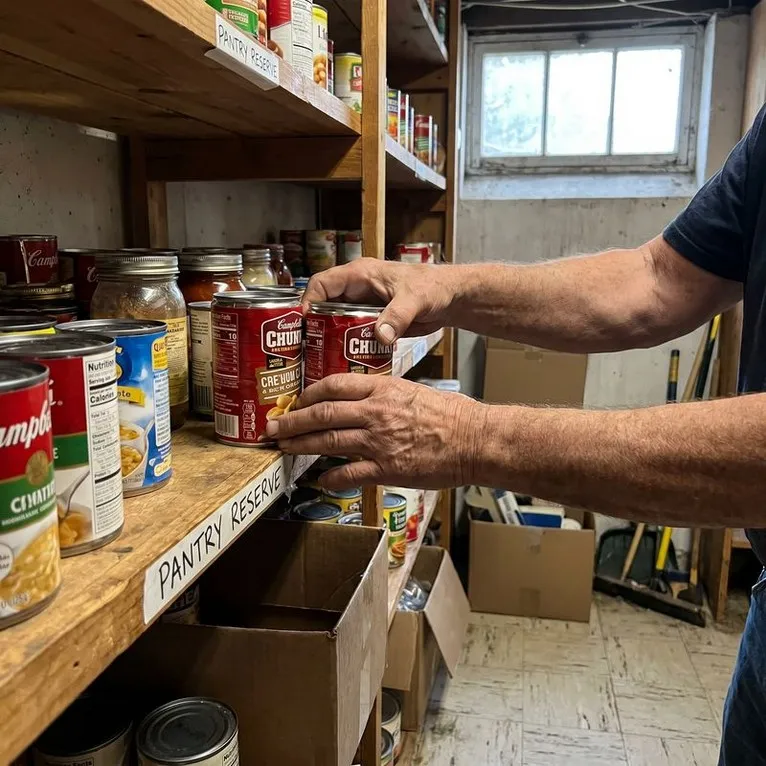
Most families already buy the same staples every week: a can of tomatoes, a jar of peanut butter, a bag of rice. Copy canning simply doubles a few of them. One goes in the kitchen cupboard to be used this week; the copy goes on the reserve shelf.
Over a few months the reserve grows into weeks of food, and because it is made of things you already cook, it gets eaten and replaced in the normal course of life. The Handbook's field note for the project sums up the idea: store what you eat, eat what you store. Reserves of unfamiliar food tend to sit unopened for years; reserves of Tuesday dinner get rotated forever.
Federal guidance points the same way. Ready.gov's low-cost preparedness advice is to pick up an extra item you use regularly each time you go to the grocery store, especially when it is on sale.
Why copy canning works
- It spreads the cost. A few dollars a week instead of one large bill. The book calls the 30-day pantry budget-scaled for this reason.
- It avoids panic buying. When a storm is forecast, you top up instead of fighting for the last can of soup.
- It buys food your family eats. No pallet of something nobody likes.
- It rotates itself. Because you cook from the reserve, the oldest cans get used before they lose quality.
How to build a food stockpile slowly, step by step
- Write a 7-day menu of meals your household already likes that need only shelf goods and water. The Handbook repeats it four times for a 30-day plan.
- Turn the menu into a quantity list. The book's rule of thumb is roughly 2,000 calories per adult per day, counted once so the list is based on numbers, not on how full the shelf looks.
- Set a target for each item. The book calls it a par level, the count you never drop below.
- Add two or three duplicates every shopping trip until each item reaches its target. Rotate which items you double.
- Date each can on arrival with a marker, big month and year, and shelve new cans behind older ones.
- Do a monthly two-minute check. Anything under target goes on the shopping list; anything near its date goes on this week's menu.
Steps 5 and 6 come from Project 36, the book's rotation shelves. Our guide to the DIY can rotation rack shows how to build a rack that keeps the oldest can in front automatically.
A copy canning example
Take a household of two adults. The Handbook's 30-day staple core per adult includes 12 to 15 cans of protein and 20 or more cans of vegetables and fruit, so for two people that is 24 to 30 cans of protein and at least 40 cans of vegetables and fruit.
Say the menu uses canned chicken, tuna, black beans, diced tomatoes, green beans and peaches. Each week you buy one extra can of three of them, and of the other three the following week, with a second copy when something is on sale. That is roughly three to six extra cans a week. At that pace, about 70 cans takes three to six months to reach, without a single large bill.
The dry staples work the same way. The book's per-adult list adds 10 pounds of rice, 8 pounds of beans, 5 pounds of pasta, 5 pounds of oats, 2 quarts of oil and 2 pounds of salt for 30 days. Doubling a bag of rice or pasta now and then fills those lines as well. The full list and the scaling for larger households are in our 30-day food supply list, and the emergency supply calculator does the multiplying for you.
Where copy canning stops: targets and the par rule
Copy canning without a target turns into hoarding. The Handbook's Project 65 gathers every standing number in the house into one table posted inside the pantry door, and adopts the par rule: touching a threshold puts the item on the next normal shopping trip. In the book's words, resilience by grocery run, not by panic.
Once an item reaches its target, stop buying copies of it and simply replace what you use. The reserve stays the same size and stays fresh, because it is just your pantry, deeper.
Common copy canning mistakes
- Buying sale items nobody eats. A bargain that sits for five years is not a bargain.
- Storing the reserve in the garage. FSIS says canned goods keep best below 85°F, and that temperatures over 100°F are harmful. Keep the shelf in a cool, dry part of the house, away from the stove and out from under the sink.
- Forgetting water. Ready.gov's baseline is one gallon per person per day, and the Handbook adds roughly half a gallon per person per day for cooking this kind of menu.
- Only cans that need cooking. Keep some of the reserve ready to eat. See no cook emergency food.
- No can opener. Keep a manual one with the reserve.
How long a copy-canned stockpile keeps
According to FSIS, unopened low-acid canned goods keep their best quality for 2 to 5 years, high-acid foods such as tomatoes and fruit for 12 to 18 months, and rice and dried pasta for about 2 years on the shelf. With monthly rotation, few cans ever get close. Our guide to how long canned food lasts covers dates, damaged cans and storage in detail, and prepping on a budget has more low-cost ideas.
Frequently asked questions
What is copy canning?
Copy canning means buying one or two extra of the shelf-stable foods you already use every time you shop, and storing the copies until you reach a set target. It has nothing to do with home canning. The Off-Grid Handbook adds two or three duplicates per grocery run, with no single panic purchase.
How do you build a food stockpile on a budget?
Start from a 7-day menu your family already eats, turn it into a quantity list, and add two or three extra items on each normal grocery trip until you reach your targets. Ready.gov suggests buying an extra item each trip, especially when it is on sale.
How long does it take to build a 30-day food supply?
It depends on how many extras you add per trip. For two adults, the Handbook's list includes 24 to 30 cans of protein and 40 or more cans of vegetables and fruit; adding three to six extra cans a week reaches that in about three to six months, alongside the dry staples.
Where should you store a food stockpile?
In a cool, dry part of the house. FSIS says canned goods keep best below 85°F and warns that temperatures over 100°F are harmful. Avoid spots above or beside the stove, under the sink, and damp garages or basements. Date each can and use the oldest first.
Sources
- The Off-Grid Handbook, Garrett Dalton, Project 37
- Ready.gov: Low and No Cost Preparedness
- USDA FSIS: Shelf-Stable Food Safety
- Ready.gov: Food
- Ready.gov: Build a Kit
- FEMA: Food and Water in an Emergency (PDF)
Safety guidance changes. Check the agency pages above for the current version, and follow your local code and manufacturer instructions.