Prepping for beginners: a calm first month, a short list and the mistakes to skip
Most of what a new prepper needs costs little and fits on one page. The trick is doing it in the right order, one weekend at a time.
In this article
Prepping for beginners is simpler than the internet makes it look. Plan for the emergencies that actually happen where you live, usually a power outage or a winter storm, and make sure your household can get through the first few days at home without a trip to the store. Start with working smoke and carbon monoxide alarms, stored water, battery lights and a written plan. Those cost the least and protect the most. Bigger gear comes later, a little at a time.
This guide gives you four questions to answer first, a short beginner's list, a four-week starting plan and the mistakes that cost new preppers the most. It follows the order in Project 75 of The Off-Grid Handbook, the book's master build order.
Prepping for beginners: what it means for an ordinary household
The word brings up bunkers and camouflage. For most families it means something quieter: the questions about water, light, heat and food are answered before the storm, so nobody has to improvise in the dark.
The Handbook's readiness chapter states its doctrine as bug-in, not bug-out. For the overwhelming majority of realistic events, it says, the prepared household's strongest position is its own home, with its water, food, heat and power around it. Evacuation is a planned exception, not the default. The chapter is also clear about what it is not: security means locks, light and a plan, not weapons.
Ready.gov's first no-cost step points the same way: know which disasters and emergencies are most common where you live. A household in Minnesota plans for deep cold, one on the Gulf Coast for hurricanes and heat. Sign up for your local emergency alerts while you're at it.
Where to start prepping: four questions
Before buying anything, sit down with a notebook for one evening and answer these:
- Which two or three events are most likely here? A power outage, an ice storm, a flood, wildfire smoke.
- Who lives here, and who needs extra help? Ready.gov notes that about half of all Americans take a prescription medicine every day. Add anyone who uses powered medical equipment, an older parent nearby, and the pets.
- What do we rely on that runs on electricity? Taking that inventory is Ready.gov's first step for power outages.
- Who calls whom, and where do we meet? Write it on paper, not only in a phone.
Project 75 asks for nothing more than that evening, a binder and the book itself. Its printed cost is $0. The answers become the first page of your plan.
A prepping list for beginners
This is the core most households need first. It is drawn from Ready.gov's basic kit and the book's first phase.
| Item | How much | Why |
|---|---|---|
| Smoke and CO alarms with battery backup | Every level, outside sleeping areas | Carbon monoxide has no color or smell |
| Drinking water | 1 gallon per person per day | Ready.gov says several days at minimum; the book works toward two weeks |
| Food your household already eats | Several days, growing toward 30 | No cooking power, no fridge needed |
| Headlamps or flashlights | One per person, plus lanterns | The first minutes of an outage are dark |
| Battery or hand-crank radio | One, with the NOAA weather band | News when phones and internet fail |
| First aid kit and medications | Several days of what you take daily | Pharmacies may be closed |
| Manual can opener, spare batteries, phone battery pack | One set | Small items people forget |
For the full contents of a three-day kit, use our 72-hour kit checklist. For exact water and food quantities by household size, try the emergency supply calculator.
Your first four weeks
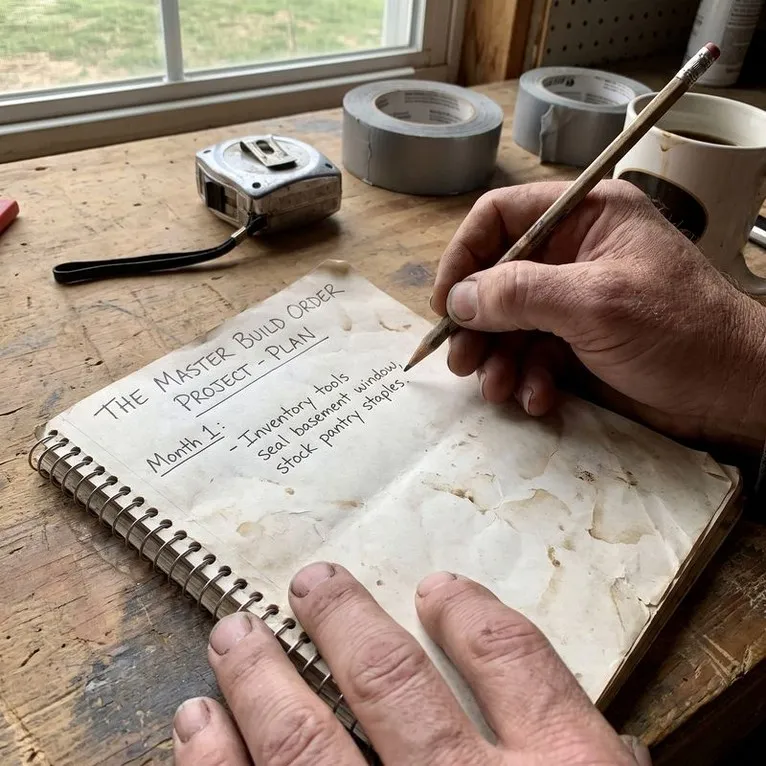
The Handbook's Phase 1 is designed to be done in one weekend, and the book says it retires the most risk in 48 hours. If a weekend feels like too much, spread it over a month:
- Week 1, alarms. Test every smoke alarm and add battery-backed CO alarms on every level. Project 52 takes about an hour and roughly $90, and the book calls it the highest life-safety-per-dollar project it contains. See where to put CO detectors.
- Week 2, water. Store water in clean containers, dated, one gallon per person per day. The book's water storage project runs about an hour and $40 to $100, and its disinfection station, plain unscented bleach and a dropper, about 20 minutes and $15.
- Week 3, light. A headlamp at each bedside, a lantern in the kitchen and the main room, and plug-in night lights in the hallway that switch on when the power fails. Project 29 costs about $50 and 30 minutes.
- Week 4, the plan on paper. A first-hour checklist (an evening and about $10) and a named job for every person in the house, children included ($0).
The book's estimate for the whole first phase is under $250 all-in, roughly one family dinner out per project. After that come the radio, the pantry, a warm room and the rest. Our guide to off-grid living for beginners walks through all five phases in order.
Beginner prepping mistakes that cost the most
- Buying gear first. The field note in Project 75 says capability starts as organization, becomes habit, and only then becomes equipment.
- Storing food nobody eats. The pantry project's rule is "store what you eat, eat what you store." Unfamiliar food tends to sit unopened until it expires.
- One big panic trip. Add two or three extra items on each normal grocery run instead, the method our guide to copy canning explains. Ready.gov suggests the same: buy an extra of what you use, especially on sale.
- Candles for light. The CDC recommends flashlights and battery lanterns instead, because of the fire risk.
- Burning fuel indoors. Grills, camp stoves and generators run outdoors only. A generator goes at least 20 feet from windows, doors and vents, and never in a garage, even with the door open.
How to keep it going
The last step of Project 75 is maintenance, and it is short: the drill, the seasonal calendar and the par rule are the whole maintenance manual. In the book's words, a capable household is not an achievement; it is a rhythm.
- A quarterly drill. One evening with the plan running for real, lights and radio up, a meal from storage.
- The par rule. When anything drops below its restock number, it goes on the next normal shopping list.
- A yearly review. Ready.gov advises replacing expired items and rethinking your needs every year as the household changes.
Money tight? Our guide to prepping on a budget shows which projects cost nothing at all.
Frequently asked questions
What should a beginner prepper buy first?
Battery-backed smoke and carbon monoxide alarms, then water containers, then headlamps and lanterns. Those protect the most for the least money. A written first-hour plan and household roles cost nothing and belong in the same first weekend, before any bigger gear.
How much water should a beginner store?
One gallon per person per day, for drinking and sanitation. Ready.gov recommends a supply for several days at minimum. The Off-Grid Handbook works toward a two-week reserve, which is 56 gallons for a household of four. Date the containers and rotate them.
How much does it cost to start prepping?
Less than most people expect. The Off-Grid Handbook estimates its whole first phase, alarms, water, disinfection, lighting, a first-hour card and household roles, at under $250 all-in. Several readiness steps, like the plan and the roles, cost nothing.
Is prepping the same as planning to bug out?
No. For most realistic emergencies, like outages and winter storms, the safer plan is staying home with your supplies. Leaving is the planned exception: when officials order an evacuation or the home itself becomes unsafe.
Sources
- The Off-Grid Handbook, Garrett Dalton, Project 75
- Ready.gov: Build a Kit
- Ready.gov: Low and No Cost Preparedness
- Ready.gov: Power Outages
- CDC: What to Do During a Power Outage
- CDC: Use a Generator Safely
Safety guidance changes. Check the agency pages above for the current version, and follow your local code and manufacturer instructions.