Heirloom vs hybrid seeds: what the labels mean and which to plant
One kind of seed gives you the same plant again next year. The other gives you a strong crop now and a surprise later. Both have a place.
In this article
The difference between heirloom vs hybrid seeds comes down to what happens next year. Heirloom and other open-pollinated varieties breed true: save their seed, plant it, and you get the same plant again. Hybrid seed, usually labeled F1, comes from crossing two chosen parent plants. It grows strong, even plants this season, but seed saved from them will not grow into the same plant.
Neither one is better in every way. University of Illinois Extension notes that many successful home and commercial growers plant both every year. The real questions are what you want from the garden and whether you plan to save seed.
Heirloom vs hybrid seeds: the three labels
Seed packets use three terms, and they overlap:
- Open-pollinated (OP). Pollinated naturally, by insects, wind or the plant itself. University of Minnesota Extension explains that seed from open-pollinated varieties grows into plants very similar to the parent.
- Heirloom. An open-pollinated variety with a history, kept going by gardeners who saved and passed on the seed. Every heirloom is open-pollinated, but not every open-pollinated variety is an heirloom, since plenty of newer OP varieties exist. There is no single official definition, so the word on a packet is a description, not a certification.
- Hybrid or F1. Illinois Extension describes an F1 hybrid as seed produced by intentionally crossing two carefully selected parent plants of the same species. "F1" stands for first generation.
One point clears up a common worry: hybrids are not GMOs. Illinois Extension states that F1 hybrids are made with traditional plant breeding, not genetic engineering. A bee carrying pollen between two squash varieties makes a hybrid too. The seed company simply does it on purpose, with known parents.
Open pollinated vs hybrid: what each does well
| F1 hybrid | Open-pollinated or heirloom | |
|---|---|---|
| Yield | Often higher in less space | Usually lower, varies by variety |
| Disease resistance | Often bred in | Varies by variety |
| Uniformity | Same size, ripens at nearly the same time | More variation from plant to plant |
| Flavor | Varies by variety | Often better, per Illinois Extension |
| Saved seed | Does not grow true | Grows true if not crossed |
| Buying seed | A new packet every year | Buy once, then save your own |
Illinois Extension lists the hybrid advantages plainly: higher yields in less space, more disease resistance, better drought or cold tolerance, and crops of uniform size that ripen at nearly the same time. That uniformity is why farms like hybrids, and it can suit a home cook who wants to put up a whole batch of tomatoes in one weekend.
Heirlooms win on flavor, texture and aroma, according to the same source, and on independence. Because their seed can be saved every year without losing its main traits, a household that keeps its own seed can, over several seasons, end up with plants that suit its own garden.
Can you save seeds from hybrid plants?
You can save them, and they will usually sprout. The trouble is what grows. The Off-Grid Handbook says it in one line in Project 44: hybrid (F1) seed grows, but not into its parent.
The University of Missouri explains why with tomato color. Cross a pure red-fruited parent with a pure pink-fruited one and every F1 plant bears red fruit. Let that F1 pollinate itself and the next generation, the F2, comes out about three red plants for every pink one. Real varieties differ in many traits at once, so the F2 is a mixed bag. Illinois Extension describes offspring that vary wildly in size, flavor, yield and disease resistance, typically for the worse, and Missouri notes that hybrid vigor lasts only one generation.
The practical answer: if you loved a hybrid, buy the same packet again. Put your seed-saving effort into open-pollinated varieties, where it pays off.
Crosses can happen in your own garden
Open-pollinated seed only breeds true if the flower was pollinated by the same variety. Squash, cucumbers and melons are insect-pollinated and cross easily, and Oregon State University Extension says it usually doesn't pay to save their seed without controlled pollination. Beans, peas and tomatoes mostly pollinate themselves, which is why they are the usual first crops. Our seed saving for beginners guide covers hand-pollinating squash and the dry and wet methods.
How to tell which seed you have
- Read the packet or catalog. Hybrids are normally marked "F1" or "hybrid." Open-pollinated seed is often marked "OP" or "heirloom."
- Check the plant tag. Nursery seedlings carry a tag with the variety name. Look the variety up before you plan to save its seed.
- Treat unknown seed as an experiment. If you don't know whether last year's plant was a hybrid, sow a few of its seeds in a corner, not as the main crop.
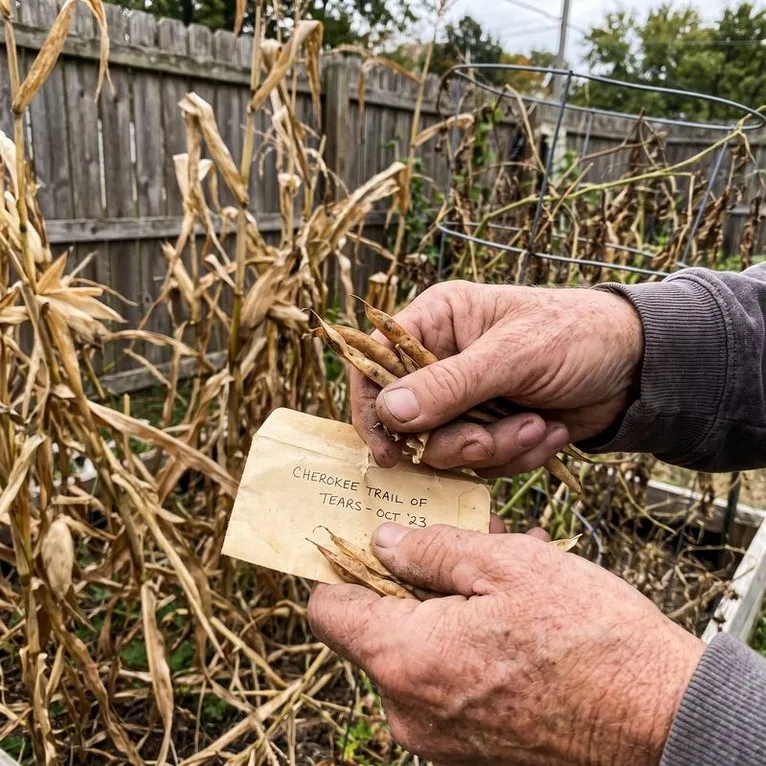
- Label everything. Project 44 has you put each lot in an envelope labeled with the variety and the year, so next spring you know exactly what you have.
Which seeds to buy for a garden you can replant
The materials list for Project 44 calls for open-pollinated (heirloom) varieties, along with envelopes, labels, an airtight jar and silica gel packets. The whole seed vault costs about $15 and an hour, per the book.
A sensible mix for a home food garden:
- Open-pollinated for the crops you will save: dry beans, peas, tomatoes and lettuce. These are the backbone of a seed vault.
- Hybrids where they solve a problem: a disease-resistant variety for a garden that keeps losing a crop, or an even crop you plan to preserve all at once. Buy fresh seed each year.
- Potatoes are their own case. They grow from tubers, and Project 39 of the Handbook calls for certified seed potatoes, not sprouted grocery stock. See growing potatoes in containers.
Project 44 also asks you to vault a restart core: one season's worth of the calorie and storage crops from Projects 39 and 40, refreshed by rotation. That only works with open-pollinated seed, because a vault of hybrid seed can't be renewed from your own harvest. The raised garden bed guide lists the storage crops the book plants.
Keep both kinds fresh
Whichever you choose, seed is alive and slowly ages. Store it cool, dark and dry in an airtight jar with desiccant, as Project 44 describes, and write the year on every envelope. Our guide on how long seeds last has a viability chart and a simple germination test. For fall and winter sowing, what to plant in a cold frame lists the hardy greens and roots that keep growing after frost.
Frequently asked questions
Are heirloom seeds better than hybrid seeds?
Not in every way. University of Illinois Extension says F1 hybrids often yield more, resist disease better and ripen evenly, while heirlooms often taste better and can be saved year after year without losing their main traits. Many gardeners plant both: heirlooms for the crops they save, hybrids where a trait solves a problem.
Can you save seeds from hybrid plants?
You can, and they will usually sprout, but they won't grow into the plant you saved them from. The Off-Grid Handbook puts it simply: hybrid (F1) seed grows, but not into its parent. Extension sources describe the next generation as a mix that varies in size, flavor, yield and disease resistance.
Are hybrid seeds GMO?
No. University of Illinois Extension states that F1 hybrids are created with traditional plant breeding, by crossing two parent plants of the same species, not with genetic engineering.
Is open-pollinated the same as heirloom?
Not quite. Every heirloom is open-pollinated, meaning its seed grows true when it isn't crossed with another variety. But many open-pollinated varieties are newer and have no long history, so they aren't called heirlooms. Both kinds are good for seed saving.
Sources
- The Off-Grid Handbook, Garrett Dalton, Project 44
- University of Illinois Extension: F1 hybrid vs. heirloom vegetable seed (2026)
- University of Missouri IPM: Why Not Save Hybrid Seeds?
- University of Minnesota Extension: Saving vegetable seeds
- Oregon State University Extension: Collecting and storing seeds from your garden
Safety guidance changes. Check the agency pages above for the current version, and follow your local code and manufacturer instructions.