How long do seeds last? A seed viability chart and how to store seeds long term
Seeds don't spoil on a date. They fade slowly, and heat and damp decide how fast.
In this article
How long do seeds last? Most vegetable seed stays good for about 3 to 5 years when it is kept cool, dark and dry, while a few kinds, such as onion and parsnip, fade within a year or two. Colorado State University Extension says vegetable and flower seed keeps for a year without much drop in germination, and that well-dried seed stored properly can last 10 years or more.
Seeds don't go bad on a fixed date. They lose the ability to sprout gradually, and storage decides how fast that happens. This guide gives the chart, the storage rules and a ten-minute way to check old seed before you plant it.
How long do seeds last? The short answer
The Off-Grid Handbook puts it in one line in Project 44: most garden seed holds 3 to 5 years; onion and parsnip fade fastest. That matches the extension guidance. Seed that sat in a hot garage for two summers can be weak after one year, and seed kept dry in a cold jar can beat the chart.
Two habits make the numbers work: write the year on every envelope, and use the oldest seed first.
Seed viability chart
Oregon State University Extension groups common vegetables by how long their seed usually lasts:
| Seed life | Crops |
|---|---|
| Short: 1 to 2 years | Corn, onion, parsley, parsnip, pepper |
| Intermediate: 3 to 4 years | Asparagus, bean, broccoli, carrot, celery, leek, pea, spinach |
| Long: 4 to 5 years | Beet, chard, cabbage family, turnip, radish, cucumber, eggplant, lettuce, muskmelon, pumpkin, squash, tomato, watermelon |
These are averages under good storage, and sources don't agree on every crop. Colorado State's chart, for example, gives lettuce only 1 year, where Oregon State lists it with the long-lived seeds. Use the chart to decide which seed to plant first, and test anything older before you count on it.
What makes seeds age faster
Heat and moisture. Gordon Johnson, a vegetable specialist with University of Delaware Extension, writes that every 1 percent rise in seed moisture cuts storage life in half, and so does each rise of about 9°F.
His rule of thumb is easy to remember: the storage temperature in °F plus the relative humidity in percent should add up to less than 100. A spot at 50°F and 50 percent humidity passes. So does 40°F and 60 percent. A summer kitchen at 80°F and 60 percent humidity is far over.
- Avoid hot spots: attics, cars and uninsulated metal sheds. Delaware Extension says uninsulated metal buildings make poor summer storage.
- Avoid damp spots: an open shelf in a humid basement or a paper envelope left loose in a steamy room.
- Keep it dark, and leave packets closed until you are ready to plant.
How to store seeds long term
- Dry it fully. Colorado State says seed stores well when it is dry, below 8 percent moisture, and cold, below 40°F. For dry-seed crops like beans, peas and lettuce, Project 44 lets the seed mature and dry on the plant, then finishes it indoors for two weeks.
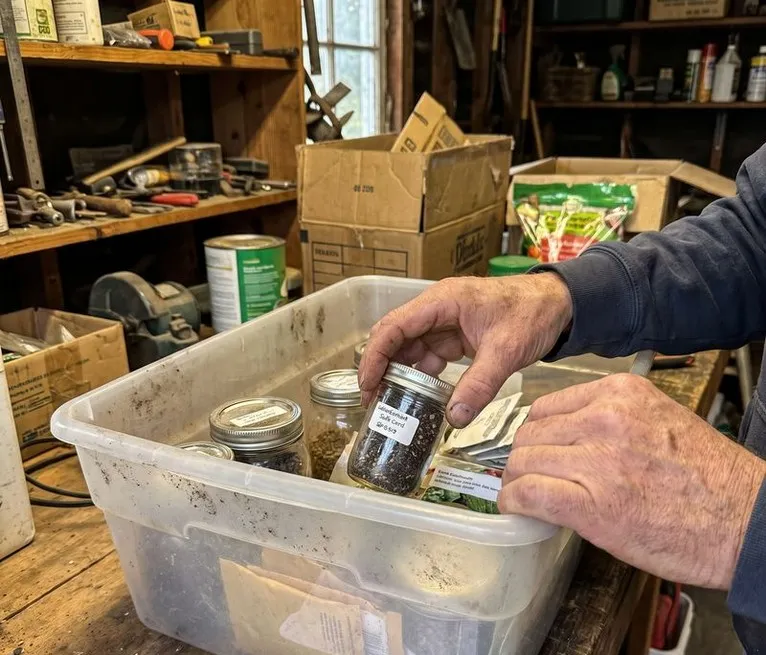
- Envelope and label. One variety per envelope, with the name and the year, as the book describes.
- Seal it. Colorado State recommends moisture-proof containers, sealed cans or jars rather than plastic bags. The Handbook uses an airtight jar or an ammo-style dry box.
- Add desiccant. Project 44 uses silica gel packets. Oregon State suggests dry powdered milk as a homemade moisture absorber.
- Keep it cold. Colorado State says a refrigerator or deep freezer works for sealed, dry seed. A cool, dark closet is the next best place.
If you keep seed in the refrigerator or freezer, let the closed jar warm to room temperature before you open it, so moisture from the room doesn't settle on cold seed. The whole vault, per the Handbook, costs about $15 and an hour.
Test old seed before you plant it
A germination test tells you what the chart can't. Oregon State's method:
- Moisten paper towels and lay out 25 to 50 seeds.
- Roll the towels loosely and keep them in a warm spot.
- Check every two days. Radish sprouts in 2 to 3 days; peppers can take 10 to 14.
- Count the sprouted seeds and work out the percentage.
If half the seeds sprout, the seed is still usable: sow about twice as thickly. If very few sprout, replace it. A test in late winter leaves time to order fresh seed before planting season.
Which seed to use first
A simple order keeps the vault from aging out:
- Short-lived seed first: onion, parsnip, parsley, corn and pepper. Plan to replace these every year or two.
- Oldest envelopes next: anything three or more years old, after a quick germination test.
- Fresh, long-lived seed last: tomato, squash, beet and the cabbage family can wait in the jar.
Weak seed shows itself before it fails completely. Sprouting gets slow and uneven, and the seedlings that do come up are smaller and less vigorous. When a lot starts acting that way, sow it thickly this year and replace it for next.
Seed you buy vs seed you save
Packets from a seed company were dried and stored under controlled conditions before they reached you, so they usually start out strong. Seed you save at home is only as good as your drying. Give homegrown seed the full drying time from Project 44, two weeks indoors for dry-seed crops, and test a sample before you depend on it.
Rotate the seed vault
Project 44 asks for more than working seed. It asks you to vault a restart core: one season's worth of the calorie and storage crops, refreshed by rotation. Rotation is what keeps that core alive. Plant from the oldest envelopes, save or buy fresh seed to replace them, and replace short-lived seed like onion and parsnip every year or two.
The book's field note says a seed vault the size of a lunchbox represents a season of food. Keep a list of what it holds in your emergency binder, with the year beside each variety.
Seed you save yourself only stays true if it comes from open-pollinated plants. Our guides on heirloom vs hybrid seeds and seed saving for beginners cover which seed to keep. Garden seed is not sprouting seed, so keep a separate supply for sprouting in a jar. Cold-hardy greens from a cold frame are good candidates for the vault too.
Frequently asked questions
Do seeds expire?
Not on a fixed date. Seeds lose the ability to sprout gradually. Most vegetable seed stays good about 3 to 5 years if kept cool, dark and dry, while onion, parsnip, parsley, corn and pepper usually fade within 1 to 2 years. Heat and humidity speed the decline.
Can you plant 10-year-old seeds?
Sometimes. Colorado State University Extension says well-dried seed stored cold can last 10 years or more, but seed kept in ordinary conditions is often weak by then. Run a germination test with 25 to 50 seeds on a damp paper towel before you rely on it.
Should you store seeds in the freezer?
Dry seed sealed in an airtight jar keeps well in a refrigerator or deep freezer, according to Colorado State University Extension. The seed must be thoroughly dry first. Let the closed jar warm to room temperature before opening it so moisture doesn't settle on the cold seed.
How do you know if old seeds are still good?
Do a germination test. Roll 25 to 50 seeds in a moist paper towel, keep it warm, and check every two days. If half sprout, sow twice as thickly. If very few sprout, replace the seed.
Sources
- The Off-Grid Handbook, Garrett Dalton, Project 44
- Oregon State University Extension: Collecting and storing seeds from your garden
- Colorado State University Extension: Storing Vegetable and Flower Seeds
- University of Delaware Cooperative Extension: Storing Vegetable Seed
- University of Minnesota Extension: Saving vegetable seeds
Safety guidance changes. Check the agency pages above for the current version, and follow your local code and manufacturer instructions.