Emergency meal plan: a 7-day menu from the pantry, with water and fuel counted
A pantry is a pile of ingredients until someone decides what dinner is. Write those decisions down now, while the lights are on.
In this article
- What goes into an emergency meal plan
- A 7 day emergency meal plan you can adapt
- Count the water cost of every meal
- Count the fuel, and keep cooking outdoors
- Power outage meal ideas that need almost nothing
- Calories and the people at your table
- Test the plan: one storage-only day per quarter
- Frequently asked questions
An emergency meal plan is a written 7-day menu of meals your household already eats, made only from shelf food and water, with the water and cooking fuel for each meal counted. It starts with the refrigerator and freezer, moves to no-cook shelf meals, and then to simple cooked meals made outdoors. Repeat the week to cover a longer outage.
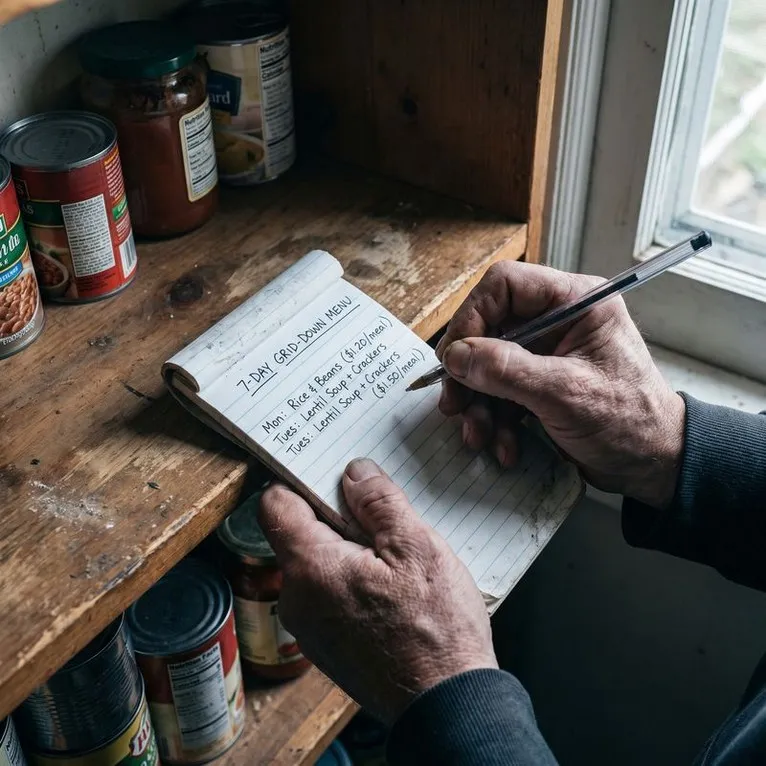
The Off-Grid Handbook builds it in two places: Project 37 writes the menu that shapes the pantry, and Project 45 writes the actual grid-down week against the shelf you really have, water cost per meal included. Here is how to do both, with a sample week to start from.
What goes into an emergency meal plan
A useful plan answers five questions before anyone is hungry:
- What do we eat each meal? Real dishes, not "canned goods."
- In what order? Perishables first, shelf food last.
- Which meals need cooking? And on what, since indoor cooking may be gone.
- How much water does each meal take? Drinking water is not the only demand.
- How much fuel does the week take? Counted, not guessed.
The Handbook's Project 37 starts from meals your household already likes, because familiar food gets eaten. FEMA makes the same point: familiar foods lift morale and give a feeling of security in times of stress.
A 7 day emergency meal plan you can adapt
This sample week assumes a winter or summer outage with no power from the first morning. Days 1 and 2 use up the refrigerator and freezer, days 3 to 5 need no cooking, and days 6 and 7 use a camp stove or grill outdoors.
| Day | Breakfast | Lunch | Dinner |
|---|---|---|---|
| 1 | Yogurt, fruit and bread from the fridge | Sandwiches from the fridge | Fridge leftovers, cooked outdoors if needed |
| 2 | Cereal with shelf-stable milk | Thawed freezer items still holding ice crystals, cooked outdoors | The rest of the safe freezer food |
| 3 | Peanut butter on crackers, canned fruit | Canned tuna on crackers | Canned chili, eaten cold, with crackers |
| 4 | Granola with shelf-stable milk | Canned chicken and three-bean salad | Ready-to-serve soup, canned green beans |
| 5 | Protein bar, canned fruit | Peanut butter and jelly on crackers | Canned ham, canned corn, applesauce |
| 6 | Oatmeal with dried fruit, coffee | Rice and beans with canned tomatoes | Pasta with canned sauce and canned chicken |
| 7 | Oatmeal, coffee | Canned soup, heated | Rice with canned vegetables and tuna |
Swap in what your household actually eats. The shape matters more than the dishes: perishables first, no-cook next, cooking last, which follows FEMA's order of refrigerator, then freezer, then non-perishables. USDA's limits set the pace: about 4 hours for a closed refrigerator, about 48 hours for a full freezer and 24 for a half-full one. Perishables above 40°F for 2 hours or more are thrown out, never tasted to check.
Count the water cost of every meal
The Handbook's Project 45 asks for the water cost per meal in the menu itself, and this is the step most plans skip. Rice, pasta, oatmeal, beans and coffee all need water to cook. Read the amount off each package and write it next to the meal.
Project 37 gives a planning figure: cooking a shelf-stable menu like this adds roughly half a gallon per person per day on top of drinking and sanitation water. Ready.gov's baseline for drinking and sanitation is one gallon per person per day. Together that is about a gallon and a half per person on cooking days.
- No-cook days use far less water, which is why they sit early in the week, while stored water is still being counted.
- Canned fruit in juice, canned vegetables and soups bring their own liquid.
- If water is short, FEMA says to avoid salty foods, which make you thirsty.
Check the totals against your supply with our guide to how much water per person per day.
Count the fuel, and keep cooking outdoors
Every cooked meal also has a fuel cost. Project 45's method: count the full-flame minutes each day takes, multiply by seven, add half again for margin, and stage that fuel. For the cylinder and canister numbers, see how long a 1 lb propane tank lasts.
The book also assigns the sun the slow jobs: its solar oven, Project 57, takes the long bakes and saves canister minutes for quick ones.
All of it happens outdoors. The CDC says never to use a charcoal grill, hibachi or portable camping stove inside a home, tent or camper, and never to use a gas range or oven to heat a home. Our guide to how to cook without electricity covers the safe setups, and a food thermometer keeps cooked meals out of the food danger zone.
Power outage meal ideas that need almost nothing
- Peanut butter and crackers with canned fruit
- Canned tuna or chicken with crackers and a pickle
- Cold canned beans or chili with crackers
- Cereal or granola with shelf-stable milk
- Canned three-bean salad with canned chicken
- Trail mix of nuts and dried fruit
More ideas, and the three-day kit behind them, are in no cook emergency food.
Calories and the people at your table
The Handbook's rule of thumb is roughly 2,000 calories per adult per day, counted once so the menu rests on numbers rather than on how full the shelf looks. Older or less active adults need less; anyone shoveling snow or hauling water needs more. FEMA's nutrition tip for disasters is to eat at least one well-balanced meal each day.
Plan separately for babies, special diets, allergies and anyone with a medical diet; if in doubt, ask their doctor or dietitian. The quantities that back this menu for a full month are in our 30-day food supply list, and copy canning shows how to stock them gradually.
Test the plan: one storage-only day per quarter
A plan on paper has holes you can't see. Project 45 closes them with one full storage-only day per quarter, cooked on the backup gear. Log what ran short, what nobody ate and what took longer than planned, then feed the log back into the pantry list and the fuel supply.
The book's field note says the quarterly storage day finds every hole in the plan at a cost of zero, and that the other way of finding them is expensive.
Frequently asked questions
What is an emergency meal plan?
A written 7-day menu of meals your household already eats, made only from shelf food and water, with the water and fuel for each meal counted. It uses the refrigerator first, then the freezer, then no-cook shelf meals, then simple meals cooked outdoors, and repeats for longer outages.
What should a 7 day emergency meal plan include?
Breakfast, lunch and dinner for each day from foods you actually have, listed in the order you will eat them, with the water each meal needs and the cooking fuel for the week. The Off-Grid Handbook plans roughly 2,000 calories per adult per day.
How much water do you need for emergency cooking?
The Off-Grid Handbook estimates roughly half a gallon per person per day for cooking a shelf-stable menu, on top of Ready.gov's one gallon per person per day for drinking and sanitation. Read the water amounts off rice, pasta and oatmeal packages and write them into the plan.
What are good power outage meal ideas?
Peanut butter and crackers with canned fruit, canned tuna or chicken on crackers, cold canned beans or chili, cereal with shelf-stable milk, canned bean salad and trail mix. Eat food from the refrigerator first, then the freezer, before opening the shelf supply.
Sources
- The Off-Grid Handbook, Garrett Dalton, Project 45
- FEMA: Food and Water in an Emergency (PDF)
- Ready.gov: Food
- Ready.gov: Build a Kit
- USDA FSIS: Keep Your Food Safe During Emergencies
- CDC: What to Do to Protect Yourself During a Power Outage
Safety guidance changes. Check the agency pages above for the current version, and follow your local code and manufacturer instructions.