The food danger zone: temperatures, time limits and what to do in an outage
Two numbers settle most food safety questions in a kitchen: 40°F and 2 hours. In a power outage, they become the rules you live by.
In this article
The food danger zone is the temperature range between 40°F and 140°F, where bacteria grow fastest, doubling in number in as little as 20 minutes, according to the USDA. The rule that goes with it: never leave perishable food out of refrigeration for more than 2 hours, or more than 1 hour if it is above 90°F. Keep cold food at 40°F or below and hot food at 140°F or above.
Those numbers answer most kitchen questions, and they matter even more when the power goes out. Here is how the rule works, and how to apply it with a thermometer instead of a guess.
Food danger zone temperatures
The USDA Food Safety and Inspection Service (FSIS) names bacteria such as Salmonella, E. coli O157:H7, Staphylococcus aureus and Campylobacter as the kinds that can grow to dangerous levels when food sits too long at room temperature. These are the temperatures to remember:
| Temperature | What it means |
|---|---|
| 0°F or below | Where FSIS wants your freezer |
| 40°F or below | Safe cold holding: your refrigerator |
| 40°F to 140°F | The danger zone: bacteria multiply quickly |
| 140°F or above | Safe hot holding for cooked food |
| 165°F | Reheat leftovers to this temperature, or until hot and steaming |
The middle of that range, around room temperature, is where a kitchen spends most of its time. That is why a platter left on the counter is the classic problem.
Food danger zone time: the 2-hour and 1-hour rules
Time is the other half of the rule. FSIS and the CDC give the same limits:
- 2 hours is the most perishable food should spend out of refrigeration.
- 1 hour is the limit when it is hotter than 90°F, such as a picnic, a hot car or a summer outage.
The CDC defines perishable food as meat, seafood, dairy, cut fruit, some vegetables and cooked leftovers. Eggs belong on the list too. Whole uncut fruit, bread and unopened shelf-stable cans don't.
Leftovers
FSIS calls improper cooling of cooked food one of the most common causes of foodborne illness. Put leftovers in shallow containers so they cool quickly, and get them into the refrigerator within 2 hours. When you reheat them, bring them to 165°F.
Keep cold food cold and hot food hot
The practical side of the rule comes down to a few habits:
- Cold dishes: serve them in containers set on ice, so they stay at 40°F or below.
- Hot dishes: hold them at 140°F or above in a slow cooker, warming tray or chafing dish.
- Thawing: thaw frozen food in the refrigerator, in cold water or in the microwave, never on the counter. The CDC explains that bacteria multiply quickly in the parts of the food that reach room temperature.
- Cooking: use a food thermometer and the FSIS minimums below.
| Food | Safe minimum internal temperature |
|---|---|
| All poultry, leftovers and casseroles | 165°F |
| Ground meats and egg dishes | 160°F |
| Beef, pork, veal and lamb steaks, chops and roasts | 145°F, then rest at least 3 minutes |
| Fish and shellfish | 145°F |
The danger zone during a power outage
An outage turns the refrigerator into a slowly warming box, and the danger zone becomes a clock. USDA's figures, as long as the doors stay shut:
- A refrigerator keeps food safe for about 4 hours.
- A full freezer holds its temperature for about 48 hours, and a half-full one about 24.
Project 43 of The Off-Grid Handbook takes these numbers straight from USDA. Its fifth step is the food-safety line: perishables above 40°F for too long are discarded, and a fridge thermometer makes the call a reading, not a guess. The book words the limit as more than 2 hours. USDA's own wording is 2 hours or more, so treat the 2-hour mark itself as the time to throw food out.
The same project keeps food out of the danger zone longer with an ice bank: water bottles frozen flat and kept in the freezer as standing policy, then moved into a good cooler when the power fails. The cooler becomes the one cold box you open, while the fridge and freezer stay shut. The book prices the project, ice bank and zeer pot together, at about $25 and an hour of work. Keep a thermometer in the cooler too, and add ice as it melts.
In winter it is tempting to set food outside in the snow. FSIS says not to: outdoor temperatures vary, and food can be exposed to animals and unsanitary conditions. Instead, fill jugs or buckets with water, let them freeze outside, and use that ice in the cooler. Our guide to how long food lasts in the fridge without power has the full keep-or-toss list.
Why you can't smell your way out of the danger zone
FSIS describes two different families of bacteria. Spoilage bacteria make food smell, taste and feel bad, and they can grow even in the refrigerator. Pathogenic bacteria, the kind that cause illness, grow fast in the danger zone but generally don't change how food tastes, smells or looks. Food left too long on the counter can look perfectly fine and still be dangerous.
The Handbook's safety box for Project 43 says the same thing in fewer words: when in doubt, throw it out, because no taste test exists for the bacteria that matter. The 40°F and 2-hour rule from USDA is the rule.
A thermometer turns the rule into a reading
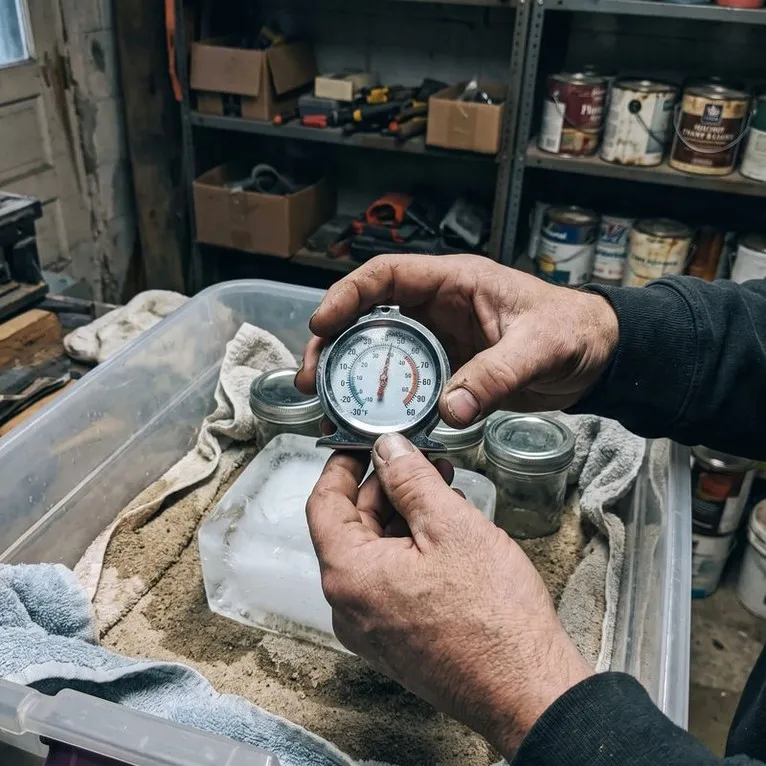
Most danger zone mistakes come from guessing. An appliance thermometer is inexpensive and takes the guessing out.
- Keep one in the refrigerator and one in the freezer. FSIS wants 40°F or below and 0°F or below.
- In an outage, write the time the power went off on the fridge door in marker, so you know how long the clock has run. The full first-hour routine is in what to do when the power goes out.
- When the power returns, read the thermometer before you decide. Food that stayed at 40°F or below is fine.
- Keep a food thermometer with your cooking gear for meats and reheated leftovers.
For meals that sidestep the problem, keep a few days of no cook emergency food on the shelf, and see how long canned food lasts. If you cook outdoors during an outage, how to cook without electricity covers the safe setups.
Frequently asked questions
What is the food danger zone?
It is the temperature range between 40°F and 140°F, where bacteria grow fastest, doubling in as little as 20 minutes according to USDA. Keep cold food at 40°F or below, hot food at 140°F or above, and reheat leftovers to 165°F.
How long can food sit in the danger zone?
No more than 2 hours for perishable food such as meat, poultry, seafood, eggs, dairy, cut fruit and cooked leftovers. If the temperature is above 90°F, the limit drops to 1 hour, per USDA and the CDC.
Is food safe if it was left out for 3 hours?
Perishable food left out of refrigeration for more than 2 hours should be thrown away, and after 1 hour above 90°F. Don't taste it to check: USDA notes that the bacteria that cause illness generally don't change how food looks, smells or tastes.
What temperature should a refrigerator and freezer be?
USDA says the refrigerator should be at 40°F or below and the freezer at 0°F or below. Keep an appliance thermometer in each, so you can check the reading after a power outage instead of guessing.
Sources
- The Off-Grid Handbook, Garrett Dalton, Project 43
- USDA FSIS: "Danger Zone" (40°F to 140°F)
- CDC: Preventing Food Poisoning
- USDA FSIS: Refrigeration and Food Safety
- USDA FSIS: Safe Minimum Internal Temperature Chart
- USDA FSIS: Keep Your Food Safe During Emergencies
Safety guidance changes. Check the agency pages above for the current version, and follow your local code and manufacturer instructions.