Power outage kit list: light, power and cold, staged before the lights go out
Water and food live in your 72-hour kit. This is the other half: the things that replace the grid for a few days, and where they should sit so nobody hunts for them.
In this article
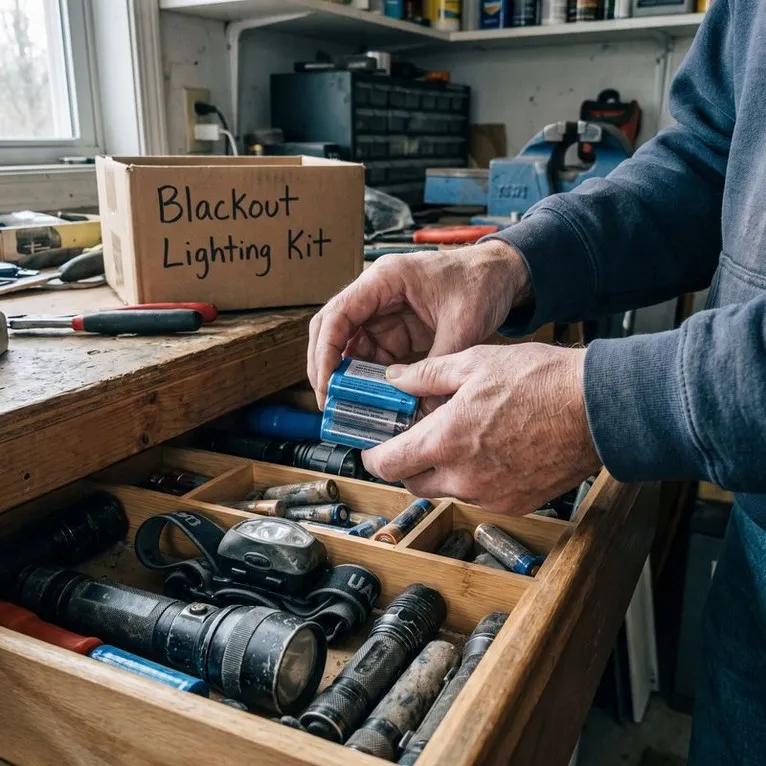
A power outage kit list covers three jobs the grid normally does for you: light, power for phones and small devices, and cold for food, plus warmth for people in winter. The core is a headlamp for each person, two or three LED lanterns, plug-in night lights that switch on by themselves, lithium spare batteries, a crank or battery radio with the NOAA weather band, two charged power banks, a cooler with frozen water bottles and a fridge thermometer, and battery-backed carbon monoxide alarms.
Water, food and first aid belong in your 72-hour kit. This list is the electrical side, built from four projects in The Off-Grid Handbook.
Power outage kit list at a glance
| Item | How many | From the Handbook |
|---|---|---|
| Headlamp | One per person | Project 29 |
| LED lantern, 300+ lumen class | Two or three | Project 29 |
| Power-failure night lights | Hallway and stair outlets | Project 29 |
| Lithium spare batteries | A drawer's worth | Project 29 |
| Crank or solar radio, NOAA band, USB out | One | Project 23 |
| USB power banks, 10,000 mAh class | Two | Project 23 |
| 10 W folding USB solar charger and cables | One set | Project 23 |
| Good cooler, frozen water bottles, fridge thermometer | One | Project 43 |
| Battery-backed CO and smoke alarms | Every level | Project 52 |
| Sleeping bag, pad and wool blanket (winter) | One set per person | Project 53 |
The printed costs: about $50 for the lighting kit, about $35 for the radio, about $25 for the cold kit, about $90 for the alarm grid and about $60 for the sleep systems. You don't have to buy it all at once. If money is tight, start with the lights and the alarms, since those protect people in the first minutes, and add the rest over a few grocery trips. Much of it may already be in a drawer: old flashlights, a cooler from summer, sleeping bags from camping.
Power outage essentials: light in the first minute
The first five minutes of an outage are decided by where the lights physically are. Project 29 gives them fixed homes: a lantern in the kitchen, a lantern in the main room and a headlamp at every bedside, always in the same place. The power-failure night lights go in hallway and stair outlets, so the escape routes light themselves the moment the grid drops.
- Headlamps over flashlights. The book's reason: tasks need both hands.
- Lithium primary spares. They hold for about a decade and work in the cold.
- No candles. The CDC recommends flashlights and battery lanterns instead, because of the fire risk. The Handbook's field note puts it plainly: candles are ambiance, not emergency lighting.
Ready.gov's own list starts here too: flashlights for every household member. Our guide to power outage lighting covers lumens, models and the battery drawer.
Power: a radio, phones and a small station
Project 23 is the buy-side kit: a hand-crank and solar radio with the NOAA weather band and a real USB output, two small power banks, a 10-watt folding solar charger and a short cable set in a labeled pouch. Test everything when it arrives: crank for two minutes and confirm both the radio and the charging output work.
The book is honest about the crank: two minutes of hard cranking buys a few minutes of radio and a sliver of phone charge. The crank is the backup's backup; the panel and the banks are the plan. Top up the banks every quarter, since lithium banks lose charge in storage, and retire any bank at the first sign of swelling. More in our guide to the hand crank emergency radio.
If someone uses a CPAP or you want to run the fridge, a battery power station is the next step up. It makes no exhaust and can sit indoors. A gas generator is a different tool with fixed rules: outdoors only, at least 20 feet from windows, doors and vents, never in a garage even with the door open.
Cold: keep food safe without the fridge
Project 43 builds an ice bank: a stack of frozen water bottles kept in the freezer as standing policy. In an outage they move to a good cooler, and the cooler becomes the fridge you open and close, so the real fridge and freezer stay shut.
- A closed refrigerator keeps food safe for about 4 hours; a full freezer about 48 hours, half full about 24, per USDA.
- Perishables above 40°F for more than 2 hours are thrown out. A fridge thermometer makes it a reading, not a guess.
- The bottles become drinking water when they melt.
The full timeline is in how long food lasts in the fridge without power.
Warmth and safety for a winter outage
In cold weather, add the pieces that keep people warm without burning anything indoors. Project 53 gives each person a sleeping bag rated at least 20°F below the coldest indoor temperature you expect, a pad underneath and a wool blanket on top, for about $60 and 30 minutes. Project 49, the One Warm Room, gathers the household into one small, sealed room for about $40 and an hour of planning. See how to stay warm without power.
Two safety items belong in every kit: battery-backed CO alarms on every level, as Ready.gov advises, and a firm household rule that the gas stove and oven are never used for heat. Grills and camp stoves stay outdoors. Our guide to CO detector placement shows where the alarms go.
Power outage kit for home: where it lives
A kit in a box in the basement fails in the dark. The Handbook spreads it out on purpose: lights at their stations, the radio and one power bank at the first-hour station in the kitchen, the second bank in the car kit, the cooler where you can reach it. Then a quarterly ninety-second drill: every station present, every light lit, on the calendar.
Log purchase dates, rotate the spares and recharge the banks every quarter. If leaving ever becomes the better choice, our guide to bug in vs bug out explains when, and renters will find a closet-sized version in power outages in an apartment.
Frequently asked questions
What should be in a power outage kit?
A headlamp for each person, two or three LED lanterns, plug-in power-failure night lights, lithium spare batteries, a crank or battery radio with the NOAA weather band, two charged power banks, a cooler with frozen water bottles, a fridge thermometer and battery-backed CO alarms. Add warm bedding in winter.
How many flashlights do you need for a power outage?
Ready.gov says to have flashlights for every household member. The Off-Grid Handbook goes further: a headlamp at each bedside, so hands stay free, plus a lantern in the kitchen and one in the main room, always kept in the same places.
Are candles OK for a power outage?
Battery lights are safer. The CDC recommends flashlights and battery-powered lanterns instead of candles during an outage because of the fire risk. If you must use a candle, the CDC says to use a safe holder away from anything that can burn and never leave it unattended.
Is a hand crank radio enough to charge a phone?
Not really. Two minutes of hard cranking gives a few minutes of radio and only a sliver of phone charge. Keep two charged power banks and a small solar charger as the real plan, and treat the crank as the backup's backup.
Sources
- The Off-Grid Handbook, Garrett Dalton, Project 29
- Ready.gov: Power Outages
- CDC: Proper Use of Candles During a Power Outage
- CDC: What to Do During a Power Outage
- USDA FSIS: Keep Your Food Safe During Emergencies
- Ready.gov: Build a Kit
Safety guidance changes. Check the agency pages above for the current version, and follow your local code and manufacturer instructions.