What to do during a power outage for fun: games, jobs and a lantern-lit evening
Children remember an outage by the mood of the adults around them. A calm evening with a lantern, a game and a job for everyone is the version they will ask to repeat.
In this article
- Make the outage an evening, not an emergency
- What to do during a power outage for fun: a list to keep
- Power outage activities for kids: give them a job
- Light the room safely
- Food and fun without opening the fridge
- Practice on purpose: a power-down evening
- Keep one eye on safety while you play
- Frequently asked questions
What to do during a power outage for fun: board games and cards by lantern light, reading aloud, storytelling, puzzles, a picnic from the pantry, music on a battery radio, stargazing from the yard, and a real job for every child. The safety rules are few and fixed: battery lights instead of candles, cooking outdoors only, and the fridge door stays shut.
The idea comes from Project 71 of The Off-Grid Handbook, which treats a planned evening without power as a household skill worth practicing, and worth enjoying.
Make the outage an evening, not an emergency
The last step of the Handbook's Power-Down Drill is about tone: this is the household's quarterly evening of competence, not a fire alarm. The book adds that households that enjoy the drill keep drilling. The same is true of a real outage. If the adults treat it as an interesting evening with a plan, children usually follow.
The CDC's advice for families in an emergency points the same way: stay calm, reassure your children, and talk about what is happening in simple words they can understand. It also suggests keeping a flashlight, games and special toys in the family's emergency kit to help children stay calm.
What to do during a power outage for fun: a list to keep
Here are things to do when the power is out that need nothing but light and people.
- Board games and cards. The classic. Keep a deck of cards and a couple of games with the lanterns so you aren't hunting in the dark.
- Read aloud. One headlamp, one chapter a night. A long book can carry a three-day outage.
- Tell stories. Grandparents' stories of storms past go over especially well by lantern light.
- Puzzles and drawing. A jigsaw on the kitchen table, coloring books, paper airplanes.
- Shadow puppets. A lantern and a blank wall are all it takes.
- A pantry picnic. Spread a blanket on the living room floor and eat crackers, peanut butter and fruit.
- Music and the radio. Sing, play an instrument, or listen to the battery radio together on the hour for news.
- Stargazing. With the neighborhood dark, the sky can be remarkable. Bundle up and go out to the yard for a few minutes.
- Write it down. Older children can keep an "outage log": the time the power went out, the temperature in the warm room, what you ate.
Power outage activities for kids: give them a job
Project 62 of the Handbook, Household Roles, gives every person in the house a named role with real tasks, and children get real roles scaled to their age. The book's examples: flashlight steward, pet officer, supply counter. Its reasoning is short: included children are calmer children. The field note adds that a person with a job has somewhere to put the adrenaline.
- Flashlight steward: hands out headlamps, checks the lanterns, collects them at bedtime.
- Pet officer: feeds and waters the pets and keeps them calm.
- Supply counter: counts the water jugs and the snacks and reports to the adults.
- Log keeper: writes the times and temperatures in the notebook.
Every role has a deputy, the book says, so the plan survives one absence. Project 62 takes one evening and costs nothing. More ideas in our guide to emergency preparedness for kids.
Light the room safely
Lanterns make the evening, and they are also the main safety decision. Project 29 stages one lantern in the kitchen, one in the main room and a headlamp at each bedside, so nobody gropes for a light. The CDC recommends flashlights and battery lanterns instead of candles during an outage because of the fire risk, and the book agrees: candles are ambiance, not emergency lighting.
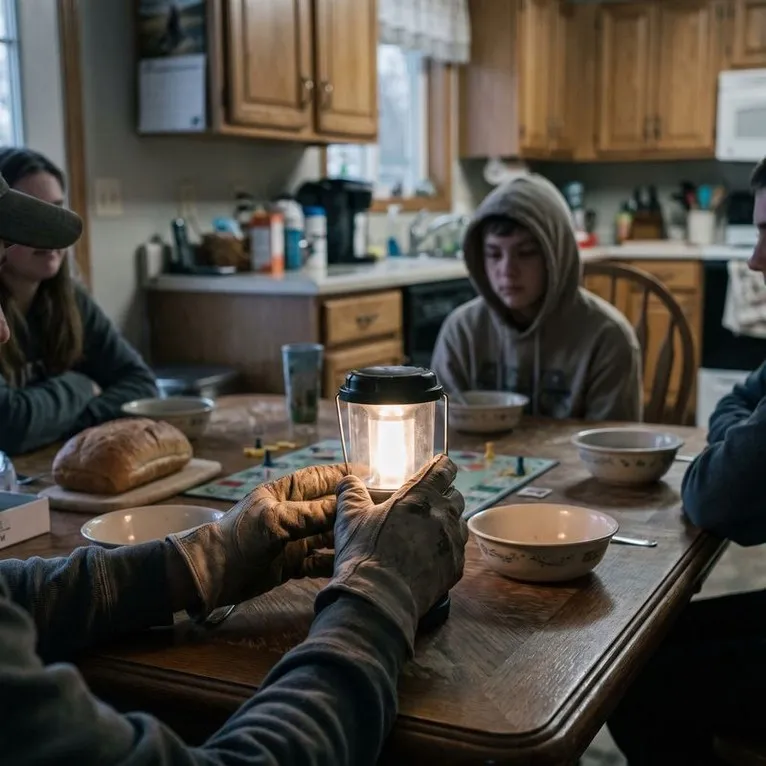
A lantern in the middle of the table lights a game for the whole family. Headlamps are better for reading, and children love them. Our guide to power outage lighting covers what to buy.
Food and fun without opening the fridge
Every opening of the refrigerator lets cold out, and USDA says a closed fridge keeps food safe for only about 4 hours. So the fun food comes from the shelf: crackers, peanut butter, canned fruit, granola bars, trail mix you mix together at the table. Our list of no-cook emergency food has more.
If you want a hot meal, the Handbook's drill cooks the evening meal on the outdoor station, and that is the rule: grills and camp stoves are used outdoors only, never in the house or garage, and never the gas stove or oven for heat. Roasting something on the grill outside, with the children watching from the door, can be the highlight of the night.
Practice on purpose: a power-down evening
The best way to make a real outage feel familiar is to have a pretend one first. Project 71 schedules it like it matters: a weekend evening once a quarter, everyone home, two to four hours. The refrigeration stays powered, the book notes; it is a drill, not a sacrifice of groceries. It costs nothing.
- Turn off the lights and run the first-hour plan: lanterns up, radio on, roles in action.
- Make dinner from storage, cooked outdoors or no-cook.
- Play, read and talk by lantern light.
- Debrief over the meal, kindly: what stumbled, what surprised, and what the children handled better than the adults.
Log it and fix one thing before the next drill. Then when a real outage comes, use what to do when the power goes out for the first hour and the power outage kit list for the gear.
Keep one eye on safety while you play
A fun evening still needs battery-backed CO alarms on every level. If anyone gets a headache, feels dizzy or sick to the stomach while a generator, heater or grill is running anywhere nearby, stop the game: everyone outside to fresh air, then call 911. Our page on carbon monoxide poisoning symptoms lists the signs.
If the house gets too cold or too hot to be safe, Ready.gov's advice is to go to a community location with power. Pack the cards; the game can continue there. Renters can find building-specific tips in power outages in an apartment.
Frequently asked questions
What can you do for fun when the power goes out?
Play board games or cards by lantern light, read aloud, tell stories, do a jigsaw, make shadow puppets, have a pantry picnic on the floor, listen to a battery radio, or step outside to look at the stars. Give children small jobs so they feel part of the plan.
How do you keep kids calm during a power outage?
The CDC advises staying calm, reassuring children and explaining what is happening in simple words. Keep a flashlight, games and favorite toys in the emergency kit, and give each child a job, like flashlight steward or pet officer, so they have something useful to do.
Is it safe to use candles for a game night in a power outage?
Battery lanterns are safer. The CDC recommends flashlights and battery-powered lanterns instead of candles during an outage because of the fire risk. A lantern in the center of the table lights a game for the whole family.
Can we cook on the grill during a power outage?
Yes, outdoors only. Grills and camp stoves must never be used inside the house or in a garage, because they produce carbon monoxide. Never use a gas stove or oven to heat the home. A no-cook meal from the pantry is the simplest option.
Sources
- The Off-Grid Handbook, Garrett Dalton, Project 71
- CDC: Before, During, and After an Emergency (children)
- CDC: Proper Use of Candles During a Power Outage
- Ready.gov: Kids
- Ready.gov: Power Outages
- CDC: Carbon Monoxide Poisoning Basics
Safety guidance changes. Check the agency pages above for the current version, and follow your local code and manufacturer instructions.