How to secure a door from being kicked in: longer screws, a real deadbolt, the weak door first
Most doors fail at a strip of thin trim held by half-inch screws. Fixing that costs about two dollars and fifteen minutes.
In this article
The fastest way to learn how to secure a door from being kicked in is to look at the strike plate, the metal plate on the frame where the bolt goes. Swap its short screws for 3-inch screws that reach the wall stud, fit a deadbolt with a 1-inch throw on every exterior door, and reinforce the weakest door first, which is usually the garage service door.
That is step 1 and step 2 of Project 66 in The Off-Grid Handbook. The book says the screw swap alone multiplies the door's kick-in resistance "for two dollars."
Why doors get kicked in at the strike plate
The Seattle Police Department's door security bulletin explains it well. The most common way to force a door with a wooden frame is to kick it. When that happens, the frame usually splinters, and the weakest point is almost always the strike plate. On a typical door, the plate is screwed only into the doorframe molding, a thin strip of wood that can tear away with one firm kick.
So the lock itself is rarely what breaks. The bolt stays locked and simply rips out of the wood around it. The fix is to tie the strike plate into the framing behind the trim.
How to secure a door from being kicked in: the two-dollar screw fix
Here is the job, door by door:
- Remove one short screw from the deadbolt strike plate and look at it. Factory screws are often about half an inch long.
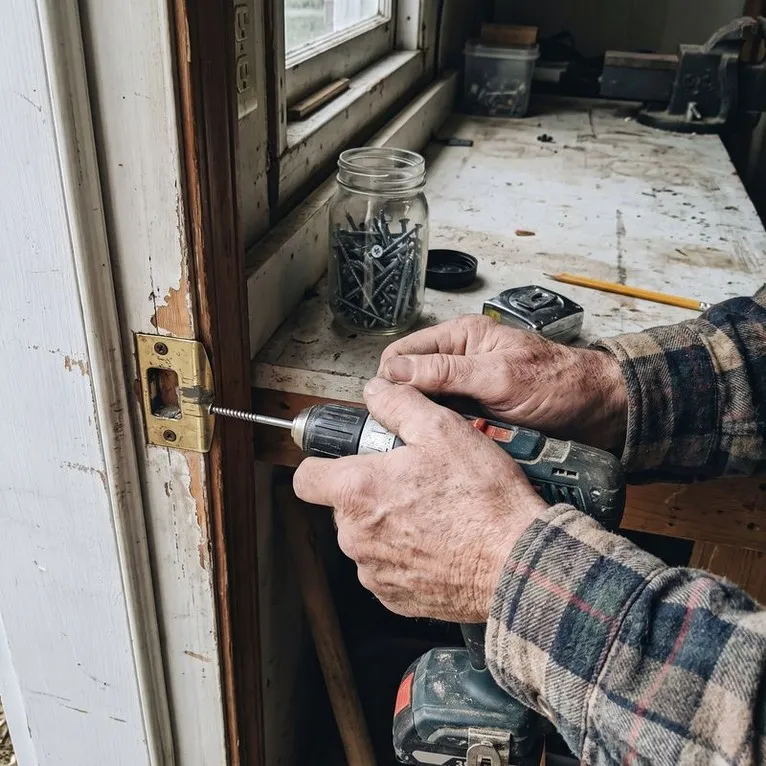
- Drive a 3-inch wood screw in its place, through the plate and the jamb into the stud behind. Seattle Police recommend 3 to 4 inch screws. Repeat for the other screw.
- Do the same on the knob latch strike plate.
- Put at least one long screw in each hinge, as the Seattle bulletin suggests, so the hinge side can't give way instead.
- Check that the door still closes and locks smoothly. If a long screw pulls the jamb and the door starts to stick, back it off a turn.
Seattle Police also suggest upgrading to a heavy-duty four-screw strike plate, sold at any hardware store, installed with the same long screws. Their bulletin says this one step will deter or prevent most forced entries through a door, and that even without a new plate, longer screws in the existing one vastly improve security.
The Handbook lists the tools for the whole project: a drill/driver, a screwdriver and a box of 3-inch wood screws.
Deadbolts with a 1-inch throw
The "throw" is how far the bolt sticks out into the frame when locked. Both the Handbook and the Seattle bulletin set the same minimum: 1 inch. A short bolt can slip out of the strike with a little flex in the door. Turn the key or thumb turn and measure; if it is shorter, replace the deadbolt.
The Handbook puts a deadbolt on every exterior door. Seattle Police add the door that leads from the garage into the house, which people often forget.
Choose a deadbolt with a thumb turn inside. A lock that needs a key from the inside can slow everyone down in a fire, and NFPA's escape planning guidance says doors on your escape routes should open easily. Seattle notes that its city code does not allow keyed-inside deadbolts in apartments and condos, so check your own local rules before you consider one.
Door reinforcement for the weakest door
Every house has one door that gets less attention. The Handbook names the usual suspect: the garage service door, often a hollow door in a light frame, on the side of the house nobody watches. That is where the project's door reinforcement kit or security bar goes.
- Reinforcement kits add metal plates around the jamb, the lock and the hinges, so a kick spreads across a large area instead of one strip of trim.
- A door security bar braces the door from inside against the floor. It works when you are home, and anyone inside can remove it fast.
- A latch guard covers the gap where the bolt meets the frame. Seattle Police recommend one against pry tools and note that they cost about $12 at major hardware stores.
For prices on the rest, the Handbook budgets about $150 for the full Project 66: deadbolts, strike plates, a reinforcement kit, motion lights and window pins. Seattle's bulletin puts a decent deadbolt at about $30.
Habits that matter as much as hardware
Step 5 of Project 66 is not hardware at all. It is three household habits: doors locked as a habit, a lit-house look on timers, and an agreement on answering the door, or not, during an event. Agree on that last one before an outage, so nobody has to decide at the door.
One more habit from the Seattle bulletin: don't hide a spare key near the front door, because burglars know all the hiding places. Leave it with a trusted neighbor instead, and don't keep house keys in the glove box of a car parked in the driveway.
The book is clear about what it leaves out. Household security in the Handbook is deterrence and delay, "a house that is annoying to enter," and nothing in the project involves weapons. The field note explains why: statistically, the burglar's tools are a door nobody locked and thirty seconds. Locks, screws and light defeat the actual threat; drama defeats only the budget.
A half-day plan for the whole house
| Job | Where |
|---|---|
| 3-inch screws in strike plates and hinges | Every exterior door |
| Check the deadbolt throw (1 inch) | Every exterior door, plus garage-to-house |
| Reinforcement kit or security bar | The weakest door |
| Bar, pins and anti-lift screws | Sliding glass doors |
| Motion lights | Doors, driveway, dark side of the house |
Sliders need their own approach, covered in how to secure a sliding glass door. Lighting is in solar motion sensor lights. Since you will be at the door with a drill anyway, see how to stop a draft under a door for winter. The best security of all is neighbors who notice, which a neighborhood emergency plan builds in one evening, and a home inventory covers the worst case.
Frequently asked questions
How do I reinforce a door so it can't be kicked in?
Replace the short screws in the strike plate with 3-inch screws that reach the stud, add a long screw to each hinge, and fit a deadbolt with at least a 1-inch throw. A heavy-duty strike plate or reinforcement kit adds more strength on the weakest door.
What size screws should go in a strike plate?
Seattle Police recommend 3 to 4 inch wood screws so they pass through the jamb into the wall stud. The Off-Grid Handbook uses 3-inch screws. Factory screws are often far shorter and hold only the thin trim.
How long should a deadbolt throw be?
At least 1 inch. That is the minimum in both The Off-Grid Handbook and Seattle Police guidance. A shorter bolt can slip out of the strike when the door flexes under force.
Do door security bars work?
A security bar braces the door from inside and adds resistance while you are home. Use it as an extra layer on top of long strike plate screws and a good deadbolt, and make sure everyone inside can remove it quickly in an emergency.
Sources
- The Off-Grid Handbook, Garrett Dalton, Project 66
- Seattle Police Crime Prevention Bulletin: Door Security (PDF)
- St. Louis Park Police: Home Security (PDF)
- Seattle Police Crime Prevention Bulletin: Deterring Burglary From Outside the Home (PDF)
- NFPA: How to Make a Home Fire Escape Plan
Safety guidance changes. Check the agency pages above for the current version, and follow your local code and manufacturer instructions.