Solar motion sensor lights outdoors: where to put them so they work when the grid doesn't
A light that snaps on when someone walks up is one of the cheapest deterrents there is. A solar one keeps doing it during an outage.
In this article
If you are comparing motion sensor lights outdoor solar models, the placement matters more than the brand. The Off-Grid Handbook puts them in three places: at the doors, along the driveway, and on the dark side of the house, and it picks solar-charged models because they keep working when the grid does not.
That is step 3 of Project 66, Security Basics: Locks, Light, Sightlines. The idea is deterrence: a house that is bright where someone doesn't want to be seen.
Why motion lights work as security
The Seattle Police Department's bulletin on deterring burglary from outside the home puts it simply: good lighting lets suspicious people near your home be seen, and criminals don't want to be seen or identified. A light that switches on suddenly also tells anyone nearby that the house is paying attention.
The Handbook budgets about half a day and roughly $150 for all of Project 66, which covers deadbolts, strike plates, a door reinforcement kit, window pins and the motion lights. Lights are the part most people can install in an hour with a drill and two screws per fixture.
Motion lights have one more advantage over lights left burning. Seattle Police point out that porch or garage lights left on all day are a giveaway that you are out of town. A motion light only reacts when something moves.
Where to put solar motion lights
Walk around the house after dark with a flashlight and look at it the way a stranger would. Then cover these spots:
- Every exterior door, including the back door and the garage service door.
- The driveway and the spot where you park. Seattle Police recommend a motion light there; suddenly being lit up may deter a car prowler.
- The dark side of the house, the side yard or back corner nobody can see from the street.
- Sliding glass doors and ground-floor windows that face the back yard.
The Seattle bulletin suggests motion lights for the rear and side yard and steady dusk-to-dawn lighting on the front of the property, bright enough to see about 100 feet. Many households use both: a steady light by the front door and motion lights everywhere else.
Choosing motion sensor lights outdoor solar models: what to check
The packages all promise a lot. These are the questions that matter:
| Check | Why it matters |
|---|---|
| Separate panel or all-in-one | A separate panel can sit in the sun while the light sits in the shade of an overhang |
| Replaceable battery | Rechargeable batteries wear out; a light with a sealed battery gets thrown away |
| Brightness and spread | A floodlight suits a driveway; a small wall light suits a door |
| Outdoor rating | The box should say it is made for outdoor, wet locations |
| Modes and timer | Motion-only mode saves the battery for when it counts |
Solar flood lights with a motion sensor make sense for the driveway and the dark side of the house. Smaller wall units are enough at doors. You don't need the most expensive light. You need it pointed at the right spot.
Mounting and aiming
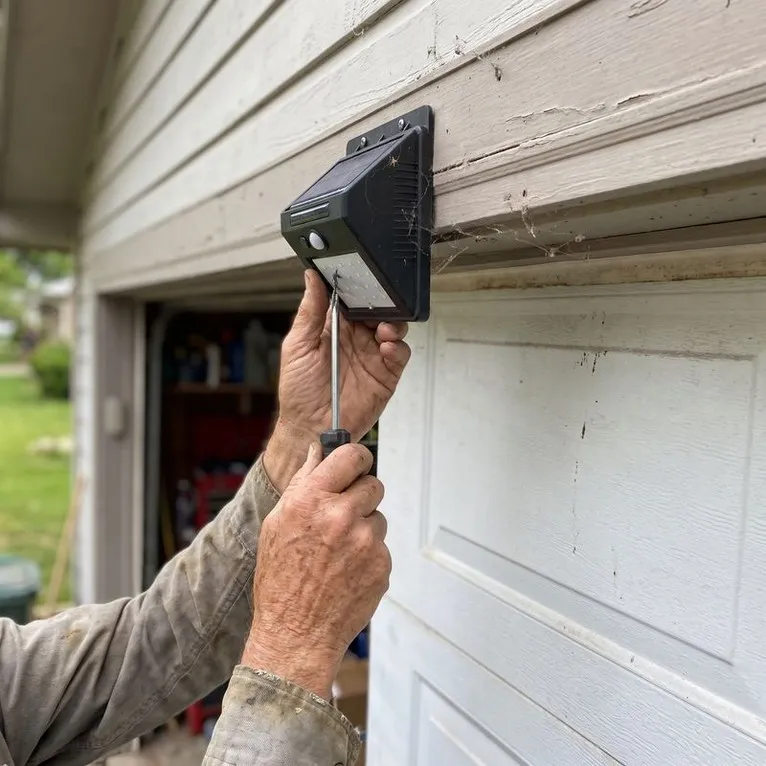
Most solar lights mount with two screws. The panel has to face open sky, so the best spot for the light and the best spot for the sun are not always the same. That is where a model with a separate panel on a cord helps.
- Hold the light in place before drilling and check where the panel will get the most direct sun through the day.
- Screw into solid wood or a proper anchor, not just the siding edge.
- Aim the sensor along the path someone would walk, not at the street, where every passing car sets it off.
- Test it that night. Walk the approach and adjust the angle until it catches you a few steps before the door.
Be a good neighbor while you aim. A floodlight that fires into the house next door every time a cat walks by will get switched off, by you or by them. Tilt it down toward your own path and driveway, and turn the sensitivity down if wind-blown branches keep setting it off.
Many mounting spots need a ladder. The Handbook is blunt about it: ladder work causes more household injuries than any project in the book. Use a stabilizer, keep three points of contact, and never work a roof edge alone or in wind. If a spot needs a tall ladder, pick a lower spot or get help.
Keeping solar lights working through winter and outages
Solar lights charge from daylight, so the short, cloudy days of winter are their hard season. A few habits keep them going:
- Brush off snow and leaves after storms. A covered panel doesn't charge.
- Wipe the panel with a soft cloth now and then. Dust and pollen cut the charge.
- Set them to motion-only in winter, so the battery isn't spent glowing all night.
- Check them on your seasonal walk-around, and replace batteries when the light starts fading early.
The payoff comes during an outage. Step 6 of Project 66 says the deterrent posture during outages is simply a normal, lit, occupied-looking home: light and routine signal presence, "and presence is the whole game." Solar motion lights are the part of that picture that needs no fuel and no generator.
Light is one layer of three
Project 66 pairs light with locks and sightlines. The book trims back shrubs that screen windows and doors from the street, and the Seattle bulletin uses a 3/6 rule: shrubs under 3 feet, tree limbs no lower than 6 feet. Indoors, the project uses lamps on timers for a lived-in look.
Inside the house during an outage, use flashlights and battery lanterns, not candles. NFPA warns that candles are a common cause of home fires. Our guide to power outage lighting covers indoor light, and a DIY solar charging station or a 12 V LED lighting system keeps it running.
For the doors themselves, read how to secure a door from being kicked in and how to secure a sliding glass door. And talk with the neighbors: a lit street where people know each other is the real deterrent, which is what a neighborhood emergency plan is for.
Frequently asked questions
Where should outdoor motion sensor lights be placed?
At every exterior door, along the driveway and parking spot, and on the dark side of the house that can't be seen from the street. Aim the sensor along the path someone would walk, not at the street.
Do solar motion sensor lights work in winter?
Yes, but they get less charge on short, cloudy days. Keep the panel clear of snow and dust, face it toward open sky, and use motion-only mode so the battery lasts through the night.
Do motion sensor lights deter burglars?
Police crime prevention guidance says good lighting is a deterrent because criminals don't want to be seen or identified. Seattle Police recommend motion lights for rear and side yards and parking areas, along with good locks and trimmed shrubs.
Are solar security lights good during a power outage?
Yes. Because they charge from sunlight and store power in their own battery, they keep working when the grid is down, which helps a home look normal and occupied during an outage.
Sources
- The Off-Grid Handbook, Garrett Dalton, Project 66
- Seattle Police Crime Prevention Bulletin: Deterring Burglary From Outside the Home (PDF)
- Seattle Police Crime Prevention Bulletin: Door Security (PDF)
- NFPA: Candle Safety
- Ready.gov: Power Outages
Safety guidance changes. Check the agency pages above for the current version, and follow your local code and manufacturer instructions.