What to plant in a survival garden: calories first, then storage
A survival garden is judged by one test: does it put food on the shelf for winter? That narrows the seed list to a handful of hardworking crops.
In this article
What to plant in a survival garden comes down to two questions: does the crop give real calories, and does it keep for months without a freezer? The crops that pass both are potatoes, dry beans, winter squash, carrots, beets and onions, with sweet potatoes in warm climates and a few hardy greens for vitamins. Salad crops are pleasant, but they will not carry a household through winter.
That list comes almost word for word from Project 40 of The Off-Grid Handbook, which builds one 4x8 raised bed in about three hours for around $70. The book's planting rule for it is short: plant to store, not to garnish.
Why calories and storage come first
An ordinary vegetable garden is planned around fresh eating: lettuce, cucumbers, tomatoes, herbs. A survival garden is planned around the pantry. The difference shows up in winter, when the fresh crops are long gone and the storage crops are still in the cellar or on the shelf.
The Handbook's field note on potatoes states the test plainly: a resilience crop should be a meaningful buffer, not a garnish. A head of lettuce is mostly water. A pound of potatoes, by the book's figure, carries roughly 350 to 500 calories and stores for months.
Plant what your household already eats. A survival garden full of crops nobody likes ends up on the compost pile, and the Handbook's pantry chapter makes the same point about stored food: build the menu from meals your family already enjoys. If nobody in the house eats beets, plant more carrots. If everyone loves baked potatoes, give them the extra bags. The goal is a shelf of food that gets eaten and replaced, not a museum of jars.
What to plant in a survival garden, at a glance
| Crop | What it gives you | How it keeps |
|---|---|---|
| Potatoes | The calorie anchor | Cured, then dark and cool for months |
| Dry beans | Protein and calories | Dried on the vine, stored in jars |
| Winter squash | Calories, vitamin A | Cured, then on a shelf at 50 to 55°F |
| Carrots and beets | Sugars, vitamins | In damp sand in a cold spot |
| Onions | Flavor for everything else | Cured, then cool and dry |
| Kale and collards | Vitamins and greens | Picked fresh into cold weather |
Before you buy seed, look up your zone on the USDA Plant Hardiness Zone Map and your frost dates through your county extension office. Clemson Cooperative Extension recommends choosing varieties adapted to your area and to how you plan to use them, whether fresh, canned or stored.
Potatoes: the calorie anchor
If a household grows only one food for resilience, the Handbook says it should be potatoes, the densest common calorie crop per square foot. Project 39 grows them in four to six 10 to 15 gallon fabric grow bags on a patio for about $40, and the book expects 5 to 10 pounds per bag.
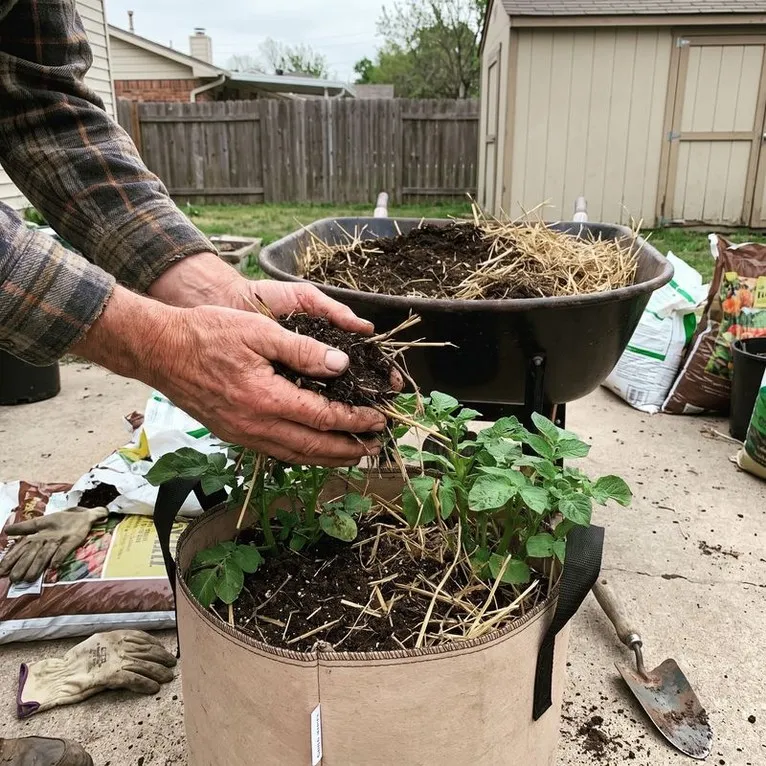
Use certified seed potatoes, not sprouted grocery potatoes. Plant three or four pieces per bag, hill with mix or straw as the plants grow, and water deeply and evenly. Harvest two weeks after the vines die back, then cure the potatoes for two weeks somewhere dark and ventilated before storage. Each step is in how to grow potatoes in containers and how to store potatoes.
Beans, squash and roots
Dry beans
Dry beans are the easiest protein to grow and store. University of Illinois Extension explains vine drying: leave the pods on the plant until they dry and shrivel, then harvest. Clemson Extension recommends pasteurizing vine-dried beans before storage to kill insect eggs, either 48 hours in a freezer at 0°F or below, or 30 minutes in a 160°F oven.
Winter squash
Squash sprawls, so let the vines run off the end of the bed or up a trellis. Cured squash keeps best in a dry spot around 50 to 55°F, warmer than a root cellar. The details are in how to store winter squash.
Carrots and beets
Both grow well in the loose soil of a raised bed. The Handbook stores them in damp sand in the coldest part of a cellar, as explained in how to store carrots in sand.
Greens for vitamins, onions for flavor
A diet of potatoes and beans gets monotonous fast, and onions are what make the rest edible. Grow them from sets along the edge of the bed. Hardy greens such as kale and collards keep producing as the weather cools, and Clemson notes that leafy crops tolerate partial shade, so they can take the less sunny end of the bed. A cold frame stretches that season further, as described in what to plant in a cold frame.
Survival garden layout: one bed plus bags
For a first season, the Handbook's two builds make a workable layout on almost any lot:
- The bed (Project 40): one 4x8 in 6 to 8 hours of sun, within hose reach of the rain barrel. Rows of carrots and beets in the middle, onions along one long edge, bush beans along the other, squash at the end where it can trail out.
- The bags (Project 39): four to six potato bags on the patio, where they are easy to water and to tip out at harvest.
- The log: the book's last step is to record planting dates in the binder, because the log becomes next year's calendar.
The book's field note sums up the growth plan: one bed teaches, three beds feed. Add a frame each season. Building it is covered in how to build a raised garden bed.
Seeds you can save, and food you can keep
A survival garden should be able to restart itself. Grow open-pollinated, or heirloom, varieties of beans and other easy crops so the seed you save grows true next year. Seed saving for beginners walks through the method.
Then plan where the harvest goes. Roots and potatoes go to cool, dark storage, surplus vegetables can be dried as in dehydrating food for beginners, and low-acid vegetables canned at home must go through a pressure canner using a tested USDA or NCHFP recipe, as the Handbook insists. That is the full loop: garden to jar to shelf to table.
Frequently asked questions
What are the best crops for a survival garden?
Crops that give calories and store for months: potatoes, dry beans, winter squash, carrots, beets and onions, plus sweet potatoes in warm climates. Add hardy greens such as kale and collards for vitamins. Salad crops are fine extras but do not fill a pantry.
What is the most calorie-dense crop to grow at home?
Potatoes are one of the best choices for small spaces. The Off-Grid Handbook calls them the densest common calorie crop per square foot, at roughly 350 to 500 calories per pound, and expects 5 to 10 pounds from each 10 to 15 gallon grow bag.
How big should a survival garden be?
Start with what you can keep weed-free: one 4x8 raised bed and four to six potato grow bags is a workable first season. Add one bed per season as your skills and time allow. A small, well-tended garden produces more than a large, neglected one.
How do you store dry beans from the garden?
Let the pods dry on the vine, shell the beans, and make sure they are fully dry. Clemson Extension recommends pasteurizing them by freezing at 0°F or below for 48 hours, or heating at 160°F for 30 minutes, then storing them in airtight jars.
Sources
- The Off-Grid Handbook, Garrett Dalton, Project 40
- Clemson Cooperative Extension HGIC: Planning a Garden
- Clemson Cooperative Extension HGIC: Drying Foods
- University of Illinois Extension: Drying Foods at Home
- USDA ARS: Plant Hardiness Zone Map
- NCHFP: Canning Vegetables
Safety guidance changes. Check the agency pages above for the current version, and follow your local code and manufacturer instructions.