How to store potatoes so they last for months: cure, then dark, cool and humid
A bag of potatoes can keep for months or sprout in weeks. The difference is light, temperature, humidity and what sits next to them.
In this article
How to store potatoes comes down to two steps: cure them first, then keep them in the dark at about 40°F with high humidity and a little air movement. Iowa State University Extension gives 40°F and 90 to 95% relative humidity for storage, and puts the average storage life of potatoes at 5 to 8 months. Keep them away from apples and other fruit, and out of the refrigerator.
Without a cellar, the best spot is the coolest dark place in the house, such as a closet or pantry, which is what the FDA recommends. The Off-Grid Handbook covers the long-term version: Project 39 grows and cures the crop, and Project 34 stores it in a vented corner of an unheated basement.
How to store potatoes: the five conditions
| Condition | Target | Why |
|---|---|---|
| Light | Darkness | Light turns potatoes green; the green pigment contains the toxic alkaloid solanine |
| Temperature | About 40°F | Colder turns them sugary; warmer makes them sprout |
| Humidity | 90 to 95% | Dry air shrivels them |
| Air | Crates or slatted shelves | Airflow keeps rot from spreading |
| Neighbors | No apples or other fruit | Ripening fruit gives off ethylene gas |
Extension sources land in a narrow band. Iowa State says 40°F, Nebraska Extension says about 40 to 45°F after curing, and the University of Alaska Fairbanks warns that potatoes stored above 40°F begin to sprout. Aim for the coolest spot you have that stays at or a little above 40°F.
Cure potatoes before you store them
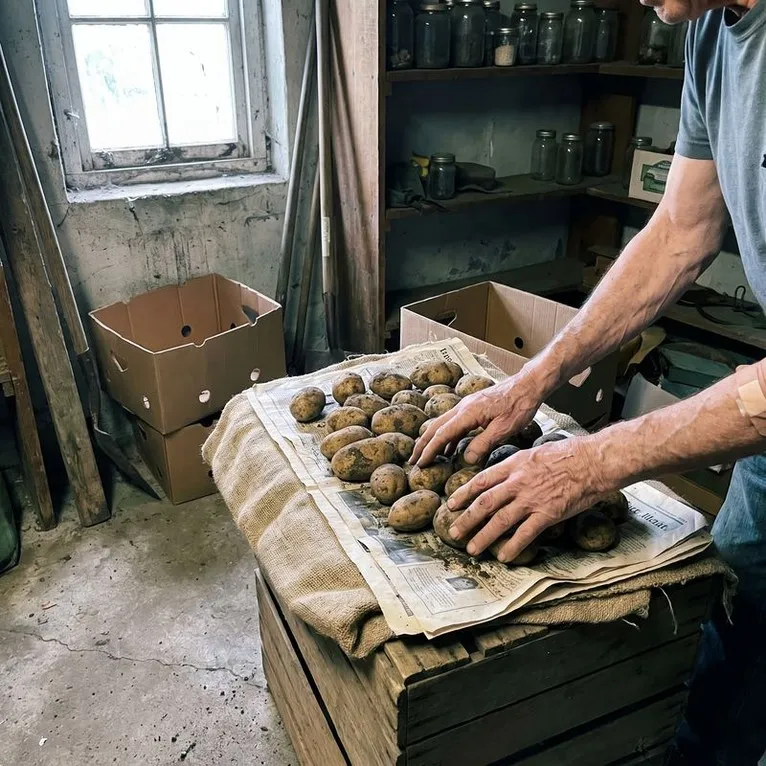
Fresh-dug potatoes have thin skins and small nicks. Curing heals the wounds and toughens the skin so the tubers lose less water and resist rot. Project 39 of the Handbook calls for two weeks in a dark, ventilated spot, then into the root cellar.
Extension figures vary a little. Iowa State cures at 50 to 60°F and 85 to 90% humidity for two weeks; Nebraska Extension holds late potatoes in moist air at 60 to 75°F for one to two weeks. A dark spare room or basement corner in early fall usually falls in that range.
Sort as you go. Utah State University Extension advises storing only the best produce and sending anything with blemishes straight to the kitchen. Cut, bruised or green potatoes will not keep, and one rotting tuber can spoil its neighbors.
If you grow your own, Project 39 gets 5 to 10 pounds per grow bag, per the book, and six bags make a real winter supply. Our guide to growing potatoes in containers covers the growing side.
How to store potatoes long term
For months of storage, you need a place that holds cold, damp and dark through the winter. That is the job of the root cellar in Project 34, a partitioned, vented corner of an unheated basement that takes a weekend and $150 to $300 in materials, per the book. Its loading rule is simple: potatoes dark, and never beside apples.
- Store them in wooden crates, ventilated boxes or open bins, a few layers deep rather than piled high.
- Keep crates on slatted shelves, off bare concrete and away from walls, as the book specifies.
- Put potatoes on the side of the cellar that holds closest to 40°F.
- Check every week or two and pull anything soft, sprouting or smelly.
Humidity is the part most people miss. A basement with a concrete floor is often too dry for potatoes, and the University of Alaska Fairbanks suggests setting several pans of water on the floor when the floor is concrete or wood; a dirt floor holds moisture best. A hygrometer next to the thermometer tells you whether it is working.
How much to keep depends on the household, but potatoes earn the space. USDA nutrient data puts raw potatoes at about 350 calories per pound, and the Handbook calls them the densest common calorie crop per square foot, which is why a few crates go a long way in a winter food plan.
One adjustment to the book: Project 34 aims the whole cellar at 32 to 40°F for roots. That suits carrots and beets, but potatoes belong at the top of that range. Iowa State notes that below 40°F potatoes develop a sugary, sweet taste. The root cellar temperature and humidity guide explains how to hold each zone, and how to build a root cellar covers construction.
Should potatoes go in the refrigerator?
No. A home refrigerator is set at or below 40°F and is dry inside. The FDA says storing potatoes in the refrigerator can result in increased acrylamide during cooking, and recommends storing them outside the refrigerator, preferably in a dark, cool place such as a closet or a pantry, to prevent sprouting.
Acrylamide is a chemical that forms in starchy foods during high-heat cooking such as frying and roasting. Cold storage converts some starch to sugar, which is why chilled potatoes taste sweet.
How to store potatoes for winter without a cellar
Most households do not have a root cellar, and a modest supply keeps well without one.
- A closet or pantry on an outside wall, away from the stove, the furnace and sunny windows.
- An unheated spare room or enclosed porch that stays cool but never freezes. Frozen potatoes turn soft and spoil.
- Paper bags or cardboard boxes with holes, not sealed plastic bags, which trap moisture.
- A buried barrel in the yard, for larger harvests; see the buried barrel root cellar.
Keep onions in a separate spot. Iowa State gives onions 32 to 40°F at only 65 to 70% humidity, far drier than potatoes want, so the two do better apart.
Green potatoes, sprouts and soft spots
Green skin means the potato saw light. Nebraska Extension notes that the green pigment contains solanine, a toxic alkaloid, so cut away green areas and sprouts before cooking, and throw out potatoes that are green throughout.
Sprouting is a sign of storage that is too warm, too bright or too close to fruit. Move the rest to a cooler, darker spot. Soft, wrinkled or rotting potatoes go to the compost.
A good store of potatoes pairs naturally with the rest of a home food supply. Our 30-day food supply list shows how fresh storage crops fit alongside shelf-stable food.
Frequently asked questions
Should potatoes be stored in the refrigerator?
No. The FDA recommends storing potatoes outside the refrigerator, in a dark, cool place such as a closet or pantry, because refrigerator storage can increase acrylamide during cooking. Cold temperatures below 40°F also turn some starch to sugar, so chilled potatoes taste sweet.
How long do potatoes last in storage?
Iowa State University Extension puts the average storage life at 5 to 8 months for cured potatoes kept at 40°F and 90 to 95% humidity in the dark. In a closet or pantry, which is warmer and drier, expect weeks to a few months. Check them every week or two and remove any that are soft or sprouting.
Can you store potatoes and onions together?
It is better not to. Potatoes want high humidity, around 90 to 95%, while Iowa State gives onions 32 to 40°F at only 65 to 70% humidity. Stored side by side, one of them is in the wrong conditions. Keep potatoes in a dark, damp spot and onions in a cooler, drier, well-ventilated one, and keep both away from apples.
Why are my stored potatoes sprouting?
Usually because they are too warm, exposed to light or stored near fruit. The University of Alaska Fairbanks says potatoes begin to sprout when stored above 40°F, and ripening apples give off ethylene gas. Move them somewhere darker and closer to 40°F, away from fruit, and remove sprouts before cooking.
Sources
- The Off-Grid Handbook, Garrett Dalton, Project 34
- Iowa State University Extension: Storing Winter Storage Vegetables
- Nebraska Extension: Storing Fruits and Vegetables From the Home Garden (G1264)
- FDA: Acrylamide and Diet, Food Storage, and Food Preparation
- University of Alaska Fairbanks Cooperative Extension: Vegetable Storage in Root Cellars
- Utah State University Extension: Harvest and Storage of Vegetables and Fruits
- USDA FoodData Central: Potatoes, flesh and skin, raw
Safety guidance changes. Check the agency pages above for the current version, and follow your local code and manufacturer instructions.