Backyard homestead: a layout that fits an ordinary lot
A suburban yard can grow a real share of a household's food. The trick is placing each piece where you will actually tend it.
In this article
- What a backyard homestead can realistically do
- Backyard homestead layout: place things by how often you visit
- The patio: potatoes in grow bags
- The bed: one 4x8 in full sun
- The downspout: a rain barrel for the garden
- Compost: the bed's free refill
- Suburban homestead rules: check before you build
- Frequently asked questions
A backyard homestead fits on an ordinary suburban lot when each piece goes where it is easy to tend: potato grow bags on the patio, one raised bed in the sunniest spot, a rain barrel at the nearest downspout and a compost bin in between. By the book's figures, those three builds come to under $200 in materials, and they can feed a household a meaningful share of its vegetables.
The Off-Grid Handbook builds its food system from exactly these pieces. Project 39 puts potatoes in fabric bags on a patio or a strip of yard for about $40, Project 40 builds one 4x8 raised bed for about $70, and Project 1 hangs a rain barrel off a downspout for about $60, per the book.
What a backyard homestead can realistically do
A small lot will not make a household self-sufficient, and it does not need to. What it can do is grow calories and storage crops, save money on produce, and keep a pantry stocked through the year. The Handbook's yield figure for potatoes gives a sense of scale: 5 to 10 pounds per grow bag, so six bags is a real buffer, not a garnish.
If you are starting from zero, our guide to homesteading for beginners covers the order to do things in. This guide is about where to put them.
Backyard homestead layout: place things by how often you visit
Clemson Cooperative Extension notes that people are more likely to work in a garden, and check it for pests, when it is close to the house, and that a garden needs to be close to a good water supply. That gives a simple layout rule: what needs daily attention goes nearest the back door.
| Zone | What goes there | Why |
|---|---|---|
| Patio or steps | Potato grow bags, herbs in pots | Containers dry fast and need water often |
| Sunniest open spot | One 4x8 raised bed | Needs 6 to 8 hours of sun and hose reach |
| Nearest downspout | Rain barrel on two blocks | Feeds the bed and bags by watering can or hose |
| Back corner, partial shade | Compost bin | Visited weekly, not daily |
Walk the yard at a few times of day before you build anything. Note where the sun falls in the morning and the afternoon, and where the shade of the house, trees and fence lands. Clemson points out that leafy crops tolerate partial shade, while fruiting vegetables such as tomatoes and peppers need full sun.
The patio: potatoes in grow bags
The Handbook's first food build is not a garden bed at all. Project 39 uses four to six 10 to 15 gallon fabric grow bags, certified seed potatoes and compost-rich potting mix. The book explains why potatoes come first: they are the densest common calorie crop per square foot, and at roughly 350 to 500 calories per pound they store for months.
Bags suit a suburban homestead because they sit on concrete, move with the sun and tip straight into a wheelbarrow at harvest, with no digging. The catch is water: the book warns that containers dry fast and irregular watering splits the tubers. Keep them close to the hose or the barrel. The full method is in how to grow potatoes in containers.
The bed: one 4x8 in full sun
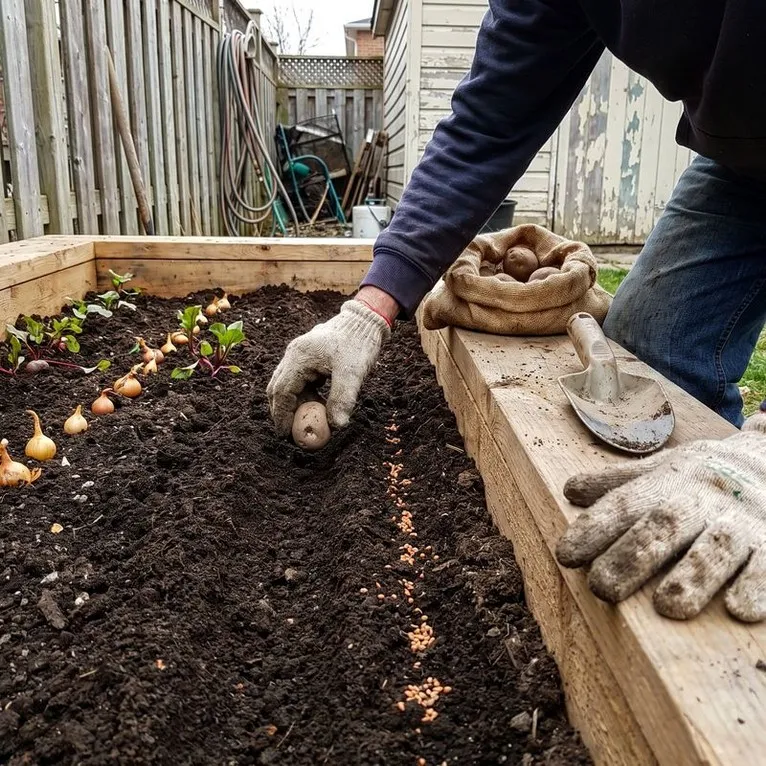
Project 40 calls one raised bed the production floor of the food system. The book's build takes about three hours: frame a 4x8 in untreated cedar or fir, lay cardboard over the grass, and fill to within 2 inches of the rim with roughly half topsoil and half compost. Plant to store: potatoes, carrots, beets, onions, winter squash and dry beans.
A raised bed also helps with one suburban problem. Older neighborhoods can have lead in the soil from old paint and past traffic. EPA advises getting your soil tested, siting gardens away from old painted buildings and busy roads, and says one of the best ways to reduce exposure is a raised bed filled with clean soil. Wash produce and peel root crops. Building details are in how to build a raised garden bed.
The downspout: a rain barrel for the garden
Project 1 is the foundation of the book's water system: one downspout, one food-grade barrel, one spigot, set on two concrete blocks so it can fill a watering can. The book's field note says the most common first-build mistake is leaving the barrel on the ground.
Two cautions. A barrel fills fast in a real storm, so plan the overflow from day one. And roof water is for the garden, not for drinking, unless it has been properly filtered and disinfected, which is the position of both the book and CDC. The setup is in how to set up a rain barrel, and watering vegetables with it is covered in rain barrel water for a vegetable garden.
Compost: the bed's free refill
Each spring a raised bed settles and needs topping up. A compost bin turns yard and kitchen scraps into that refill. EPA describes three ingredients in balance: carbon-rich browns such as dry leaves, nitrogen-rich greens such as vegetable scraps and grass clippings, and water.
EPA also lists what to keep out of a backyard pile: meat, fish and bones, dairy, fats and oils, and pet waste. The first three attract animals, and backyard piles generally do not get hot enough to break them down fully, which matters next to a neighbor's fence.
Suburban homestead rules: check before you build
A suburban homestead lives next to neighbors, so a few checks save trouble later:
- Homeowners association rules may cover rain barrels, raised beds in front yards, compost bins and structures.
- City or county ordinances set rules for backyard poultry, if you allow it at all, and for structures such as a raised water tank.
- Rainwater rules vary by state. Check yours before installing a large system.
- Poultry health: CDC advises keeping birds out of the house, washing hands after handling them, and not letting children under 5 handle chicks.
Start with the bags and the barrel this season, add the bed next spring, and log what you plant. The Handbook's own advice is to add one bed per season so the cost never arrives as a single number. More projects are collected in our readiness guides.
Frequently asked questions
How do you lay out a backyard homestead?
Put what needs daily care closest to the house: potato grow bags and herbs on the patio, then one raised bed in the spot with 6 to 8 hours of sun and hose reach, a rain barrel at the nearest downspout, and a compost bin in a back corner you visit weekly.
How much food can a backyard homestead produce?
It depends on space and climate, but even a small setup is meaningful. The Off-Grid Handbook puts potato yields at 5 to 10 pounds per grow bag, so six bags plus one raised bed of storage crops gives a real buffer for the pantry.
Is it safe to grow vegetables in suburban soil?
Usually, but older neighborhoods can have lead in the soil. EPA recommends a soil test, siting gardens away from old painted buildings and busy roads, and using raised beds filled with clean soil. Wash produce and peel root crops.
Do I need permission for a backyard homestead?
Gardens rarely need permission, but homeowners association rules and local ordinances can cover rain barrels, structures, front-yard beds and poultry. Check both before building, and check your state's rules before installing a large rainwater system.
Sources
- The Off-Grid Handbook, Garrett Dalton, Project 39
- Clemson Cooperative Extension HGIC: Planning a Garden
- EPA: Healthy Gardening Practices to Reduce Exposure to Lead-Contaminated Soil
- EPA: Composting At Home
- CDC: Backyard Poultry
- CDC: Collecting Rainwater and Your Health
Safety guidance changes. Check the agency pages above for the current version, and follow your local code and manufacturer instructions.