How to board up windows for a hurricane, done in July instead of the night before
Plywood costs the same in July as it does two days before a named storm. Only one of those weeks still has any on the shelf.
In this article
- What plywood to use for hurricane window covers
- How to attach plywood to windows: three methods compared
- How to build a storm board-up kit
- Does taping windows help in a hurricane?
- Which windows to board up first
- The patch kit for after the storm
- When to board up, and staying safe while you do
- Frequently asked questions
To board up windows for a hurricane, use 5/8-inch exterior-grade or marine plywood, cut to fit each window and ready to install, which is the National Weather Service's own recommendation. Cut and label the panels before hurricane season, pre-drill the mounting holes, and store the hardware with them. On storm day the job then takes under an hour instead of a weekend.
Project 58 of The Off-Grid Handbook builds exactly this: a pre-cut, pre-labeled board-up kit, about two hours of work and $50 in hardware, per the book, plus the plywood.
What plywood to use for hurricane window covers
NWS calls for 5/8-inch exterior-grade or marine plywood. NOAA's Hurricane Research Division gives 5/8 or 3/4 inch for its tested shutter design. Thinner sheathing and particle board are not substitutes.
Permanent storm shutters offer the best protection, NWS notes. Plywood is the option for homeowners who don't have them, and it works well when the panels are fitted and fastened properly.
How to attach plywood to windows: three methods compared
How the board is fastened matters as much as the board. NOAA's hurricane researchers compared the common methods after major storms.
| Method | How it works | How it holds up |
|---|---|---|
| Inset with barrel bolts | Panel cut to fit inside the window recess, locked with heavy barrel bolts into the sill and sides | The best homemade method; NOAA reports it performed extremely well in Hurricane Andrew. Needs a recess of at least 2 inches. |
| Overlap with screws and anchors | Panel larger than the opening, screwed through into anchors in the wall | Better than nails, but many failed in the most intense hurricanes |
| Overlap with concrete nails | Panel nailed over the opening at the last minute | The least effective; boards rip off and become flying debris |
The inset design wins because the wind can't get under the edge of a recessed panel, and the bolts are loaded across their length instead of being pulled straight out. If your windows sit flush with the wall, use the overlap method with pre-drilled anchors (the book specifies lag screws and pre-drilled anchors for masonry), and fasten well into solid framing.
How to build a storm board-up kit
- Measure every window now, in calm weather. Measure each side and corner angle, since many frames are not square.
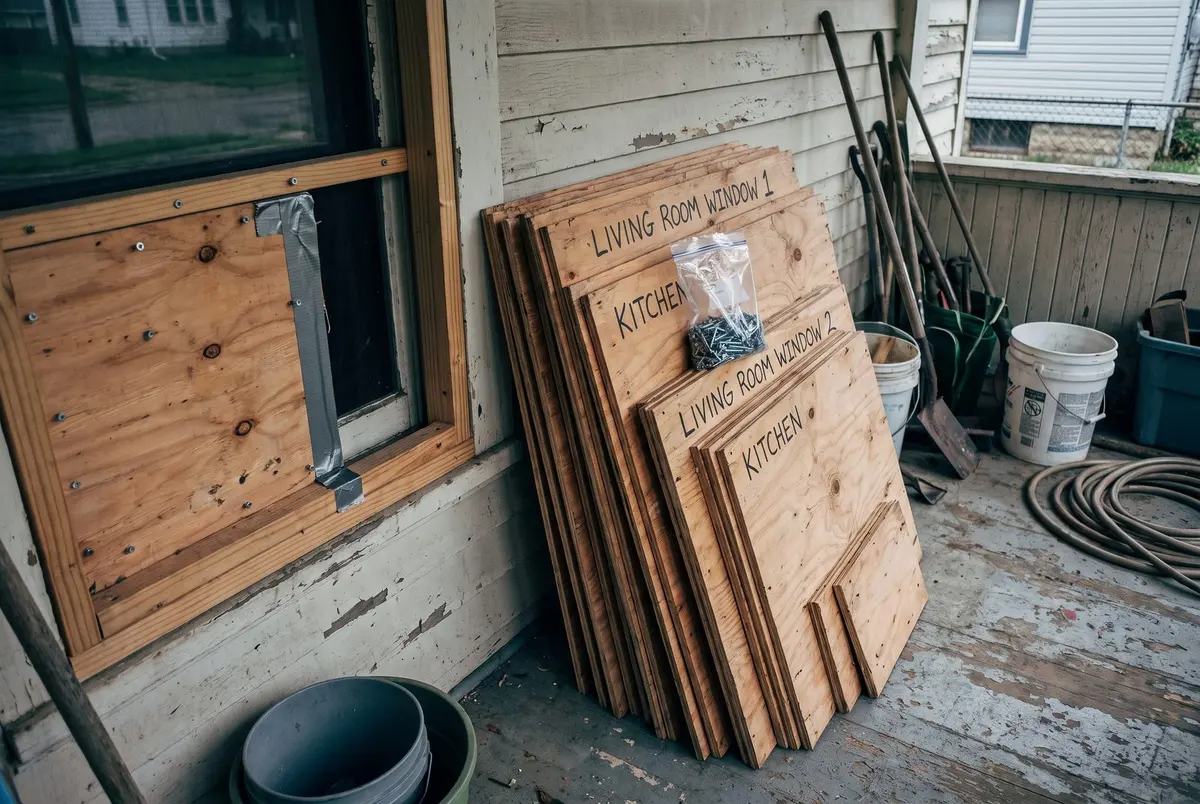
- Cut a panel for each exposed window and test the fit. Mark which edge is the top and which face goes out.
- Label each panel with the window it covers: "Kitchen," "Living room 2."
- Fit the hardware. For inset panels, NOAA recommends 3- or 4-inch heavy-duty barrel bolts: four for a small or medium window, and about one every 2 feet on larger ones.
- Drill the matching holes in the window recess, or set the anchors in the wall for overlap panels, so storm day involves no layout.
- Seal the panels with paint or varnish to keep them from warping in storage.
- Store them flat and dry, with the hardware bagged and taped to panel one.
- Practice one window once, and write the time in your household binder. The book's standard is the whole kit deployed in under an hour.
Large openings such as sliding glass doors can be covered with several panels joined with 2x4s, or hinged so they fold for storage, NOAA notes.
Does taping windows help in a hurricane?
No. NOAA's Hurricane Research Division calls tape the most worthless type of protection: it does little or nothing to prevent breakage, can produce larger and more dangerous pieces of flying glass, and is very hard to remove after the storm. Skip it, and spend the time on plywood.
Which windows to board up first
The book's kit starts with the exposed windows: the ones facing the open water, the open field or the prevailing storm winds, and the large panes that would let the most wind and rain in if they broke. Glass doors belong on the same list.
NOAA's researchers add a reminder that applies to every house: no shutter can make up for an unprotected garage door or large loose objects in the yard. Bring in outdoor furniture, and check whether your garage door is rated for high winds or needs bracing.
If plywood for every window is not in the budget yet, cut panels in order of exposure and add a few each season. Write the list, with each window's measurements, in your binder so the next panel takes ten minutes to order.
The patch kit for after the storm
The second half of the book's kit is for the after phase: a heavy tarp, wood battens, spring clamps, and duct tape. A breached window or a torn roof section can be closed against rain in minutes with a tarp held by battens screwed to the framing.
Keep the patch kit with the panels. After a storm, hardware stores are often closed or empty, and the next rain rarely waits.
When to board up, and staying safe while you do
NWS advises gathering supplies before hurricane season begins. Install the panels while the weather is still calm; once winds pick up, a sheet of plywood on a ladder becomes a sail. Have a second person steady the ladder and hand up each panel.
- Follow evacuation orders. Plywood protects the house, not the people in a storm surge zone.
- During the storm, stay away from windows and glass doors, in a small interior room on the lowest floor that is above flood risk.
- Keep at least one door you can open from inside as a way out.
- Run any generator outdoors, at least 20 feet from the house, never in the garage (see why the garage is never safe).
The board-up kit is one line of a wider plan. Pack the 72-hour kit, put the plan and the window list in your emergency binder, and review what to do when the power goes out, because after a hurricane it usually does.
Frequently asked questions
What thickness plywood do you need to board up windows for a hurricane?
Use 5/8-inch exterior-grade or marine plywood, as the National Weather Service recommends. NOAA's Hurricane Research Division uses 5/8 or 3/4 inch in its tested shutter design. Cut each panel to fit its window ahead of time, label it, and keep the mounting hardware with it so installation is quick before the storm arrives.
Should you tape windows for a hurricane?
No. NOAA's Hurricane Research Division says tape does little or nothing to prevent breakage, may result in larger and more dangerous pieces of flying glass, and is very difficult to remove after the storm. Protect the glass with fitted plywood panels or permanent storm shutters, and stay away from windows while the storm passes.
Is it better to nail or screw plywood over windows?
Neither nails nor screws alone are ideal. NOAA found boards nailed over the opening with concrete nails are the least effective and often rip off. Screws into wall anchors are better, but the strongest homemade method fits the panel inside the window recess and locks it with heavy barrel bolts into the sill and sides.
When should you board up windows before a hurricane?
Cut and fit the panels before hurricane season, then install them while the weather is still calm, well before winds arrive. Plywood and hardware sell out in the days before a named storm, and working on a ladder in gusts is dangerous. A practiced kit should go up in under an hour.
Sources
- The Off-Grid Handbook, Garrett Dalton, Project 58
- National Weather Service: Hurricane Safety, Take Action
- NOAA Hurricane Research Division: A Short Lesson in Building Effective Shutters (PDF)
- Ready.gov: Hurricanes
Safety guidance changes. Check the agency pages above for the current version, and follow your local code and manufacturer instructions.