Hurricane shutters vs plywood: cost, effort and protection compared
The best window protection is the kind that actually goes up before the storm. For some homes that is a shutter, for others a stack of labeled plywood.
In this article
In the hurricane shutters vs plywood question, the National Weather Service is clear: permanent storm shutters offer the best protection for windows, and 5/8-inch exterior-grade or marine plywood, cut to fit and ready to install, is the second option. Plywood costs the least but must be lifted, fastened and removed for every storm. Shutters cost more but are tested products that close quickly. The right choice depends on your budget, how many windows you have, and who will put the protection up.
Here is how the options compare, and what each one asks of you.
Hurricane shutters vs plywood at a glance
FEMA's coastal construction guidance sorts window protection into temporary and permanent options:
| Option | Relative cost (FEMA) | Advantages | Drawbacks |
|---|---|---|---|
| Temporary plywood panels | Low | Inexpensive; you can make them yourself | Installed and taken down every time; must be well anchored to prevent blow-off |
| Temporary manufactured panels (steel, aluminum) | Low to medium | Easily installed on lower floors | Still installed and removed every time |
| Permanent manual shutters (accordion, Bahama, colonial) | Medium to high | Always in place, ready to close | Closed by hand, usually from outside |
| Permanent motor-driven roll-down shutters | High | Opened and closed from inside | Highest cost; needs power or a manual override |
Impact-resistant windows are a separate path, covered below.
Why window protection matters so much
FEMA explains that windows and doors are a home's most vulnerable points in a hurricane. Once one breaks, wind rushing in can cause a dramatic change in pressure inside the house, and the roof becomes more likely to blow off. Protection is about the whole house, not just the glass.
Tape is not protection. NOAA's hurricane researchers say taping windows does little or nothing to prevent breakage and can create larger, more dangerous pieces of flying glass.
Plywood for hurricane windows: what it takes
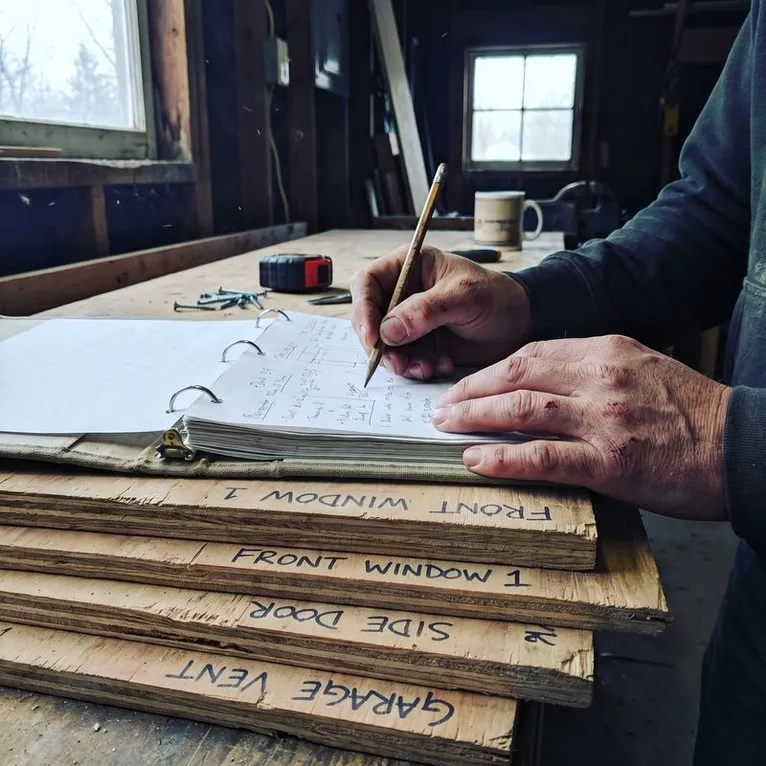
FEMA says you can make storm shutters from 5/8-inch thick exterior-grade plywood. Plywood works when it is prepared before the season, not bought the day before landfall. Project 58 of The Off-Grid Handbook turns it into a kit:
- Panels pre-cut to each exposed window, labeled to that window, with matched holes pre-drilled.
- Barrel bolts or plywood clips chosen for your window type, and lag screws with pre-drilled anchors for masonry walls.
- Panels stored flat and dry, hardware bagged and taped to panel one.
- One window practiced once, so storm day is not the first try. The book's standard is the whole kit up in under an hour.
The book prices the hardware at about $50, plus the plywood, and the job at two hours. Fastening details, including NOAA's tested inset method with barrel bolts, are in our guide to how to board up windows for a hurricane.
The honest drawback is the lifting. A full sheet of 5/8-inch plywood is heavy and awkward, and every panel has to go up in the hours before a storm, often in rising wind. If nobody in the household can safely handle panels, especially above the first floor, that settles the question.
Types of hurricane shutters
FEMA notes that manufactured shutters come in wood, steel and aluminum. The common styles:
- Storm panels: corrugated steel, aluminum or clear polycarbonate panels that slide into tracks or bolt onto studs around the window. They are the cheapest manufactured option, but still go up storm by storm.
- Accordion shutters: folding panels that stay beside the window and slide closed along a track.
- Roll-down shutters: a box above the window holds slats that roll down by crank or motor.
- Bahama and colonial shutters: hinged, decorative shutters that close and lock over the window.
FEMA's mitigation guidance adds two rules. Shutters must be securely connected to the wall framing, and you should install only shutters with a label showing they have been tested and are building code compliant. Many areas require a permit for permanent shutters, so ask your local building department before you buy.
Impact-resistant windows
FEMA describes laminated glazing as two or more glass panes bonded with a plastic interlayer. Debris may crack the glass, but the interlayer holds and keeps wind and rain out. The advantage is that nothing has to be put up: protection is in place at 3 a.m., when nobody is home, or when the person who usually hangs the plywood is out of town. Replacement windows are a contractor job and the most expensive route, so many households phase them in, starting with the most exposed side of the house.
Large glass doors deserve the same thought. A sliding door is often the biggest pane in the house, and plywood for it means several joined panels. Tested shutters or impact-rated glass are usually the more practical choice there. Our guide to how to secure a sliding glass door covers the everyday side of the same door.
DIY hurricane shutters: what you can do yourself
Plywood panels for ground-floor windows are a reasonable home project with a circular saw and drill, which is exactly what the Handbook's kit uses. FEMA's guidance points to the APA hurricane shutter design guide for building and installing wood panel shutters, and it stresses anchoring them well so they don't become windborne debris themselves.
Leave these to professionals:
- Anything that requires working from a ladder above the first floor. The Handbook's ladder rule is a stabilizer, three points of contact, and never working a roof edge alone or in wind.
- Permanent shutter systems and impact windows, which need correct anchors and often a permit.
- Garage door bracing. FEMA says a trained door systems technician should decide whether a garage door needs reinforcing.
How to choose
- Who will install it? If the answer is "one person over 60, alone," lean toward permanent shutters, at least on the hardest windows.
- How exposed is the house? Windows facing open water or the prevailing storm winds come first.
- What is the budget this year? Plywood now, upgraded over time, beats a perfect plan you can't afford yet.
- What does your insurer offer? Some states require wind mitigation discounts for verified opening protection. Ask your agent before choosing.
Mixing is normal: shutters on the big windows and glass doors, plywood on the rest. Whatever you choose, keep a tarp and battens for the after phase, as in how to cover a broken window, and fold the work into your hurricane preparedness checklist. When the storm has passed, photograph any damage before repairs, as FEMA advises, and work through what to do after a hurricane.
Frequently asked questions
Are hurricane shutters better than plywood?
Yes, for protection and speed. The National Weather Service says permanent storm shutters offer the best protection. Plywood, 5/8-inch exterior grade cut to fit, is the second option: it costs much less but must be installed, anchored and removed for every storm.
What thickness plywood is best for hurricane windows?
FEMA and the National Weather Service call for 5/8-inch exterior-grade plywood, and NWS also accepts marine plywood. Cut each panel to fit its window before the season, label it, pre-drill the holes and keep the hardware with it.
Can you make DIY hurricane shutters?
Yes, for ground-floor windows. Plywood panels cut and labeled ahead of time are a reasonable home project with a saw and drill. Anchor them well so they don't blow off. Upper-floor work, permanent shutters and garage door bracing are jobs for professionals.
Do hurricane shutters lower insurance premiums?
In some states, insurers must offer windstorm discounts for verified opening protection such as tested shutters or impact windows. The rules vary by state and insurer, so ask your agent which products and inspections qualify before you buy.
Sources
- The Off-Grid Handbook, Garrett Dalton, Project 58
- National Weather Service: Hurricane Safety, Take Action
- FEMA: Avoiding Hurricane Damage, A Checklist for Homeowners (PDF)
- FEMA P-2181 Fact Sheet 3.2: Wall Systems and Openings (PDF)
- FEMA Home Builder's Guide to Coastal Construction: Shutter Alternatives (PDF)
- FEMA: Protecting Doors and Windows During a Typhoon
- NOAA Hurricane Research Division: A Short Lesson in Building Effective Shutters (PDF)
Safety guidance changes. Check the agency pages above for the current version, and follow your local code and manufacturer instructions.