At what temperature do pipes freeze? The 20°F rule and what to do before it
Water freezes at 32°F, but the number that matters for plumbing is lower, and it depends on where the pipe runs.
In this article
At what temperature do pipes freeze? Water freezes at 32°F, but house pipes usually aren't in danger until the outdoor temperature falls to about 20°F or below. That threshold comes from field research on home plumbing cited by Texas A&M AgriLife Extension and the Institute for Business and Home Safety (IBHS). Unprotected pipes in attics, crawl spaces, garages and outside walls are at risk first, and wind or a cold draft can freeze them sooner.
So the useful question is not just how cold it gets, but where your pipes run and how much heat reaches them. Here is how to tell which ones are at risk and what to do before the temperature drops.
At what temperature do pipes freeze?
The 20°F figure is a temperature alert threshold, not a guarantee. It describes when freezing tends to start in pipes that have little protection, such as uninsulated lines in an unheated attic. Texas A&M AgriLife Extension puts it this way: pipes have the potential to freeze and burst when the outside temperature reaches 20°F or below.
Three things change the number for your house:
- Location. A pipe inside a heated wall is far safer than one in a crawl space.
- Insulation. Foam sleeves slow heat loss, but they only slow it. They don't add heat.
- Air movement. Cold air blowing on a pipe through a crack or vent pulls heat out much faster than still air.
Homes in the South are often more exposed than homes up north, because pipes there are more likely to run through uninsulated attics and crawl spaces. That is why a hard freeze in a warm state does so much damage; our guide to Texas winter storm preparedness covers that case.
Which pipes freeze first
The extension service lists the pipes most at risk:
- Outdoor hose bibs, swimming pool supply lines and sprinkler lines.
- Water pipes in basements, crawl spaces, attics and garages.
- Pipes that run along outside walls with little or no insulation.
- Supply lines under kitchen and bathroom sinks on outside walls.
Hot water lines can freeze too, if water isn't moving through them. The Off-Grid Handbook adds a useful habit in Project 59: log your house's cold spots, the pipe that always chills first, and treat it as an early-warning sensor. If that pipe is cold to the touch, the others are next.
How long can a house go without heat before pipes freeze?
There is no reliable countdown. A well-insulated house with interior plumbing can hold its warmth for a long time, while an older house with pipes in a crawl space can freeze overnight in a hard cold snap. Wind, sunshine, how cold it gets and how long it stays there all matter.
Plan by the forecast instead of the clock. If the power is out and temperatures are heading toward 20°F, start protecting the plumbing right away instead of waiting to see what happens. If the house will stay unheated for days, drain the system before it freezes, as described below and in our guide to keeping pipes from freezing when the power is out.
Will pipes freeze if the heat is off?
They can, especially the ones in unheated spaces. Pipes inside heated rooms are generally safe as long as the indoor air stays well above freezing, but a house with the heat off loses warmth steadily, and the outer walls and crawl space go first.
If you are leaving home in cold weather and the heat works, the Red Cross advice repeated by Texas A&M is to leave the heat on, set no lower than 55°F, with the cabinet doors open under sinks. Keep the thermostat at the same setting day and night during a cold snap rather than letting it drop overnight.
What to do when temperatures drop toward 20°F
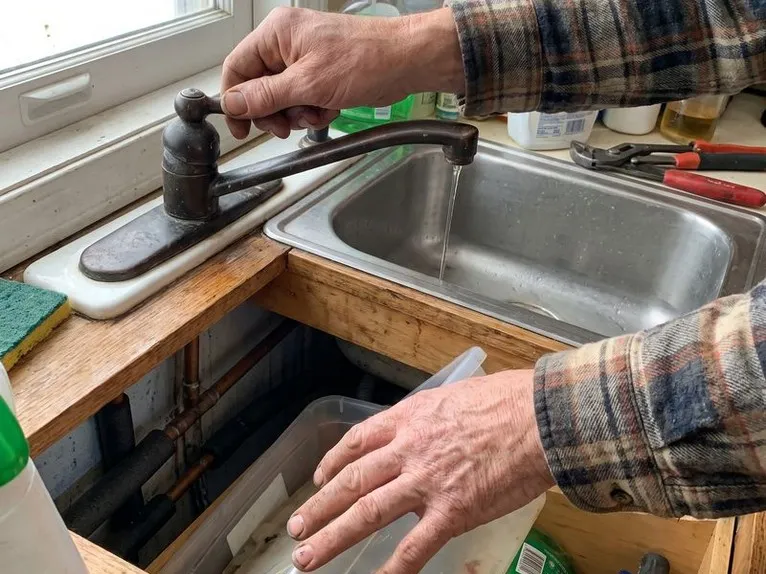
- Drip the far faucets. The Handbook's cold-snap routine is a pencil-thin drip at the farthest faucets, because moving water resists freezing. On a private well with no power, dripping only drains the pressure tank, so skip it.
- Open the cabinet doors under sinks on outside walls so room air reaches the pipes. Move cleaners out of children's reach.
- Keep the garage door closed if water lines run through the garage.
- Stop drafts near pipes. Our guide to finding air leaks in your house shows where they hide.
- If the power is out, set up your heated room next to a plumbing wall if you can, as in how to stay warm without power.
Never warm pipes with an open flame, and never bring a generator or fuel-burning heater into a garage, basement or crawl space to do it.
Protect your pipes before winter
Project 59 of the Handbook, "Pipe Freeze Protection," takes about two hours and roughly $30 per the book:
- Sleeve every exposed run in foam, with the elbows mitered, seams taped and no gaps.
- Find and exercise the main water shutoff, and tag it. The book calls this thirty-second rehearsal the single highest-leverage step in the project.
- Cover outdoor faucets, drain and store hoses, and close the indoor valves feeding hose bibs.
- Drain sprinkler and pool lines per the installer's directions. Texas A&M says not to put antifreeze in them.
UL-listed heat tape or heat cable helps on problem runs, but it stops working when the power does. If you collect rainwater, winterize that too, using our rain barrel winterizing guide.
If the house will stay cold for days
The book's step for an extended outage: shut the main, open the taps and drain the system down, and give the water heater and drain traps the full winterization treatment. Fill containers and the tub first, since you'll need that water; our guide to water during a power outage covers how much.
If a pipe freezes
A trickle from an open faucet usually means ice in the line. Keep that faucet open. Know where your main shutoff is, because a frozen pipe may already be cracked and will leak once it thaws.
Texas A&M lists safe heat sources: a heating pad, a hair dryer, a portable space heater kept away from water, or towels soaked in hot water. With the power out, hot towels are the option that works. Never use a blowtorch, kerosene or propane heater, charcoal stove or other open flame. Call a licensed plumber if you can't find or reach the frozen section, then check the other faucets, because if one pipe froze, others may have too.
Frequently asked questions
At what outside temperature do pipes freeze?
Unprotected pipes are at risk once the outdoor temperature falls to about 20°F or below, according to research cited by Texas A&M AgriLife Extension and IBHS. Pipes in attics, crawl spaces, garages and outside walls freeze first, and wind or drafts can freeze them at milder temperatures.
Will pipes freeze at 32 degrees?
Water freezes at 32°F, but pipes inside a home usually don't freeze the moment it hits 32 outside, because the house holds some heat. The common alert threshold is about 20°F. Pipes that are exposed, like hose bibs or lines in a drafty crawl space, can freeze sooner.
How long can a house go without heat before pipes freeze?
There is no fixed number of hours. It depends on how cold it is outside, wind, insulation and where the pipes run. A tight house with interior plumbing can last a long time, while exposed pipes can freeze overnight. If temperatures head toward 20°F with no heat, drip faucets and open cabinets right away.
What temperature should I keep my house to prevent pipes from freezing?
If you are away in cold weather and the heat works, leave it on and set no lower than 55°F, with cabinet doors open under sinks on outside walls. Keep the same setting day and night during a cold snap rather than letting it drop overnight.
Sources
- The Off-Grid Handbook, Garrett Dalton, Project 59
- Texas A&M AgriLife Extension: Winter Storms, Preventing and Thawing Frozen Pipes (PDF)
- International Code Council: Build It to Code to Minimize Damage from Frozen Water Pipes
- American Red Cross: Frozen Pipes
- Ready.gov: Winter Weather
Safety guidance changes. Check the agency pages above for the current version, and follow your local code and manufacturer instructions.