How long does firewood take to season? Months, moisture and how to tell
Seasoning is not about the calendar. It is about getting the water out of the wood, and a simple moisture meter tells you when that has happened.
In this article
How long does firewood take to season? The EPA's rule is at least six months after the wood is split and stacked, and University of Maryland Extension puts the usual range at 6 to 9 months. Dense hardwoods and wood stacked in damp, shady spots can take longer. The real test is not the calendar: firewood is seasoned when it reads under 20% moisture on a meter.
That 20% line is the one The Off-Grid Handbook uses in Project 55, along with a line worth remembering: the meter settles arguments.
Why firewood moisture content matters
Freshly cut wood is full of water. University of Maryland Extension says it can be up to 50% moisture, and UNH Extension says green wood can exceed that. Before wet wood can burn, the fire has to boil that water off, and that is heat you paid for and never feel.
The Maine Forest Service puts the loss bluntly: you can lose up to half of the wood's energy trying to burn it green. Maryland Extension adds that wood over 20% moisture is harder to light, gives off less heat and raises the risk of a chimney fire from creosote.
The Handbook's chain is the same: wet wood makes creosote, and creosote makes chimney fires. Our guide on how to prevent creosote buildup explains what happens inside the chimney.
How long does firewood take to season? A realistic timeline
| Wood | Typical moisture | Ready to burn? |
|---|---|---|
| Freshly cut (green) | Up to 50% or more | No |
| Dealer "seasoned" | Often around 30%, per UNH Extension | Test it first |
| Split, stacked and top-covered 6 to 9 months | Approaching 20% | Usually, once it tests under 20% |
| Kiln-dried | About 20%, per UNH Extension | Yes |
So how long does firewood take to dry in practice? UNH Extension says cut and split wood needs 6 to 8 months of drying depending on species. The Maine Forest Service's simplest advice: buy green wood this year for use in the next heating season. If you are buying wood for this winter in October, assume it is not dry yet until you have tested it.
The clock starts when the wood is split
Bark is a good raincoat. A round log can sit for a long time and stay wet inside. University of Maryland Extension says that if wood is already split, you can buy it green as long as you have 6 to 9 months to dry it after it has been stacked properly and covered.
Air drying also has a floor. The Maine Forest Service notes that wood split and stacked outside for a summer may dry down to the outside moisture content but seldom less than 20%. That means wood can look done and still sit just above the line, so test it rather than trust the calendar.
Maryland Extension also makes the key point clearly: seasoning really begins after splitting, so ask a dealer when the wood was split, not when the tree was cut.
- Cut to length first. Maryland Extension suggests pieces about 3 inches shorter than your firebox, usually 16 to 20 inches.
- Split it. Split faces dry far faster than bark.
- Stack it for air. Off the ground on a rack or pallets, in rows with space for air to move through.
- Cover only the top. The EPA says covering the sides traps moisture. Our guide to storing firewood outside shows how.
How to tell if firewood is seasoned
The EPA lists three signs you can check by hand: seasoned wood is darker, weighs less and sounds hollow when two pieces are knocked together. Maryland Extension adds that dry wood turns gray, develops cracks on the ends and has bark that is peeling off.
Those signs are useful, but they can fool you. Cracked ends can sit on a piece that is still wet in the middle. That is why the Handbook puts a moisture meter on the Project 55 materials list, next to seasoned cordwood and a chimney thermometer.
Using a firewood moisture meter
- Pick a typical piece from the middle of the stack, not the top.
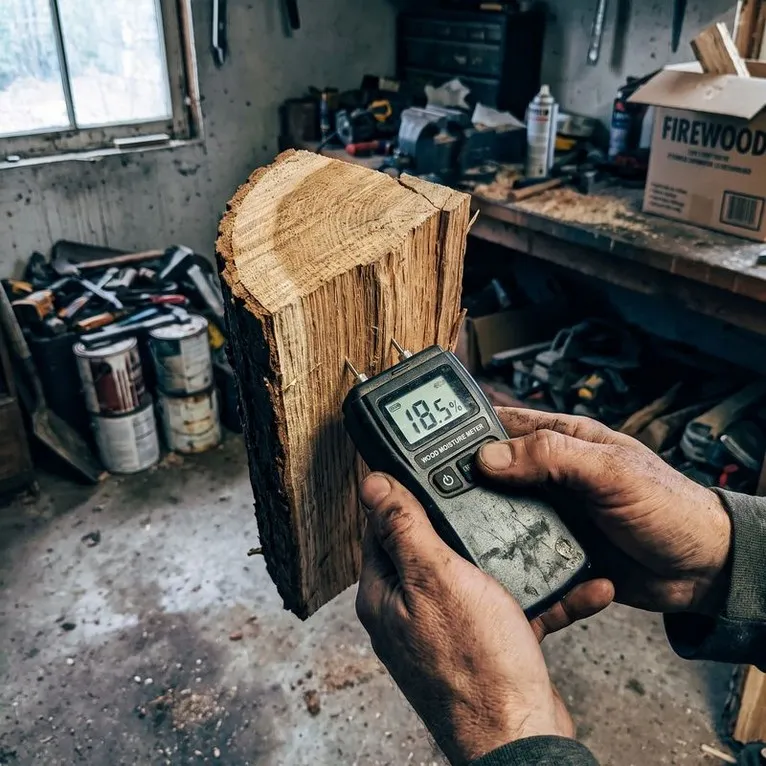
- Split it and test the freshly exposed inner face. Maryland Extension stresses testing the inside, not the outside, which dries first and reads low.
- Push the pins in and read the number.
- Test a few pieces. If most read under 20%, the stack is ready. If not, give it more time.
The same test works at delivery. Maryland Extension suggests keeping an axe on hand so you can split a few pieces and check the load before it is unloaded.
What if your wood is not dry yet?
If winter is coming and your meter reads 25% or 30%, you have a few honest options:
- Buy a smaller amount of kiln-dried wood for this winter and let your own stack keep drying for next year.
- Burn the driest wood first. The Maine Forest Service suggests stacking the greenest wood at the bottom or back of the storage area so you reach the driest first.
- Bring in only a day or two of wood at a time. A small supply near the stove can warm up, but keep it at least 3 feet from the stove, per the U.S. Fire Administration.
Do not try to make up for wet wood by smoldering the fire low to "make it last." The EPA says that for most appliances a smoldering fire is neither safe nor efficient, and it is the fastest way to build creosote.
Seasoned wood and your outage plan
Dry wood is what makes a wood stove a real backup. The Handbook's Project 55 field note describes two cords of seasoned wood, properly stored, as stored heat that needs no electricity. Wet wood gives you a fraction of that heat and a dirtier chimney.
Plan backward from the first cold month: wood split and stacked in spring is usually ready by fall. Our guides on how many cords of wood for winter and wood stove safety cover how much to buy and how to burn it. For outdoor cooking in an outage, small dry sticks are just as important in a brick rocket stove.
Frequently asked questions
How long does firewood need to season before burning?
At least six months after it is split and stacked, per the EPA, and typically 6 to 9 months according to University of Maryland Extension. Dense hardwoods or wood stored in damp, shady spots can take longer. The reliable test is a moisture meter: burn wood that reads under 20% on a freshly split inner face.
What moisture content should firewood be?
Under 20%. Freshly cut wood can be 50% water or more, and dealer wood sold as seasoned is often around 30%, according to UNH Extension. Wood above 20% is harder to light, gives off less heat and builds creosote in the chimney, which raises the risk of a chimney fire.
Does firewood season faster if it is split?
Yes. Bark holds moisture in, and split faces let it out. University of Maryland Extension says seasoning really begins after splitting, so ask a dealer when the wood was split rather than when the tree was cut. Cut pieces to firebox length, split them and stack them off the ground with only the top covered.
How can I tell if firewood is seasoned without a meter?
Seasoned wood is darker or grayish, lighter in weight, has cracks on the ends and loose or peeling bark, and two pieces knocked together sound hollow rather than dull. These signs are a good first check, but a piece can look dry and still be wet inside, so a moisture meter on a freshly split face is the surer test.
Sources
- The Off-Grid Handbook, Garrett Dalton, Project 55
- EPA Burn Wise: Best Wood-Burning Practices
- University of Maryland Extension: Buying and Storing Firewood and Pellets, FS-937 (PDF)
- UNH Cooperative Extension: Buying Firewood (PDF)
- Maine Forest Service: Tips for Burning Firewood in Your Home (PDF)
- U.S. Fire Administration: Fireplace and Wood Stove Safety (PDF)
Safety guidance changes. Check the agency pages above for the current version, and follow your local code and manufacturer instructions.