How to prevent creosote buildup in your chimney
Creosote is the reason chimneys catch fire. It builds slowly, out of sight, and almost all of it comes from habits you can change.
In this article
Here is how to prevent creosote buildup in one sentence: burn only seasoned firewood under 20% moisture, run the stove hot and clean as its manual describes, never let the fire smolder for hours, and have the chimney inspected and cleaned by a professional at least once a year, more often with heavy use. Those habits keep the flue warm and the smoke clean, which is what stops creosote from forming.
The Off-Grid Handbook sums up the danger in Project 55: wet wood makes creosote, and creosote makes chimney fires.
What is creosote?
The Consumer Product Safety Commission (CPSC) describes creosote as a tar-like substance that forms in chimneys from burning wood. Smoke carries unburned gases and tiny droplets up the flue. When the flue is cool, they condense on the inside walls as a sticky, black or brown deposit.
Creosote burns. Enough of it, lit by a hot fire, can turn into a chimney fire. According to NFPA data cited by Portland Fire & Rescue, failure to clean, mainly chimneys on wood-burning equipment, is the leading factor in home heating fires, at 25%.
What causes creosote buildup?
- Wet wood. Water in the wood cools the fire and the smoke. University of Maryland Extension says wood over 20% moisture increases the risk of a chimney fire from creosote.
- Smoldering fires. Turning the air down low to make a load last all night makes a cool, smoky fire. The EPA says that for most appliances a smoldering fire is neither safe nor efficient.
- A cool flue. University of Maryland Extension notes that low pipe or flue temperatures cause residues to condense.
- An oversized stove. The Handbook warns that oversized stoves smolder and creosote, because they are always being run below their design heat.
- Older, uncertified stoves. The EPA says certified stoves reduce creosote buildup and the risk of chimney fires.
How to prevent creosote buildup, step by step
- Burn dry wood. Under 20% moisture, tested with a meter on a freshly split face. See how long firewood takes to season.
- Burn hot and clean. Follow your stove manual for loading and air settings. The Handbook's Project 55 uses a chimney thermometer to keep the fire in the clean-burn zone the manual gives.
- Use smaller, hotter fires rather than one big load turned down to a smolder.
- Keep the stove door closed except when loading or stoking, as the U.S. Fire Administration advises.
- Burn only firewood. No trash, cardboard, or painted or treated wood. USFA also says not to burn paper in a stove or fireplace.
- Have the chimney swept and inspected every year by a professional, and more often with heavy use. The Handbook cites NFPA 211, and USFA gives the same advice.
Storing the wood right is part of it too. A stack wrapped in a tarp never dries; see how to store firewood outside.
| Habit | Why it matters | Source |
|---|---|---|
| Firewood under 20% moisture | Wetter wood raises the risk of a chimney fire from creosote | EPA, UMD Extension |
| No smoldering fires | Not safe or efficient in most appliances | EPA |
| Stove door closed except when loading | Keeps the burn controlled | USFA |
| EPA-certified stove sized to the room | Reduces creosote; oversized stoves smolder | EPA, the Handbook |
| Chimney inspected and cleaned yearly | Removes deposits before they can burn | USFA, NFPA 211, CPSC |
Using a chimney thermometer
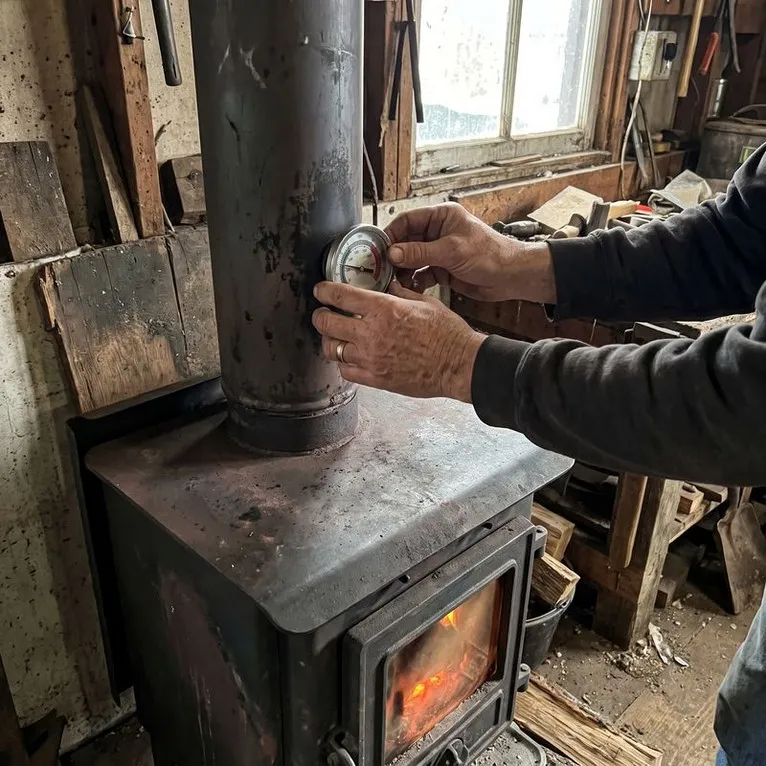
A stovepipe or chimney thermometer is a simple dial that sits on the pipe and shows whether the fire is too cool, in the right range or too hot. The right range is the one your stove manual gives, and it differs by stove and by where the thermometer is mounted, so read the manual rather than a number from the internet. If the needle keeps sitting low, the fire is starved of air or the wood is wet, and both make creosote.
Creosote buildup signs
You do not have to climb on the roof to watch for trouble. Look and smell from inside:
- Smoke you can see or smell from a stove that used to burn clean. The EPA says a properly installed stove should make very little smoke, and regular smoke means you may have a problem.
- Black, flaky or tarry deposits inside the stove door, the fireplace opening or the stovepipe.
- Dark smoke from the chimney top once the fire is established.
- A fire that is hard to get going or keeps dying down, often a sign of wet wood.
The CPSC advises checking chimneys for creosote and other blockages regularly, and as often as twice a month if deposits build up quickly. Your sweep can tell you how fast your system builds creosote, which tells you how often to clean.
Chimney fire prevention: know the warning signs
Some chimney fires are loud and dramatic. Others smolder slowly and are only found at the next inspection. Portland Fire & Rescue lists the warning signs as a loud roar, sucking sounds, shaking pipes, hot spots on the wall or chimney, or smoke in the house.
If you notice any of them:
- Shut off the fire's air supply by closing the stove's air controls, if you can do it safely.
- Get everyone out of the house.
- Call 911 from outside, even if the noise stops.
After any chimney fire, or if you suspect one, the CPSC says to have a qualified chimney sweep do a complete safety inspection and make repairs before the chimney is used again. Keep an ABC fire extinguisher near the exit of the room, and battery-powered smoke and carbon monoxide alarms on every level; see where to put CO detectors.
Creosote and your outage plan
An outage is exactly when a wood stove gets run hardest and longest, often by someone tempted to stretch the wood by turning the air down. That is the worst moment for a chimney fire, with no power and roads that may be slow for fire crews.
The Handbook treats a Level 2 chimney inspection as a prerequisite before relying on a stove for outage heat, not a suggestion. Book it in early fall, before the sweeps get busy. If you heat with an open fireplace, our wood stove vs fireplace comparison explains why it is a poor heater, and our wood stove safety guide covers clearances and ashes.
Frequently asked questions
What causes creosote buildup in a chimney?
Creosote forms when smoke cools and condenses inside the flue. The main causes are wet firewood over 20% moisture, slow smoldering fires with the air turned down, a cool flue, and stoves that are too big for the space and so always run low. Older, uncertified stoves also make more of it than EPA-certified models.
How often should a chimney be cleaned to prevent creosote?
Have it inspected and cleaned by a professional at least once a year, as the U.S. Fire Administration advises and NFPA 211 calls for, and more often if you burn a lot of wood. The CPSC advises checking for creosote regularly, as often as twice a month if deposits build up quickly.
What are the signs of a chimney fire?
Portland Fire & Rescue lists a loud roar, sucking sounds, shaking pipes, hot spots on the wall or chimney, and smoke in the house. If you notice them, close the stove's air controls if it is safe to do so, get everyone out and call 911. Have the chimney fully inspected before using it again.
Can burning hot fires remove creosote?
Burning hot and clean, as your stove manual describes, prevents new creosote from forming, but it does not safely remove what is already there. A hot fire in a dirty chimney is how chimney fires start. Existing deposits are a job for a professional chimney sweep.
Sources
- The Off-Grid Handbook, Garrett Dalton, Project 55
- EPA Burn Wise: Best Wood-Burning Practices
- EPA Burn Wise: Energy Efficiency and Your Wood-Burning Appliance
- CPSC: Consumer Safety Alert on chimneys and creosote
- Portland Fire & Rescue: Chimney and Wood Stove Safety
- U.S. Fire Administration: Fireplace and Wood Stove Safety (PDF)
- University of Maryland Extension: Heating with Wood, FS-926 (PDF)
Safety guidance changes. Check the agency pages above for the current version, and follow your local code and manufacturer instructions.