How long does a house stay warm without power? What the research shows
There is no single number, but a national laboratory study gives a realistic range, and a few choices in the first hour change it a lot.
In this article
How long does a house stay warm without power? It depends mostly on how cold it is outside and how well the house is insulated and sealed. In a national laboratory study for the Department of Energy, a typical existing house stayed livable for about half a day to a day in a hard northern cold snap, and for several days in a milder southern one. Homes built to current energy code lasted roughly twice as long.
You can't change the weather, but you can change how fast your home loses heat. The Off-Grid Handbook sums up the strategy in Project 49: stop heating the house and start heating one room.
How long does a house stay warm without power? The numbers
Researchers at the Pacific Northwest, National Renewable Energy and Lawrence Berkeley national laboratories modeled single-family homes through a seven-day extreme cold event with no power. They counted how long each house stayed within a livability limit, based on how long the indoor "feels-like" temperature spent below 54°F.
| City (cold event) | Typical existing house | House built to 2021 code |
|---|---|---|
| Minneapolis-St. Paul, MN | 0.6 days | 1.2 days |
| Detroit, MI | 0.9 days | 1.7 days |
| Portland, OR | 1.1 days | 2.4 days |
| Atlanta, GA | 1.4 days | 2.3 days |
| Houston, TX | 3.8 days | 6.9 days |
These are computer models of a median house, not a forecast for yours. Still, the pattern is clear: in hard cold, an ordinary house becomes uncomfortable within hours and unlivable within about a day. Very well-insulated homes built to Passive House standards held up for the full week in several cities.
What makes one house cool faster
- The outdoor temperature and wind. Wind pushes cold air in through every gap.
- Air leaks. Heated air escaping through gaps is, in the book's words, the largest invisible loss in most houses.
- Insulation, especially in the attic.
- Windows. The Handbook calls them the thermal holes in every wall.
- Heavy materials like brick, stone and concrete, which store heat and release it slowly.
- The number of people. Per the book, four people give off about 400 watts of heat around the clock.
How cold will my house get without heat?
The first hours go slowly, because walls, furniture and water heaters hold warmth. Then the house trends toward the outdoor temperature, faster in a drafty home and on a windy night. Rooms on the north side, rooms with many windows and rooms over a garage or crawl space cool first.
The simplest way to know is to measure. Put an inexpensive indoor thermometer in the room you would use in an outage, and in an outage, write the reading down every few hours. A trend you can see makes the decision to stay or leave much easier.
Make one room stay warm longer
A whole house is too big to defend. One small room is not. Project 49, "The One Warm Room," costs about $40 and an hour of planning, per the book:
- Pick the room now. Small, south-facing, few windows, few exterior walls, on the same floor as a bathroom if possible. Often this is not the living room.
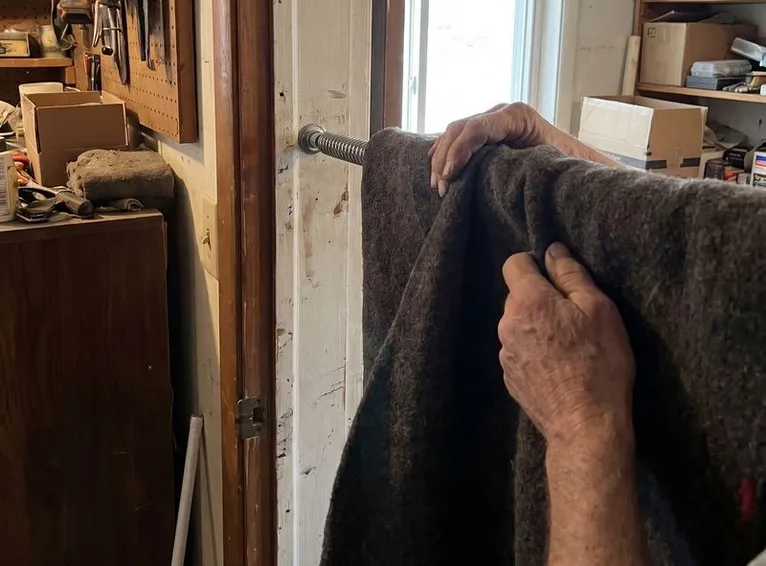
- Seal the doorway with heavy blankets on spring rods and stuff the gaps. The book calls the door of the warm room its thermostat.
- Treat the windows with shrink film, curtains that reach the sill and a draft snake, the "triple treatment" from Project 48. Our guide to insulating windows for winter shows how.
- Cover hard floors with rugs or foam mats. Cold floors defeat warm air.
- Bring everyone in. In a small sealed room, the book notes, occupancy is a heater.
Open curtains on the sunny side by day for free solar gain, and close all of them at dusk. Our full guide to how to stay warm without power has the warm room checklist.
Seal before winter, not during it
The cheapest way to add hours is to tighten the house in fall. Project 47 seals gaps with caulk, foam and weatherstripping for about $50 and three hours, and the book calls it the project that makes every other one work better. Start with how to find air leaks in your house.
How long can a house go without heat before it is unsafe?
For people, the line comes before the house gets truly cold. The National Institute on Aging advises keeping the heat at 68°F or higher when possible, because even rooms of 60 to 65°F can lead to hypothermia in older adults. If someone in the house is older, very young or unwell, act early. Our guide on keeping elderly people warm in winter covers the details.
Ready.gov describes hypothermia as an unusually low body temperature, with a temperature below 95°F an emergency. Signs include shivering, exhaustion, confusion, fumbling hands, memory loss, slurred speech and drowsiness. Call 911 for anyone with these signs.
For the house, the risk is the plumbing. Texas A&M AgriLife Extension notes that pipes can freeze and burst when the outdoor temperature reaches 20°F or below. Our guide to keeping pipes from freezing in an outage explains what to do.
Sleep warm without burning anything
The book's point about the crisis hours is that people don't freeze at 2 p.m., they get cold at 2 a.m. Project 53 gives each person a sleeping bag rated at least 20°F below the coldest expected indoor temperature, a pad and a blanket, for about $60. See sleeping bag temperature ratings for choosing one.
What never to do, and when to leave
As the house cools, the temptation is to improvise heat. The CDC is clear: never use a gas oven or stovetop to heat the home, and never bring a grill, camp stove or charcoal indoors or into a garage. A generator runs outdoors only, at least 20 feet from the house, away from windows, doors and vents. Fuel-burning space heaters are a separate question, covered in can you use a propane heater indoors. Keep battery-backed carbon monoxide alarms working on every level.
If the warm room keeps losing ground, leaving is the right call, not a failure. Ready.gov advises going to a community location with power if you can't stay warm at home. Local officials can tell you which warming centers are open, and a friend or relative with heat counts too.
Frequently asked questions
How long will a house stay warm if the power goes out in winter?
It varies with the weather and the house. In a national laboratory study, a typical existing home stayed livable for about 0.6 days in a Minneapolis cold event, 1.4 days in Atlanta and 3.8 days in Houston. Homes built to current energy code lasted about twice as long.
How fast does a house lose heat without power?
Slowly for the first few hours, then faster as walls and furniture give up their stored warmth. Drafty homes, windy nights and rooms with many windows lose heat fastest. Sealing one small room with blankets and curtains slows it down a lot.
At what indoor temperature should I leave my house?
There is no single number, but don't wait for the house to get truly cold. The National Institute on Aging warns that rooms of 60 to 65°F can lead to hypothermia in older adults. If you can't keep a warm room going, Ready.gov advises going to a location with power, such as a warming center.
Can I use my gas oven to keep the house warm during an outage?
No. The CDC says never to use a gas oven or stovetop to heat your home, because of the risk of carbon monoxide poisoning. Seal one warm room, layer up, use sleeping bags, and go to a warming center if the house gets too cold.
Sources
- The Off-Grid Handbook, Garrett Dalton, Project 49
- PNNL, NREL and LBNL for DOE: Enhancing Resilience in Buildings Through Energy Efficiency (2023, archived)
- National Institute on Aging: Cold Weather Safety for Older Adults
- Ready.gov: Winter Weather
- Ready.gov: Power Outages
- CDC: Safety Guidelines During and After a Winter Storm
- Texas A&M AgriLife Extension: Winter Storms, Preventing and Thawing Frozen Pipes (PDF)
Safety guidance changes. Check the agency pages above for the current version, and follow your local code and manufacturer instructions.