Sleeping bag temperature ratings: how to read the label and buy for a cold house
The number on the bag is not a promise. Here is what each rating means, and how to pick a bag for a winter outage instead of a campsite.
In this article
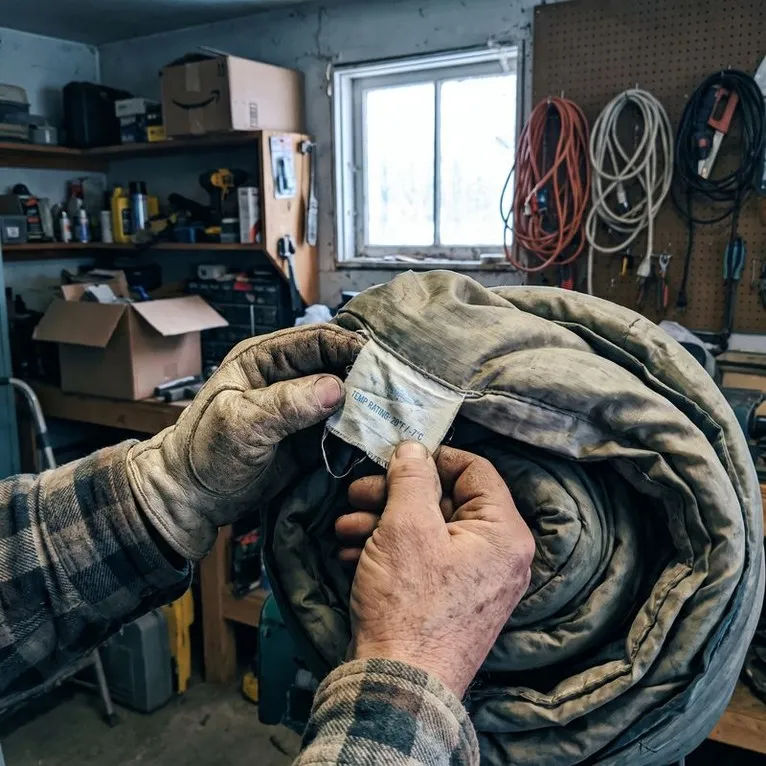
Most sleeping bag temperature ratings now follow the international standard ISO 23537, which prints up to three numbers: a comfort rating, a lower limit and an extreme rating. For a cold house, plan around the comfort rating, and buy a bag whose comfort figure sits well below the coldest temperature you expect indoors. The Off-Grid Handbook sets that margin at at least 20°F below your realistic indoor minimum.
This guide explains what each number means and how to choose. For the full bedtime setup, with pads, blankets and the warm room, see how to sleep warm in a cold house.
Sleeping bag temperature ratings explained
Under ISO 23537, bags are tested in a cold chamber on a heated mannequin, and the results are converted into ratings for a "standard" sleeper. The three numbers mean different things:
| Rating | What it describes | How to use it |
|---|---|---|
| Comfort | The temperature at which a standard woman sleeps comfortably in a relaxed position | The number to plan around |
| Lower limit | The temperature at which a standard man can sleep about eight hours curled up without waking | Only if you sleep warm, and never as your target |
| Extreme | A survival figure, with a real risk of hypothermia | Ignore it when buying |
The "standard" sleepers are young, healthy adults. Older bodies, people who are thin, tired or unwell, and most people who simply sleep cold will feel colder than the label suggests. The National Institute on Aging (NIA) notes that older adults can lose body heat faster than younger people, which is one more reason to trust the comfort number.
Read the whole label
Some bags show a single temperature in the product name. Look at the label or the specifications to see which rating that number is, and whether the bag was tested to the ISO standard at all. A bag with no tested rating is a guess.
What temperature sleeping bag should I get for a power outage?
Camping advice assumes a night outdoors. In an outage, the question is how cold the room you sleep in will get. Start there, then subtract.
- Estimate the coldest night indoors. If you have been through an outage before, use what the thermometer read. If not, put an inexpensive thermometer in your chosen sleeping room and watch it on a cold night with the heat turned down.
- Subtract at least 20°F. That is the Handbook's rule in Project 53. If you expect the room to drop to 45°F, look for a comfort rating of 25°F or lower.
- Add blankets for the margin. The book doubles each bag with a wool or fleece blanket on top, which covers the night that turns out colder than planned.
| Coldest expected room temperature | Look for a comfort rating of |
|---|---|
| 60°F | 40°F or lower |
| 50°F | 30°F or lower |
| 40°F | 20°F or lower |
How cold a room gets depends on the house and the weather, and our guide to how long a house stays warm without power shows how wide that range is. When in doubt, buy the warmer bag. You can always unzip it.
Fit matters as much as the number
The book's first step is to buy on temperature rating and honest sizing. A bag that is too large leaves dead air your body has to heat, so it warms slowly and stays cooler. A bag that is too tight compresses the insulation, which is what holds the warmth.
- Length: your feet should reach the bottom without pressing against it.
- Width: you should be able to turn over and bend your knees a little without stretching the fabric.
- Hood and draft collar: useful in a very cold room, because a lot of heat leaves through an uncovered head.
- Zipper: a full-length zipper makes it easier to get in and out for anyone with stiff knees or hips.
Rectangular bags fit more comfortably for many adults and can open flat as a quilt. Tapered bags are warmer for their weight, but weight hardly matters on a living room floor.
The pad underneath counts as much as the bag
The Handbook's layer rule for Project 53 is pad below, bag around, blanket over, hat on. It explains why: the floor steals more heat than the air. Sleeping bag ratings assume an insulated pad underneath, so a warm bag laid on a cold floor will not perform as labeled.
Sleeping pads have their own rating, an R-value, measured under the test standard ASTM F3340. A higher R-value means more insulation from the ground. The book calls for closed-cell foam pads for anyone sleeping low, and two pads stacked add their insulation together. On a bed, the mattress already does this job, and the bag goes on top.
The complete kit in Project 53 is one real bag per person, wool or fleece blankets to double the bags, foam pads, and wool socks and knit caps staged with the bedding. The book lists it at about $60 and 30 minutes of setup, and it burns no fuel overnight.
Bags for children, older adults and babies
Children often need a smaller bag. A child in an adult bag has more dead air to warm, so a youth size or an adult bag folded under at the foot works better. The book puts children and elders in the center of the group when everyone sleeps together in the warm room, where the body heat collects.
Older adults are the reason to be generous with the rating. NIA advises extra covers, long underwear under pajamas and a head covering at night, and recommends keeping the home at 68°F or higher when possible, because even rooms of 60 to 65°F can lead to hypothermia in older people. In an outage you can't control the room, so the sleep system has to make up the difference. Our guide on how to keep elderly people warm in winter covers the rest.
Babies under one year should not sleep in an adult sleeping bag or under blankets. The National Institutes of Health Safe to Sleep campaign says to keep comforters, quilts, pillows and blankets out of the baby's sleep area, and to keep a baby warm with a wearable blanket or an extra layer of clothing instead, in the baby's own crib, bassinet or play yard.
Care and storage between winters
- Store bags loose, in a large cotton sack or on a hanger, not packed tight in the stuff sack. Insulation that stays compressed for months loses loft.
- Keep them dry. The book's rule is warm, dry sleepwear only, because going to bed damp defeats any bag. The same goes for the bag itself.
- Stage them where you will sleep. Project 53 keeps the full set in or beside the warm room, as step three of the activation card from Project 49.
A good bag removes the temptation to run something unsafe at night. Space heaters should be off when everyone goes to bed, and no fuel-burning appliance belongs in a sealed sleeping room; see can you use a propane heater indoors. For setting up the room itself, read how to stay warm without power.
Frequently asked questions
Which sleeping bag temperature rating should I go by?
Go by the comfort rating. Under ISO 23537 it is the temperature at which a standard woman sleeps comfortably in a relaxed position. The lower limit is for a standard man curled up, and the extreme rating is a survival figure with a risk of hypothermia. Older adults and people who sleep cold should treat the comfort number as the floor.
What temperature sleeping bag do I need for a cold house?
The Off-Grid Handbook's rule is a bag rated at least 20°F below the coldest temperature you realistically expect indoors. If the room might drop to 50°F, choose a comfort rating of 30°F or lower, and add a wool or fleece blanket on top for colder nights.
Is a 30 degree sleeping bag warm enough indoors?
Usually, if 30°F is its comfort rating and the room stays above about 50°F. If 30°F is the lower limit, it will feel colder than that. Always sleep on an insulated pad, since bag ratings assume one, and add a blanket and a knit cap.
Can a baby sleep in a sleeping bag during a power outage?
Not in an adult sleeping bag or under loose blankets. The NIH Safe to Sleep campaign says to keep blankets, quilts and pillows out of a baby's sleep area and to use a wearable blanket or an extra layer of clothing instead, with the baby in their own crib, bassinet or play yard.
Sources
- The Off-Grid Handbook, Garrett Dalton, Project 53
- ISO 23537-1:2022, Requirements for sleeping bags, Part 1: Thermal and dimensional requirements
- ASTM F3340: Standard Test Method for Thermal Resistance of Camping Mattresses
- National Institute on Aging: Cold Weather Safety for Older Adults
- NICHD Safe to Sleep: Ways to Reduce Baby's Risk
- Ready.gov: Winter Weather
Safety guidance changes. Check the agency pages above for the current version, and follow your local code and manufacturer instructions.