How much insulation do I need in my attic? R-values by zone and how deep to go
The answer depends on where you live and what is already up there. A tape measure and one table from ENERGY STAR tell you most of what you need.
In this article
How much insulation do I need in my attic? ENERGY STAR recommends R-30 in the warmest part of the country, R-49 in most of the South, and R-60 from the middle of the country north for an attic that has none. Most common insulation gives about R-3 per inch, so that is roughly 10, 16 and 20 inches of depth. If you can easily see the tops of your ceiling joists, you almost certainly need more.
The Off-Grid Handbook builds this check into Project 54: while you are up there fixing the hatch, verify the insulation depth against the Department of Energy's recommendations for your zone and write down any shortfall for a bigger job later. This guide shows how.
How much insulation do I need in my attic? R-values by zone
R-value measures how well insulation resists heat flowing through it. Higher is better. ENERGY STAR's recommended levels for existing homes, based on the 2021 International Energy Conservation Code, are:
| Climate zone | Attic with no insulation | Attic with 3 to 4 inches already |
|---|---|---|
| Zone 1 (South Florida, Hawaii and the territories) | R-30 | Add R-25 |
| Zones 2 and 3 (most of the South and the Southwest) | R-49 | Add R-38 |
| Zones 4A and 4B | R-60 | Add R-49 |
| Zones 4C, 5 and 6 | R-60 | Add R-49 |
| Zones 7 and 8 (far north and Alaska) | R-60 | Add R-49 |
ENERGY STAR's page includes a map of the climate zones by county. If your county sits near a boundary, use the colder zone. The second column is how much to add on top of what is there, not the total.
The shortcut for the North and the South
ENERGY STAR also gives a simpler rule: in the southern US, a minimum of about R-38, or 13 to 14 inches; in the northern US, a minimum of about R-49, or 16 to 18 inches. The zone table above sets the full recommended level, which is higher.
How deep should attic insulation be?
Depth depends on the material, because each type gives a different R-value per inch. ENERGY STAR notes that most common types give about R-3 to R-3.5 per inch, so you can estimate by multiplying the depth in inches by 3.
| Target | Approximate depth at R-3 per inch |
|---|---|
| R-30 | About 10 inches |
| R-38 | About 13 inches |
| R-49 | About 16 inches |
| R-60 | About 20 inches |
For blown-in insulation, the bag itself tells you more. Federal labeling rules require loose-fill insulation bags to carry a coverage chart that lists, for each R-value, the minimum thickness and the number of bags needed per 1,000 square feet. Loose-fill settles over time, so the chart gives a settled thickness as well as the thickness when installed. Use the chart for the product you buy rather than a general rule.
How to measure the insulation you have
You need a tape measure or a yardstick, a good flashlight, a dust mask, gloves and long sleeves.
- Get up safely. The Handbook's ladder rule: a stable ladder, three points of contact, and someone home while you work. Ladders cause more household injuries than any project in the book.
- Stay on the joists or on boards laid across them. The drywall between joists will not hold your weight.
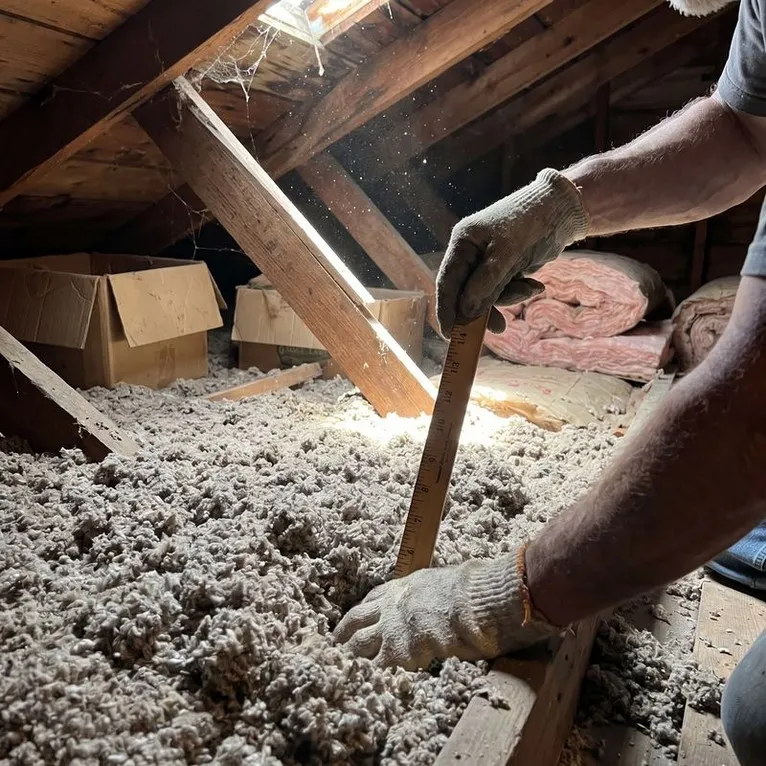
- Look across the attic. ENERGY STAR's rule: if the insulation is level with or below the tops of the floor joists, you probably need more. If it sits well above them and looks even, you may be close.
- Measure in several places. Push the ruler straight down to the drywall without packing the insulation. Check near the hatch, the middle and the edges, where it is often thin.
- Multiply by 3 for a rough R-value, and compare it with the table for your zone.
Write the numbers in your household binder, as the book suggests, along with the approximate size of the attic floor in square feet. A written shortfall is easier to plan and price than a vague feeling that the house is cold, and it lets you compare contractor quotes against the same target.
Stop if you see these
- Gray-brown or silver-gold pebbles. That is likely vermiculite. The EPA says to assume vermiculite insulation may contain asbestos and not disturb it, or to use a trained professional if it must be removed.
- Old cloth-covered wiring on ceramic knobs, wet or stained insulation, or a bath fan that blows into the attic instead of outside. ENERGY STAR advises calling a professional for these before adding insulation.
Seal the leaks before you add insulation
ENERGY STAR's guidance is to air-seal first. Loose fill and batts slow heat, but warm air still escapes through gaps around plumbing vents, wiring holes, chimneys and the hatch itself. Once new insulation is down, those gaps are buried.
The Handbook follows the same order: Project 47 seals the house first, and Project 54 adds insulation where the leaks were logged. The hatch is the obvious one. A thin, unsealed hatch can undo a lot of good insulation, and our guide to attic hatch insulation covers the fix. For hunting the rest, see how to find air leaks in your house.
A few spots need clearance from insulation rather than more of it: soffit vents at the eaves, chimneys and flue pipes, and older recessed lights that are not rated for contact with insulation. Follow ENERGY STAR's do-it-yourself guide and local code for these, or have a contractor do this part.
Do it yourself or hire it out?
Adding unfaced batts across the joists is a manageable weekend job. ENERGY STAR notes that blowing loose fill requires a blowing machine, which some home improvement stores rent, and that it may be wise to hire a professional for it. You can layer loose fill over existing batts, or unfaced batts over existing loose fill.
An insulated, sealed attic is not only about the heating bill. A national laboratory study for the Department of Energy found that homes built to current energy code stay livable for longer during a winter power outage than typical older homes. Our guide to how long a house stays warm without power has the numbers. The basement end of the job is in our guide to rim joist insulation.
Frequently asked questions
How many inches of insulation should be in an attic?
ENERGY STAR's quick rule is about 13 to 14 inches (R-38) at minimum in the southern US and about 16 to 18 inches (R-49) in the northern US. Its full recommendation for an uninsulated attic is R-49 to R-60 in most zones, which is roughly 16 to 20 inches at R-3 per inch.
How do I know if my attic needs more insulation?
Look across the attic floor. ENERGY STAR says that if the insulation is level with or below the tops of the floor joists, you probably need more. Measure the depth in several places and multiply by 3 for a rough R-value.
Is R-30 enough attic insulation?
Only in the warmest climate zone. ENERGY STAR recommends R-30 for an uninsulated attic in Zone 1, which covers South Florida and Hawaii. Most of the South calls for R-49, and the middle and northern parts of the country call for R-60.
Can you add new insulation on top of old insulation?
Usually, yes. ENERGY STAR says you can add loose fill over fiberglass batts or blankets, and use unfaced batts, without a paper or foil facing, over existing loose fill. Don't disturb vermiculite, which the EPA says to treat as possibly containing asbestos, and seal air leaks first.
Sources
- The Off-Grid Handbook, Garrett Dalton, Project 54
- ENERGY STAR: Recommended Home Insulation R-Values
- ENERGY STAR: How to Check Your Home's Attic Insulation Level
- ENERGY STAR: Adding Attic Insulation
- EPA: Protect Your Family from Asbestos-Contaminated Vermiculite Insulation
- eCFR: 16 CFR Part 460, Labeling and Advertising of Home Insulation
- PNNL, NREL and LBNL for DOE: Enhancing Resilience in Buildings Through Energy Efficiency (2023, archived)
Safety guidance changes. Check the agency pages above for the current version, and follow your local code and manufacturer instructions.