How to load test a battery bank and check its real capacity
A label says what a battery held when it was new. A load test tells you what it holds now, and whether your plan still adds up.
In this article
Here is how to load test a battery bank at home: charge it fully, let it rest and note the voltage, then run a known, steady load and log the voltage and the time until the battery reaches its cutoff or the stopping point you chose. Watts multiplied by hours gives the watt-hours it actually delivered. The Off-Grid Handbook builds a gentler version into Project 30: a two-hour evening on your real loads, with the start and end voltage written down and compared against your audit. Two hours, no cost, and the book calls it the capstone of the whole power system.
There are two tests worth knowing. The evening test checks the system. The full capacity test checks the battery.
Two kinds of battery test
| Evening load test | Full capacity test | |
|---|---|---|
| What it answers | Does the whole system carry our real loads? | How many watt-hours does this battery still deliver? |
| How long | About 2 hours | Until the battery reaches its cutoff, often many hours |
| Load | Your actual lights, phones, radio | One steady, known load |
| How often | Quarterly, per the Handbook | Yearly, per the Handbook |
How to load test a battery bank: the two-hour evening
Project 30's steps, nearly word for word:
- Announce a two-hour household test some evening. The main breaker stays on, but nothing plugs into the wall.
- Run the real loads: DC lights on, phones charging from the station, radio up, the inverter carrying its one AC job.
- Log the start and end battery voltage, the solar yield that day, and every hiccup, in the binder.
- Compare consumption against the audit, and update the audit if reality disagrees.
- Set the maintenance calendar: monthly voltage check, quarterly full test evening, yearly fuse-board inspection and battery capacity check.
- File the completed page behind the fuse-board photo.
The book's point is that afterward the system is "documented, proven, and repeatable by any adult in the house." Its field note says it best: an untested system is a hypothesis, and two hours on a calm Tuesday converts it into equipment.
How to test battery capacity: the full discharge test
A capacity test follows the same idea as the federal test procedures for stand-alone solar systems, written by the National Renewable Energy Laboratory with Sandia National Laboratories and others: measure the usable battery capacity by running the load from a full charge until the low-voltage disconnect cuts it off, then repeat the measurement later to see whether it has changed. At home, the same method needs only a meter, a clock and a notebook.
- Charge to full following the manufacturer's charging instructions, as Sandia's testing guide recommends, and let the battery rest for a while. Note the resting voltage.
- Pick one steady load you can measure, such as a lamp or a fan. Read its watts with a plug-in energy meter on the inverter outlet, or with a DC watt meter between the battery and a 12-volt load. Many power stations show watts on their display.
- Start a timer and write down the start time and voltage.
- Check every hour or so. Log the time and voltage, and feel the cables.
- Stop at the cutoff. For a LiFePO4 battery or a power station, that's when the battery management system shuts the output off. For lead-acid, see below.
- Do the math: average watts × hours = watt-hours delivered. Recharge right away.
An example: a 50-watt load that runs 11 hours delivered about 550 watt-hours. If you measured at the inverter outlet, the battery gave a bit more than that, because the inverter loses some energy in conversion.
A note on lead-acid
Don't run a lead-acid battery flat to test it. The Handbook's field note on batteries says lead-acid gives you about 50 percent of its label before you shorten its life. Test it to half its rated capacity and check that it gets there.
Battery capacity test: reading the results
Compare what the battery delivered with what it should deliver:
- Usable, not rated. The Handbook notes LiFePO4 gives you 80 to 100 percent of its label, and lead-acid about 50 percent. Its Project 18 battery box, a 12 V 50 Ah LiFePO4, stores about 600 usable watt-hours.
- Conditions change the result. Sandia's energy storage testing guide notes that battery capacity depends on the discharge rate and the temperature. A cold battery or a heavy load gives back less, so test with the same load in similar conditions each year and compare year to year. Sandia also notes that a test right after a long rest can read differently from one after regular use, so if a number surprises you, repeat the test before drawing conclusions.
- Voltage is a rough guide only. The Handbook's rule of thumb for LiFePO4 at rest: about 13.0 V is comfortable, under 12.0 V is time to charge. Our LiFePO4 voltage chart goes further.
If the result is well below what you expected, check the simple things first: a loose connection, a fuse that runs warm, or a bank where one battery doesn't match the others. The Handbook's Project 24 insists that parallel banks use batteries of the same model, capacity and age. See connecting batteries in parallel. Then update the audit and your expectations.
Safety during a load test
- Keep every fuse in the circuit. The Handbook's battery project says the master fuse stays in at all times, and never to bypass the battery management system.
- Feel the cables. The Handbook's inverter test applies here: warm is normal, hot is a fault. Stop and find the cause.
- Stay nearby and run the test in a dry spot, clear of anything that can burn.
- Stop if the battery shows warning signs. The NFPA and the U.S. Fire Administration list odor, a change in color or shape, too much heat, leaking or odd noises. If it is safe, move it away from anything that can catch fire and call 911.
- Stay at the plug-in level. Loads plug into the inverter or station directly, never into house wiring.
Put it on the calendar
The Handbook's maintenance cycle is easy to remember: voltage monthly, the evening test quarterly, capacity yearly. Put the generator's monthly run on the same day; our generator maintenance guide covers it. And if the test shows your needs have grown, revisit what size solar generator you need, or the DIY LiFePO4 battery box if you built your own.
Frequently asked questions
How do you load test a battery bank at home?
Charge it fully, note the resting voltage, then run a steady load you can measure and log the voltage and time until the battery reaches its cutoff. Multiply average watts by hours to get the watt-hours delivered. The Off-Grid Handbook also runs a two-hour evening test on real household loads every quarter.
How do I check the capacity of a power station?
Charge it to full, plug in one steady load whose watts you know, such as a lamp on a plug-in energy meter, and time how long it runs until the station shuts off. Watts times hours is roughly the usable capacity; the battery itself delivered a little more because of inverter losses.
Can you test battery capacity with a multimeter?
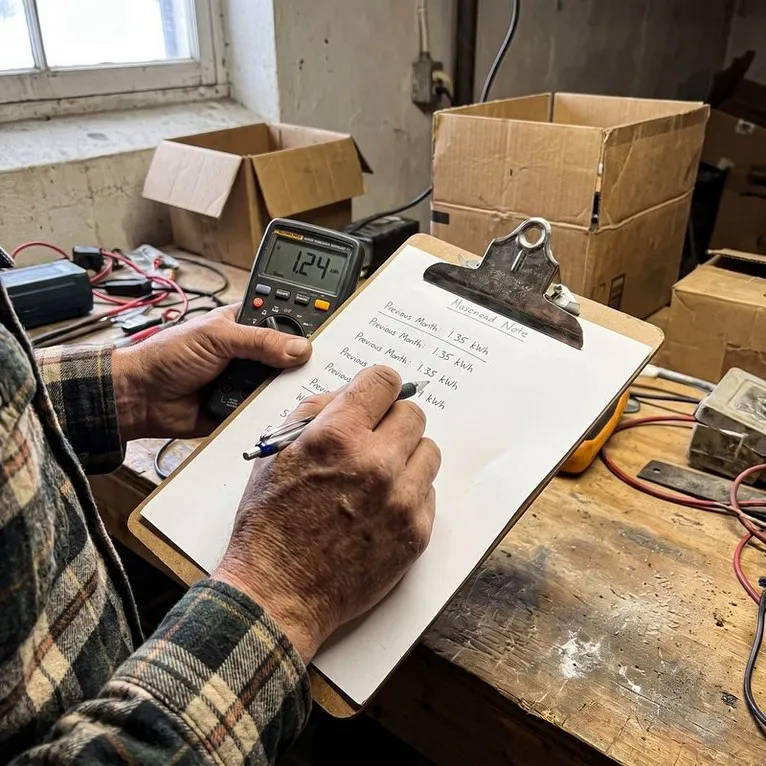
A multimeter gives voltage, which is a rough guide to state of charge but not capacity. The Off-Grid Handbook treats about 13.0 V at rest as comfortable for LiFePO4 and under 12.0 V as time to charge. To measure capacity, discharge with a known load and time it.
How often should you test a battery bank?
The Off-Grid Handbook sets a monthly voltage check, a two-hour test evening every quarter and a full battery capacity check once a year, with the results logged in the household binder.
Sources
- The Off-Grid Handbook, Garrett Dalton, Project 30
- NREL and Sandia (OSTI): Procedures for Determining the Performance of Stand-Alone Photovoltaic Systems
- NFPA: Lithium-Ion Battery Safety Tip Sheet
- U.S. Fire Administration: Battery Fire Safety
- Sandia National Laboratories: DOE Energy Storage Handbook, Chapter 16, Performance Testing
Safety guidance changes. Check the agency pages above for the current version, and follow your local code and manufacturer instructions.