What can a 100 watt solar panel run? A realistic list, device by device
One panel will not run a house. It will keep a household's phones, lights and radio going for as long as the sun comes up, which is what matters most in an outage.
In this article
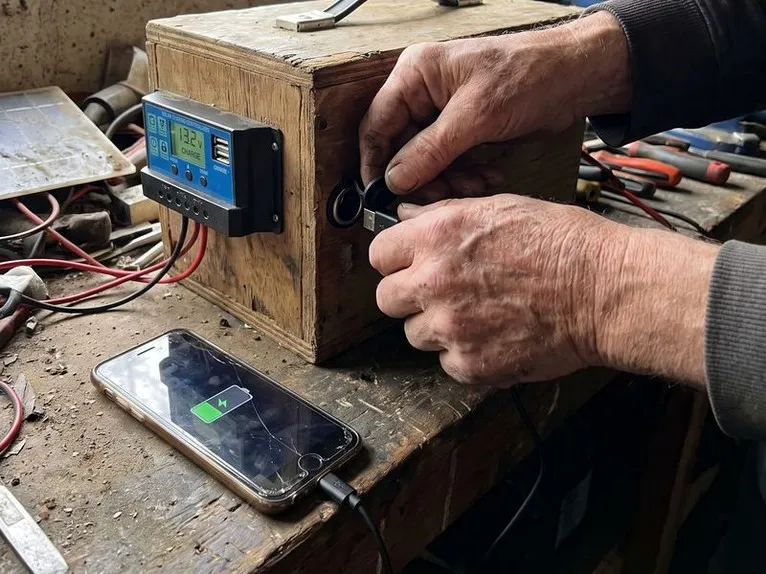
What can a 100 watt solar panel run? Paired with a charge controller and a small 12-volt battery, it runs the small, essential things: phones, LED lights, a radio, power banks and headlamps. The Off-Grid Handbook puts a 100-watt panel at about 300 to 500 watt-hours a day in decent sun, enough for 25 to 40 phone charges. It will not run a refrigerator, a space heater, a microwave or anything else that makes heat.
That makes it the right size for keeping a household connected and lit through an outage, and the wrong size for keeping the house running as usual. The rest of this guide shows how to tell the difference with your own devices.
How many watts does a 100W solar panel produce per day?
The 100 watts on the label is what the panel makes in full, direct sun, measured at 1,000 watts of sunlight per square meter. The University of Arizona Cooperative Extension explains that solar output is planned in peak sun hours: the number of hours a day that equal that full-strength sun. A place with 3.5 peak sun hours gets the same energy as three and a half hours of noon sun, and the number runs higher across the southern United States.
Real panels lose some of that on the way. The extension lists the usual culprits: heat, dust on the glass, wiring and small mismatches between parts. That is why the Handbook's figure for one panel, in Project 16, is a range: 300 to 500 watt-hours on a day of decent sun.
- Clear summer day, panel aimed well: the top of that range.
- Hazy or partly cloudy day: less, sometimes much less.
- Short winter day with a low sun: less again, even when the sky is clear.
Plan around the lower number. A battery in the middle of the system carries the good days over to the poor ones.
What can a 100 watt solar panel run, device by device
The math is simple: watts × hours = watt-hours. The Arizona extension's example is a 100-watt bulb left on for 5 hours, which uses 500 watt-hours. Read the watts on each device's label or charger, multiply by the hours you use it, and compare the total with what one panel brings in.
| Load | Energy per day | Fits on one panel? |
|---|---|---|
| One phone charge | About 12 Wh (the book's 25 to 40 charges per 300 to 500 Wh) | Yes, many times over |
| Four 4-watt LED lights for 5 hours | 80 Wh (Project 21) | Yes |
| Critical load, household of 2, no fridge | About 200 to 300 Wh (Project 17) | Yes, on a decent day |
| Critical load, household of 4, no fridge | About 300 to 450 Wh (Project 17) | Only on the best days |
| Modern refrigerator | 1,000 to 1,500 Wh (Project 17) | No |
The Handbook's watt-hour audit in Project 17 usually delivers good news: the loads that keep a family functioning, such as phones, a radio, lights and a fan, often fit in a box you can carry. It takes one honest hour with a plug-in meter or the nameplate ratings, and the number it produces drives every other choice.
The battery does the evening work
A panel makes power only while light falls on it. The battery stores the day's harvest so the lights and chargers work after dark. Project 16 pairs one 100-watt panel with a 12 V battery of 20 to 30 amp-hours, which holds roughly one good day of sun.
What one panel can't run
Anything that heats or cools draws far more power than one panel collects. A refrigerator alone needs two to five times the panel's daily output, according to the Handbook's audit figures. Heating appliances such as a space heater, hair dryer, coffee maker or microwave carry ratings high enough to empty a day's harvest in minutes; check the label and the math will show it.
Household AC devices also need an inverter, which adds its own losses. The Handbook's advice in Project 22 is to size an inverter for the one or two stubborn AC loads only, since phones, lights, radios and routers are happy on DC. If someone in the house depends on a CPAP or another medical device, plan its power with the device maker and the prescribing doctor; our guide to a power station for a CPAP covers the questions to ask.
For the refrigerator, a large power station or a generator is the realistic tool. See how long a power station will run a refrigerator before you buy either.
What's in a 100 watt solar panel kit?
A boxed kit usually bundles the panel, a charge controller, cables and sometimes mounting brackets. Many leave out the battery, which is the part that lets you charge at night. Before buying, check three things on the box: the controller's amp rating, whether it supports your battery type, and whether a battery is included at all.
The Handbook's Gear Guide comes down on the side of building this one: panel, controller and battery at about $120 match $300-plus packaged kits, and you can repair what you built. Our step-by-step guide to the DIY solar charging station follows Project 16's parts list and wiring order.
Getting the most from a single panel
- Face it true south (in the Northern Hemisphere) and tilt it to roughly your latitude, as Project 16 directs. The U.S. Energy Information Administration notes that a latitude tilt maximizes a panel's yearly exposure to direct sun.
- Keep it out of shade. The Handbook warns in Project 19 that one sliver of shade across a panel can cut output by half or more.
- Steepen it for winter. The book suggests about 15 degrees more tilt in winter; our guide to the best solar panel angle for winter has a table by latitude.
- Mount it properly. A panel leaning on a wall loses its angle and its output in the first storm. The DIY ground mount in Project 19 costs about $60.
- Charge during the day. Top up power banks while the sun is up and carry them to bedrooms at night.
When one panel isn't enough
Penn State's course on stand-alone solar design makes the key point for anyone sizing a system: plan for the month with the least sun and the highest need, not the average. If your audit lands above 300 watt-hours a day, or you want margin for cloudy weeks, add a second panel and a bigger battery.
The Handbook's field note in Project 16 is to buy the charge controller one size up from today's need, because a station that starts at 100 watts rarely stays at 100 watts. Our guides to what size charge controller you need and what size solar panel charges a 12V battery take the next step. For other ways to keep phones alive, see how to charge a phone during a power outage.
Frequently asked questions
Can a 100 watt solar panel run a refrigerator?
Not on its own. The Off-Grid Handbook puts a modern refrigerator at 1,000 to 1,500 watt-hours a day, while one 100-watt panel returns about 300 to 500 watt-hours on a day of decent sun. A refrigerator needs a large battery or power station and several panels, or a generator run safely outdoors.
How many watt-hours does a 100W solar panel produce per day?
About 300 to 500 watt-hours on a day of decent sun, according to The Off-Grid Handbook. The real figure depends on your peak sun hours, the season, the panel's angle, shade and heat. Cloudy days and short winter days give noticeably less, so plan around the lower end.
How many phones can a 100 watt solar panel charge?
Roughly 25 to 40 phone charges a day in decent sun, per The Off-Grid Handbook, which works out to about 12 watt-hours per charge. Charging through a 12 V battery lets you charge phones at night and on cloudy days from stored energy.
Can a 100 watt solar panel run a TV or a laptop?
Sometimes, for a few hours, if you have a battery and an inverter. Multiply the device's label wattage by the hours you use it and compare the result with 300 to 500 watt-hours a day, minus what your phones and lights already need. Inverters add losses, so leave margin.
Sources
- The Off-Grid Handbook, Garrett Dalton, Project 16
- University of Arizona Cooperative Extension: Calculating the Size of a Residential Solar PV System (AZ1782)
- University of Arizona Cooperative Extension: Stand Alone Photovoltaic (PV) Systems (AZ1983)
- U.S. Energy Information Administration: Solar panel tilt and latitude
- Penn State AE 868: Stand-alone system sizing
- Ready.gov: Power Outages
Safety guidance changes. Check the agency pages above for the current version, and follow your local code and manufacturer instructions.