Best solar panel angle for winter: latitude plus 15 degrees, and why
In December the sun stays low and the days are short. A steeper panel meets it more squarely, and that is when a backup system has the least to spare.
In this article
The best solar panel angle for winter is about your latitude plus 15 degrees, with the panel facing true south in the Northern Hemisphere. At 40 degrees north, that means tilting the panel to about 55 degrees from flat. The Off-Grid Handbook sets latitude as the year-round baseline in Project 19 and steepens about 15 degrees for winter, and its field note explains why it matters: summer forgives, December does not.
Tilt is measured from the ground: 0 degrees is a panel lying flat, 90 degrees is a panel standing straight up. The steeper winter angle points the panel at a sun that sits low in the southern sky.
Why the best solar panel angle for winter is steeper
A panel collects the most when sunlight hits it straight on. In summer the noon sun is high, so a flatter panel faces it. In winter the sun crosses low, so the panel has to stand up to meet it.
The numbers come from the tilt of the Earth. On the winter solstice, around December 21, the noon sun stands about 23.4 degrees lower than on the spring and fall equinoxes. At 40 degrees north, it climbs only about 27 degrees above the horizon at its highest point.
The 15-degree adjustment is a compromise across the whole winter rather than a perfect angle for one day. The U.S. Department of Energy's Energy Saver guidance makes the same trade for solar water heating collectors: latitude maximizes yearly collection, and a steeper tilt is often advised because more heat is needed in winter.
Solar panel tilt angle by latitude: a winter table
Find the city closest to your latitude. The winter tilt is latitude plus 15 degrees, rounded; the last column shows how high the noon sun gets on December 21.
| City | Latitude | Year-round tilt | Winter tilt | Noon sun, Dec. 21 |
|---|---|---|---|---|
| Miami | 26° | 26° | 41° | About 41° high |
| Houston | 30° | 30° | 45° | About 37° high |
| Atlanta | 34° | 34° | 49° | About 33° high |
| Nashville | 36° | 36° | 51° | About 30° high |
| Columbus, Ohio | 40° | 40° | 55° | About 27° high |
| Chicago | 42° | 42° | 57° | About 25° high |
| Minneapolis | 45° | 45° | 60° | About 22° high |
| Seattle | 48° | 48° | 63° | About 19° high |
The year-round column is the baseline both the Handbook and the U.S. Energy Information Administration use: tilting a panel south at an angle equal to latitude maximizes its yearly exposure to direct sun. The EIA adds the other side of the trade: panels tilted flatter than latitude gain in spring and summer at the expense of reduced output during fall and winter.
When to make the change
A simple schedule works: steepen the panel around the fall equinox in late September and flatten it back around the spring equinox in March. If you only adjust once, the Handbook's advice is to get the winter angle right.
Solar panel output in winter: what to expect
Even at the best angle, a panel makes less in December than in June. The reasons stack up:
- Shorter days. Fewer hours of usable light.
- A lower sun. Sunlight crosses more atmosphere and arrives weaker.
- More clouds and snow in much of the country.
- Longer shadows that reach panels that were clear all summer.
Cold itself is not the problem. The University of Arizona Cooperative Extension explains that temperature has an inverse effect on solar cell output: panels lose voltage as they heat up, so a cold, clear winter day is efficient hour for hour. The loss comes from the short, low path of the sun.
That is why off-grid designers size for the darkest month. Penn State's course on stand-alone systems calls it the critical design month. If your backup plan depends on one panel, check what it really delivers in December; our guide to what size solar panel charges a 12V battery shows how to plan around it.
Winter shade: the bigger risk
A low sun casts long shadows. A tree trunk, a fence or the corner of the house that never touched the panel in June can cover it all afternoon in December. The Handbook warns in Project 19 that one sliver of shade across a panel can cut output by half or more.
DOE's Energy Saver siting guidance says to make every effort to avoid shade between 10 a.m. and 2 p.m. and in winter, when the sun is lowest in the southern sky. Check your spot at those hours after the leaves have fallen, and move the panel if you need to. A ground mount makes that easy.
How to set the winter angle on a ground mount
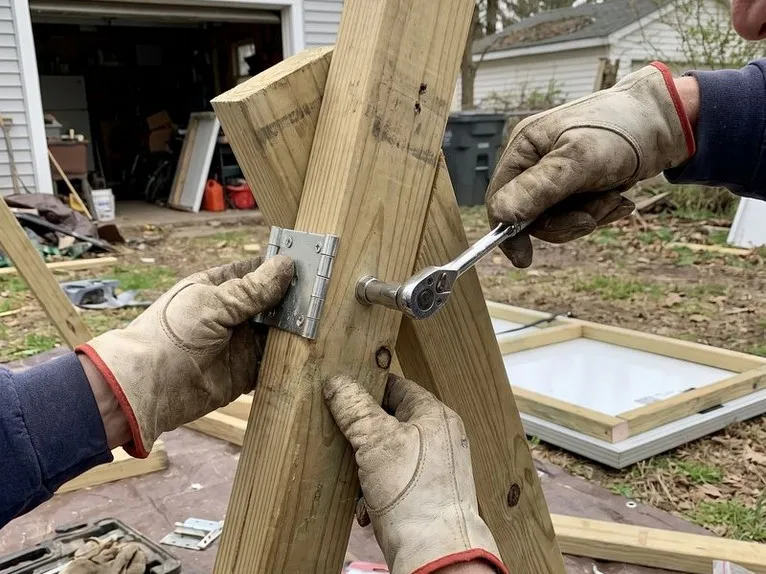
Project 19's A-frame mount has a hinged back leg for exactly this job. It takes about three hours to build and about $60 in materials; the full build is in our DIY solar panel ground mount guide.
- Look up your latitude and add 15 degrees.
- Lay an angle finder, or a phone app, flat on the face of the panel, not on the wooden legs.
- Move the back leg until the reading matches, then tighten the hinge hardware.
- Mark the leg position so next year's change takes seconds.
- Confirm the panel still faces true south and that the frame is anchored on all four corners.
Snow on the panel
A steeper winter angle also helps snow slide off sooner. To clear what stays, use a soft broom from the ground on a ground-mounted panel. Don't climb onto a snowy or icy roof to clear panels: the Handbook says ladder work causes more household injuries than any project in the book, and its rule is a stabilizer, three points of contact, and never working a roof edge alone or in wind.
Once the angle is set, check the controller display on the next clear day to see what the panel delivers. Then compare that figure with what you plan to run; our list of what a 100 watt solar panel can run helps, and the DIY solar charging station shows the full system. If you are weighing solar against fuel for winter outages, see solar generator vs gas generator.
Frequently asked questions
What angle should solar panels be in winter?
About your latitude plus 15 degrees, facing true south. At 35 degrees north that is about 50 degrees; at 45 degrees north, about 60 degrees. The Off-Grid Handbook uses latitude as the year-round baseline and steepens the panel about 15 degrees for winter.
Is it worth adjusting solar panel tilt for winter?
For a small backup system, yes. Winter is when days are shortest and output is lowest, and the U.S. Energy Information Administration notes that flatter panels lose output in fall and winter. On an adjustable ground mount the change takes a few minutes twice a year.
Do solar panels work in winter?
Yes. Cold does not hurt output; panels actually lose voltage as they heat up, according to the University of Arizona Cooperative Extension. Winter output is lower because days are shorter, the sun is lower, and clouds, snow and long shadows block more light.
How do I find my latitude for solar panel tilt?
Use a map app or search your town's name with the word latitude. Round to the nearest whole degree, add 15 for winter, and set the panel to that angle measured from horizontal on the panel's face.
Sources
- The Off-Grid Handbook, Garrett Dalton, Project 19
- U.S. Energy Information Administration: Solar panel tilt and latitude
- U.S. Department of Energy, Energy Saver: Siting Your Solar Water Heating System (archived)
- University of Arizona Cooperative Extension: Stand Alone Photovoltaic (PV) Systems (AZ1983)
- Penn State AE 868: Stand-alone system sizing
Safety guidance changes. Check the agency pages above for the current version, and follow your local code and manufacturer instructions.