What size solar panel to charge a 12V battery? Match it to the battery and the load
Every watt of panel brings in a few watt-hours a day. Once you know that, matching the panel to the battery is simple division.
In this article
What size solar panel to charge 12V battery banks depends on the battery's size and how fast you want it refilled. As a starting point, one 100-watt panel refills a small 20 to 30 amp-hour battery in a good day of sun, the pairing used in Project 16 of The Off-Grid Handbook. A drained 100 amp-hour lithium battery takes the same panel two to three sunny days; refilling it in one day takes about 200 to 300 watts of panels.
Whatever the size, the panel always charges the battery through a charge controller, never directly. The math below lets you size for your own battery and your own household.
The rule of thumb: watt-hours per watt of panel
The Handbook gives one number that does most of the work: a 100-watt panel in decent sun returns 300 to 500 watt-hours per day. Put another way, each watt of panel brings in about 3 to 5 watt-hours a day. Use 3 for cloudy regions, winter or a less-than-perfect site, and 5 only for a clear day with the panel well aimed.
The battery side is just as simple. A battery's energy in watt-hours is its voltage times its amp-hours. The Florida Solar Energy Center's example: a 12-volt, 100 amp-hour battery holds 12 × 100 = 1,200 watt-hours, or 1.2 kWh.
What size solar panel to charge 12V battery banks: the math
- Find the battery's watt-hours: 12 × amp-hours.
- Work out how much you actually use. Per the Handbook's Project 18, LiFePO4 gives you 80 to 100 percent of its label, while lead-acid gives about 50 percent before you shorten its life. The University of Arizona Cooperative Extension sets the same 50 percent limit for deep-cycle batteries.
- Divide by 3 to 5 watt-hours per watt. The answer is the panel size that refills that energy in one day.
| Battery | Energy to refill | Panel for a one-day refill | Days with one 100 W panel |
|---|---|---|---|
| 20 Ah LiFePO4 | About 190 to 240 Wh | 40 to 80 W | About 1 |
| 30 Ah LiFePO4 | About 290 to 360 Wh | 60 to 120 W | About 1 |
| 50 Ah LiFePO4 (Project 18) | About 600 Wh usable | 120 to 200 W | 1 to 2 |
| 100 Ah lead-acid, used to 50% | About 600 Wh | 120 to 200 W | 1 to 2 |
| 100 Ah LiFePO4, used to 20% left | About 960 Wh | 190 to 320 W | 2 to 3 |
Charging is never perfectly efficient, so treat the table as a floor and round panel sizes up. Panels are sold in standard sizes, so a 150-watt answer usually means two 100-watt panels or one larger one.
Size for the load, not only the battery
Refilling a drained battery once is a different goal from keeping up with daily use. In an outage that lasts days, the panel has to replace what the household uses each day. The Handbook's watt-hour audit in Project 17 puts a household of two at about 200 to 300 watt-hours a day without a refrigerator, and a household of four at about 300 to 450.
Penn State's course on stand-alone solar design sizes for the critical design month, the month with the least sun and the highest load. For most of the country, that means sizing from a short December day, not a long June one.
A 100W solar panel and a 12V battery
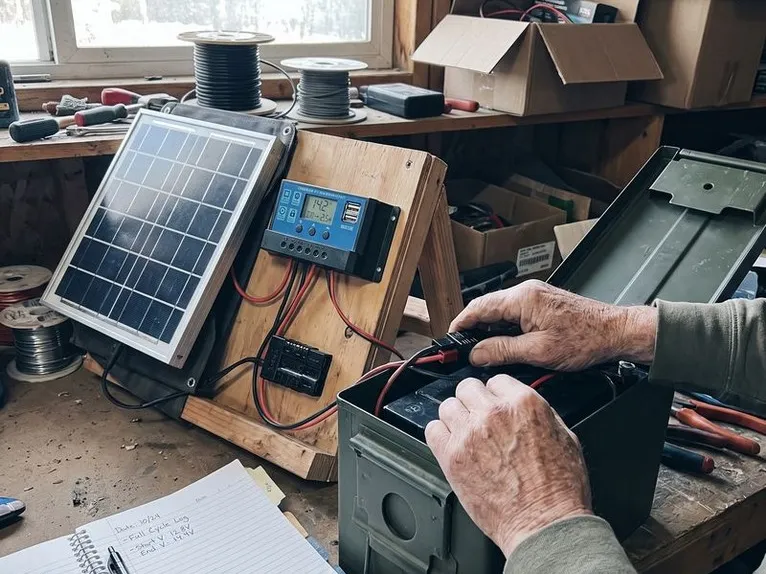
This is the classic beginner pairing, and the Handbook's DIY solar charging station is built around it: one 100-watt panel, a 10 amp controller (PWM is adequate at this scale) and a 12 V LiFePO4 or AGM battery of 20 to 30 amp-hours, for about $120.
A "12-volt" panel actually runs at a higher voltage in full sun. The Arizona extension's example 20-watt module is rated at 17.2 volts, and that extra voltage is what pushes current into the battery. It is also why the panel needs a controller: the extension explains that a battery cannot regulate the current flowing into it, so the controller prevents overcharging and undercharging.
For a full list of what one panel can keep running, see what a 100 watt solar panel can run.
Solar panel to charge a 100Ah battery
A 12 V 100 Ah battery is the common step up. If it is LiFePO4, it holds roughly 1,200 watt-hours, and one panel will take a few sunny days to refill it from low. To keep pace with a household's daily use as well, plan on 200 to 300 watts of panels.
At that size the details change:
- Controller type. The Handbook's rule is that PWM is fine under about 200 watts with 12-volt panels, and MPPT pays for itself above that. See MPPT vs PWM charge controllers.
- Controller size. Three 100-watt panels on 12 V need 300 ÷ 12 × 1.25 = 31.3 amps, so a 40 amp controller. Our guide to what size charge controller you need has a table.
- The battery's own limits. Check the manufacturer's maximum charge current and charging temperature range on the datasheet, and stay inside them.
How long that battery lasts once charged depends on what you run from it; see how long a 100Ah battery will last.
Winter, clouds and the panel you really need
Short days and a low sun cut output, and a run of gray days can leave a battery low for a week. Three ways to cover it:
- Add panel. Extra watts are the cheapest insurance for winter. Project 16's field note is to buy the controller one size up so a second panel can be added later.
- Tilt for the season. The Handbook's ground mount steepens about 15 degrees for winter; see the best solar panel angle for winter.
- Use less. LED lights, phones and a radio fit easily; anything that heats does not.
For lead-acid batteries, winter adds a specific risk. The Florida Solar Energy Center warns that lead-acid batteries can freeze in cold winters when sunny days are too few to keep them fully charged, because a discharged battery freezes at a much higher temperature than a full one. A panel large enough to keep the battery topped up protects it.
Frequently asked questions
What size solar panel do I need to charge a 100Ah battery?
To refill a drained 12 V 100 Ah LiFePO4 battery in one sunny day, plan on about 200 to 300 watts of panels. A single 100-watt panel, which returns 300 to 500 watt-hours on a decent day according to The Off-Grid Handbook, will take about two to three sunny days.
Will a 100 watt solar panel charge a 12V battery?
Yes, through a charge controller. The Off-Grid Handbook pairs one 100-watt panel with a 10 amp controller and a 12 V battery of 20 to 30 amp-hours, which the panel refills in a good day of sun. Larger batteries charge too, just over more days.
Can I connect a solar panel directly to a 12V battery?
No. A battery cannot regulate the current flowing into it, so a charge controller sits between panel and battery to prevent overcharging and undercharging, as the University of Arizona Cooperative Extension explains. Connect the battery to the controller first, then the panel.
How long does a 100W solar panel take to charge a 12V battery?
Divide the energy the battery needs by 300 to 500 watt-hours a day. A 30 Ah battery takes about one good day. A 100 Ah lithium battery drained to 20 percent needs about 960 watt-hours, or two to three sunny days. Cloudy and winter days take longer.
Sources
- The Off-Grid Handbook, Garrett Dalton, Project 16
- University of Arizona Cooperative Extension: Stand Alone Photovoltaic (PV) Systems (AZ1983)
- Florida Solar Energy Center (UCF): Batteries and Charge Control in Stand-Alone Photovoltaic Systems
- Penn State AE 868: Stand-alone system sizing
- University of Arizona Cooperative Extension: Calculating the Size of a Residential Solar PV System (AZ1782)
Safety guidance changes. Check the agency pages above for the current version, and follow your local code and manufacturer instructions.