How to charge your phone during a power outage: six ways, best to last resort
In an outage the phone is how most households get alerts and reach family. Keeping it alive takes a little gear and a few habits.
In this article
The short answer to how to charge phone during power outage: start with a charged power bank, then refill it from a small solar panel, a car parked outdoors with the engine running, or a power station. A hand-crank radio with a USB port is the last resort, good for an emergency text, not a full charge. And the cheapest charge is the one you don't spend: low-power mode, a dim screen and texts instead of calls.
The Off-Grid Handbook covers this in Project 23, "Crank, Squeeze & Pocket Power," a 30-minute project the book prices at about $35, plus Project 16, its solar charging station. This guide puts their methods in the order that works.
Before the storm: charge everything
The FCC and FEMA advise charging your phone, laptop and tablet if a storm is coming, and keeping extra batteries, a solar charger or a car charger on hand. The book's Project 23 kit is the short version: two 10,000 mAh-class USB power banks, a 10 W folding USB solar charger and a crank radio with a NOAA weather band and a real USB output, plus a short cable set in a labeled pouch.
Charge the banks when they arrive and put a quarterly top-up on the calendar, because all lithium banks self-discharge on the shelf, the book notes. It stages one bank with the radio at the kitchen first-hour station and the second in the vehicle kit, and it retires any bank at the first sign of swelling or fast self-drain.
Keep the right cables with the banks. A bank with the wrong connector is dead weight in the dark, which is why the book packs a short cable set in a labeled pouch. Write down the numbers you would need if the phone died, too: the FCC and FEMA suggest a written list of emergency services, utilities, medical providers and other key contacts.
How to charge phone during power outage: six ways, best to last
These are the main ways to charge a phone during a power outage, from most to least useful.
| Method | What it gives you | Watch out for |
|---|---|---|
| Power bank | Stored charge, ready the moment the lights go out | Top up every quarter; retire it if it swells |
| Folding USB solar panel | Refills banks and phones every sunny day | Slow, and needs direct sun |
| Solar charging station | 300 to 500 Wh a day from one 100 W panel, per the book | An afternoon to build, about $120 |
| Car | Fast, repeatable charging | Outdoors only, never in a garage |
| Laptop or power station | Charge over USB from a battery you already own | A laptop drains its own battery doing it |
| Hand-crank radio | A sliver of charge for an emergency text | Hard work for very little power |
How to charge phone when power is out using your car
"A car with fuel is a generator you already own," says Project 28 of the book. Its idle rule: charge only with the engine running, the vehicle outdoors, never in a garage, never nose-in against a wall.
The CDC says never to run a car or truck inside a garage attached to a house, even with the garage door open. The FCC adds a reminder to stay alert to carbon monoxide from your car, especially in a closed space, and not to go out to the car until it is safe to do so. After snow, the CDC says to check that the tailpipe is clear before you start the engine.
The book's fuel math: a typical sedan idles away roughly a quarter to half a gallon an hour, so batch the charging into one or two runs a day with every phone and bank plugged in at once. Its safety note is firm: never sleep in a running vehicle to stay warm. Our guide to using a car as a generator covers small inverters and cords.
Solar: the charger that refills itself
A 10 W folding USB panel charges a phone or a power bank directly in sun. It is slow, so one workable rhythm is to let the panel fill a bank during the day and charge phones from the bank in the evening.
For a whole household, Project 16 is the bigger step: one 100-watt panel, a charge controller and a small battery, about $120 and one afternoon. In decent sun it returns 300 to 500 watt-hours a day, enough for 25 to 40 phone charges, the book says. Because it recharges itself, the countdown never starts. Our DIY solar charging station guide walks through the build.
Crank radios, laptops and power stations
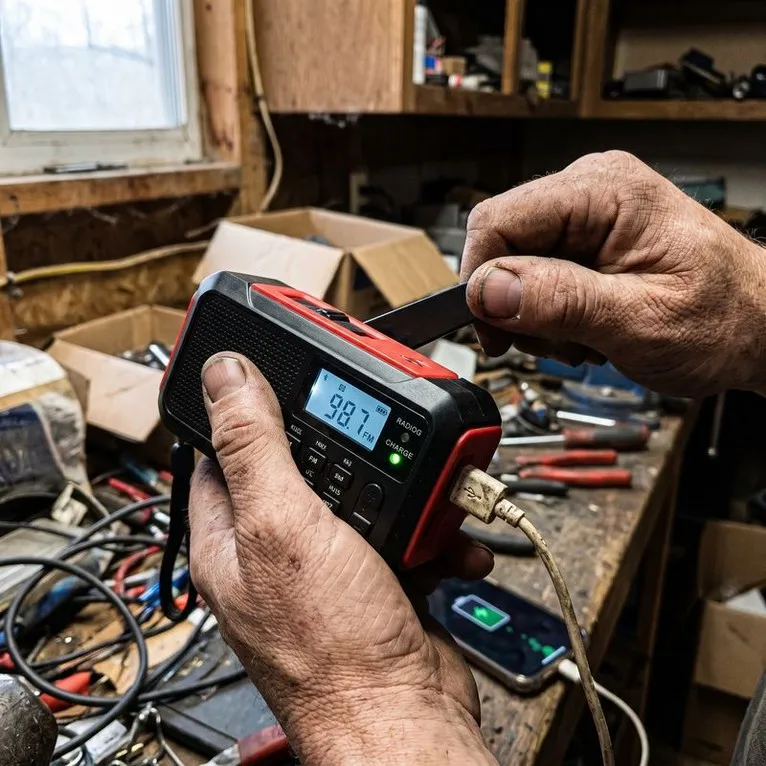
The crank is honest backup, nothing more. The book's field note: "Two minutes of hard cranking buys a few minutes of radio and a sliver of phone charge. The crank is the backup's backup; the panel and banks are the plan." The FCC suggests checking the radio's manual before using it to charge a phone, and the book says to test it on arrival: crank two minutes and confirm that both the radio and the USB output work. Our hand-crank emergency radio guide covers what to buy.
A charged laptop or tablet can recharge a phone over a USB cable, according to the FCC, though it drains the computer's battery. A battery power station does the same job at a larger scale; see what size solar generator you need. If you run a fuel generator to charge things, it stays outdoors, at least 20 feet from the house, as our generator safety guide explains.
Make every charge last longer
- Low-power mode first. The book's first-hour plan includes "phones to low-power mode" in its first 20 minutes.
- Text instead of calling. The FCC says texts may go through when a call won't, and limiting calls also saves battery and frees the network for emergencies.
- Get news from the radio. The book's rhythm for the first 48 hours is the radio on the hour and off between, to save batteries.
- Keep a corded landline if you have one. The FCC notes that traditional phone service may work in an outage with a corded phone, while many cordless phones need power. Home phone service that runs over broadband will not work without a battery or other backup power source, so test that battery before storm season.
- Sign up for local alerts before the season starts, as the FCC and FEMA recommend.
Decide in advance who calls whom, so a dying battery isn't spent tracking people down. Our family emergency communication plan template sets that up in one evening.
Frequently asked questions
How can I charge my phone without electricity?
Use a charged power bank first, then refill it from a small USB solar panel, a car parked outdoors with the engine running, a laptop over USB or a battery power station. A hand-crank radio with a USB port can add a little charge for an emergency text, but it is a last resort.
Is it safe to charge my phone in the car during a power outage?
Yes, if the car is outdoors in open air. The CDC says never to run a car or truck in a garage attached to a house, even with the door open. Clear snow from the tailpipe first, keep the charging session short, and never sleep in a running vehicle.
Can a hand-crank radio charge a phone?
Many can, through a USB port, but only a little. The Off-Grid Handbook says two minutes of hard cranking buys a few minutes of radio and a sliver of phone charge. Check the manual first and treat the crank as the backup's backup behind power banks and solar.
How do I make my phone battery last during a power outage?
Turn on low-power mode, dim the screen, close apps you don't need and send texts instead of making calls. The FCC says texts often go through when calls don't. Get news from a battery or crank radio rather than streaming it on the phone.
Sources
- The Off-Grid Handbook, Garrett Dalton, Project 23
- FCC/FEMA: Tips for Communicating During an Emergency
- FCC: Tips for Communicating in an Emergency
- CDC: About Carbon Monoxide Poisoning
- CDC: Clear Snow from Tailpipes
- Ready.gov: Build a Kit
Safety guidance changes. Check the agency pages above for the current version, and follow your local code and manufacturer instructions.