How long do power outages last? What the national data says, and how to plan
Most outages are over before the freezer starts to warm. The ones worth planning for are the storms that aren't.
In this article
How long do power outages last? Most last from a few minutes to a few hours, but outages after major storms can last days. In 2024 the average US electricity customer went without power for a total of about 11 hours over the whole year, according to the U.S. Energy Information Administration (EIA). Routine outages accounted for only about two of those hours. Major events such as Hurricanes Beryl, Helene and Milton accounted for nearly nine, or 80% of the total.
So the useful question for a household is not the average. It is how long the longest outage you are likely to face could run, and what has to keep working until it ends. The Off-Grid Handbook plans in stages: the first hour, the first 48 hours, and about three days for its battery math.
How long do power outages last on average?
The EIA measures reliability with an index called SAIDI: the total hours an average customer is without power over one year. It is a yearly total, not the length of a single outage.
| Year | Total hours without power, average customer | Routine outages only |
|---|---|---|
| 2022 | About 5.6 hours | About 2 hours |
| 2024 | About 11 hours | About 2 hours |
The EIA says the 2024 total was nearly twice the annual average of the decade before. Two patterns stand out. Routine interruptions have stayed near two hours a year for more than a decade, and the swings from year to year come from big storms. EIA's December 2025 report counted the 2024 figure as the most hours without power in ten years.
Outages are also less frequent than many people fear. The EIA counted an average of 1.5 interruptions per customer in 2024. Hawaii led with 4.4, while South Dakota, Maryland, Illinois and Massachusetts averaged less than one.
How long do power outages last after a storm?
Here the averages hide a lot. In 2024, the EIA found that customers in South Carolina averaged nearly 53 hours without power, most of it from Hurricane Helene, with North Carolina and Florida next. States such as Arizona and Massachusetts averaged under two hours.
In February 2021, Winter Storm Uri left more than 4.5 million people in Texas without power, some for as long as four days, according to the federal report on the event by FERC and NERC. Ice storms, hurricanes and deep cold are the outages to plan for. Our guides to preparing for an ice storm and the winter storm preparedness checklist cover the season.
Average power outage length vs what to plan for
The book's planning answer is in the field note of Project 24: "Three days covers the overwhelming majority of grid events." Its honest metric is days of autonomy: usable battery watt-hours divided by your audited daily load. It suggests chasing more only after water and food are equally deep.
Three days also lines up with federal guidance. Ready.gov's basic kit calls for water at one gallon per person per day for several days, and at least a several-day supply of non-perishable food. The book's water chapter cites the same FEMA and Ready.gov baseline, with a three-day minimum and two weeks as the working target for a capable household.
The book's Chapter 2 frames the goal well: not to take a house off the grid, but to make a household indifferent to losing it. Communications, light, refrigeration and medical devices make up the real emergency load, and it is far smaller than most people assume.
What runs out first, hour by hour
| Time without power | What is at stake | What to do |
|---|---|---|
| First hour | Water pressure, if your supply depends on power; light | Fill containers while pressure lasts; lights and radio on |
| 4 hours | Refrigerated food | Keep the fridge shut; USDA says food stays safe up to 4 hours |
| About 1 day | A half-full freezer; refrigerated medicine | Ready.gov: after more than a day, discard medicine that needs refrigeration unless the label says otherwise |
| About 2 days | A full freezer, which holds about 48 hours closed | Move to coolers and ice, or cook it |
| 3 days and beyond | Stored water, batteries, fuel, heat in winter | Ration to your thresholds; find a warming or cooling location if needed |
The book's Chapter 0 explains why the first hour matters most: water pressure that fills a bathtub in minute ten can be gone by hour three, and a freezer opened repeatedly in hour one is a food loss by day two. For the food rules in detail, read how long food lasts in the fridge without power.
The first 48 hours: a rhythm, not a scramble
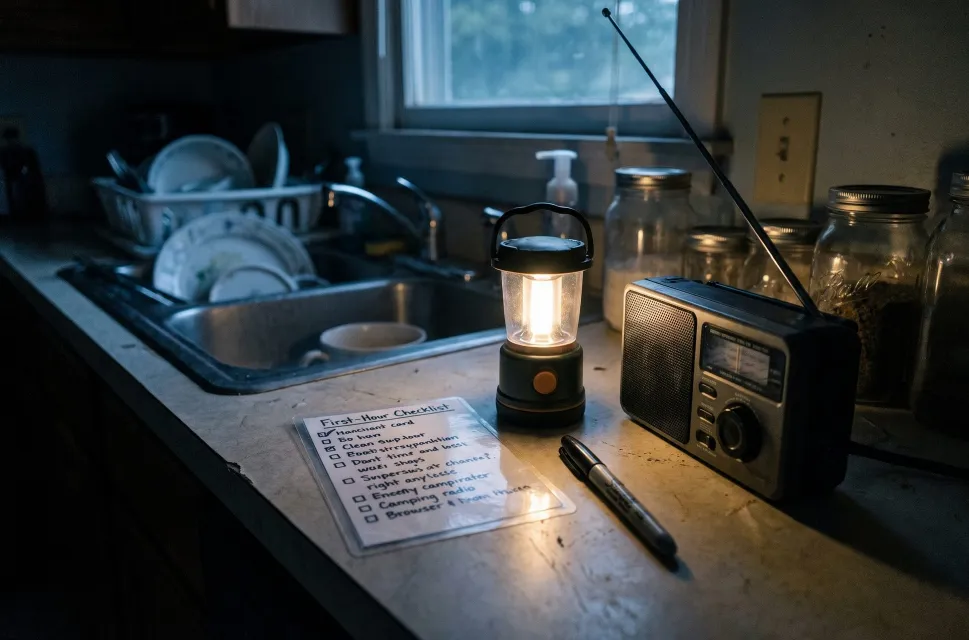
Chapter 0 of the book, the First-Hour Plan, starts with a triage block designed to take about 20 minutes: people accounted for, hazards checked, water filled, fridge and freezer shut with the start time written on the door, lights and radio on, and a one-minute household agreement on what happens next.
After that, the plan becomes a rhythm: water discipline, meals from storage, power spent against the audit, the radio on the hour and off between to save batteries, and rest in rotation, "because tired people make the expensive mistakes." Our guide to what to do when the power goes out follows that sequence, and how to prepare for a power outage sets it up in advance.
How to estimate how long your outage will last
Write the start time on the fridge door in marker, as the book's triage block says. Every food decision after that becomes a reading of the clock instead of a guess.
Report the outage to your utility and check its outage map or text alerts for an estimated restoration time. Estimates can change as crews assess damage, so plan around the longer end. Keep a battery or crank radio on for local news, and keep phones charged for alerts; our guide to charging a phone during a power outage lists the options.
If heat or cold is extreme, Ready.gov advises going to a community location with power. If anyone in the house depends on powered medical equipment, talk with your medical provider about an outage plan now, while the lights are on.
Frequently asked questions
How long do power outages usually last?
Most last from a few minutes to a few hours. In 2024 the average US customer was without power about 11 hours over the whole year, according to the EIA, but only about 2 of those hours came from routine outages. The rest came from major storms, which can cut power for days.
How long do power outages last after a storm?
It varies with the storm. In 2024, customers in South Carolina averaged nearly 53 hours without power, mostly from Hurricane Helene. In February 2021, Winter Storm Uri left more than 4.5 million Texans without power, some for as long as four days, according to FERC and NERC.
How many days should I prepare for a power outage?
Plan for at least three days. The Off-Grid Handbook says three days covers the overwhelming majority of grid events, and Ready.gov's kit calls for water and food for several days. The book treats two weeks of water as the working target for a capable household.
How long will food last in the fridge during a power outage?
USDA says a closed refrigerator keeps food safe for up to 4 hours. A full freezer holds about 48 hours with the door closed, and a half-full freezer about 24. Throw away food that has been above 40°F for two hours or more.
Sources
- The Off-Grid Handbook, Garrett Dalton, Project 24
- U.S. EIA: Hurricanes in 2024 led to the most hours without power in 10 years (December 2025)
- U.S. EIA: U.S. electricity customers averaged about five and one-half hours of power interruptions in 2022 (January 2024)
- FERC: Final Report on February 2021 Freeze Underscores Winterization Recommendations
- Ready.gov: Power Outages
- Ready.gov: Build a Kit
- CDC: Protect Yourself During a Power Outage
Safety guidance changes. Check the agency pages above for the current version, and follow your local code and manufacturer instructions.