How to prepare for an ice storm: trees, pipes, one warm room and the first night
Ice brings down limbs and lines, and the power can stay off for days. Most of the preparation happens before the forecast turns.
In this article
Here is how to prepare for an ice storm: do the outside work first and the inside work second. Have dead or overhanging limbs taken down well before the ice, protect exposed pipes, top up the fuel for anything you cook or heat with, and pick one small room the household will keep warm if the power fails. Then plan for several days without power, because ice brings down trees and lines and repairs take time.
The Off-Grid Handbook puts this work on the calendar. Project 72, The Seasonal Build Order, starts from a simple premise: the system that must be ready in January was built in October. This guide follows that order, checked against National Weather Service, CDC and Ready.gov guidance.
What an ice storm does to a house
Freezing rain falls as liquid and freezes on contact with anything at or below 32°F: branches, wires, steps, cars. The National Weather Service usually issues an Ice Storm Warning for around a quarter inch of ice or more, an amount it says makes travel dangerous or impossible.
The weight is the problem. NWS notes that heavy ice can bring down trees and topple utility poles, and that even small amounts make roads and walkways dangerous. Crews cannot restore power until fallen trees are cleared and lines rebuilt, and they drive the same icy roads as everyone else.
For a household, that means three jobs: keep trees off the roof, keep pipes from freezing, and keep people warm and safe until the lines are back.
How to prepare for an ice storm: the outside work
Project 72 calls autumn the heavy quarter of the year, the work done before winter peak. For ice, three items on its list matter most.
- Trees and roof. Project 8's roof inspection calls for no crumbling shingles, no moss mats and no overhanging deadwood. Dead limbs over the roof, the driveway or the power lines are the first to come down under ice. Have a tree professional remove them, and leave anything near a power line to the utility.
- Outdoor water. Project 12 drains rain barrels to one-quarter full or empty before the first hard freeze, opens spigots and low points, and wraps what stays outside. The book's field note: a quarter-full barrel survives most freezes; a full one splits.
- Fuel and chimney. Fill fuel for the outdoor cooking station and any generator before the forecast turns, and have the chimney serviced if you burn wood.
The book's safety note on Project 8 applies to all of it: ladder work causes more household injuries than any project in the book. Use a stabilizer, keep three points of contact, and never work at a roof edge alone or in wind. Once ice is in the forecast, stay off the ladder.
Ice storm preparedness checklist
| Task | Why it matters | In the Handbook |
|---|---|---|
| Dead limbs removed over roof, drive and lines | Ice-loaded limbs break first | Project 8 |
| Exposed pipes sleeved, main shutoff found and tagged | A burst pipe floods the house in the same week | Project 59 |
| Warm room chosen and staged | One room can be kept warm without power | Project 49 |
| Battery CO alarm on every level, tested | Outages bring improvised heat | Project 52 |
| Flashlights and a battery or crank radio | Light and news without the grid | Projects 29 and 23 |
| Stored water, one gallon per person per day | Pumps and pressure can fail | Project 5 |
| Prescriptions refilled, medical devices planned | Roads can stay impassable for days | Ready.gov |
| Car fuel tank full, car kit packed | Ready.gov's winter advice | Ready.gov |
Ready.gov's winter guidance is to gather supplies in case you need to stay home for several days without power, keeping in mind each person's needs, including medication and pets, with extra batteries for radios and flashlights. The full list is in our winter storm preparedness checklist.
Ice storm power outage preparation: one warm room
Most homes cannot hold their heat for days without the furnace, so the Handbook stops trying. Project 49, The One Warm Room, picks a small, south-facing room with few windows and few exterior walls, ideally on the same floor as a bathroom. A heavy blanket on a spring rod seals the doorway, rugs cover the floor, and the household sleeps there together.
The book's body-heat math: four people give off about 400 watts continuously, which in a small sealed room works like a heater. Project 49 takes about an hour of planning and roughly $40 in materials, per the book, and households that chose the room in advance settle in hours faster. The full setup is in how to stay warm without power.
Protect the plumbing in the rooms you stop heating. Project 59's cold-snap rule is cabinet doors open on plumbing walls and a pencil-thin drip at the farthest faucets, because moving water resists freezing. Our guide to keeping pipes from freezing when the power is out covers when to shut the main and drain the lines.
Safe heat and the generator rules
A long, cold outage is when people bring the grill inside or run the oven for warmth. Ready.gov and CDC are plain about it: never heat the home with a gas stove or oven, and grills and camp stoves belong outdoors only.
- A portable generator runs outdoors only, at least 20 feet from any window, door or vent, per CDC, and never in a garage, even with the door open.
- A fuel-burning space heater must be a model made for indoor use, run exactly as its manual says. CDC says to keep any heater at least 3 feet from drapes, furniture and bedding.
- Keep the outdoor exhaust vents of the furnace and water heater clear. Texas health officials linked some 2021 storm deaths to ice blocking the vents of gas heating equipment.
- Install battery CO alarms on every level, as Ready.gov advises. CDC lists the common symptoms of carbon monoxide poisoning as headache, dizziness, weakness, upset stomach, vomiting, chest pain and confusion. If anyone has them, get everyone to fresh air and call 911.
Running house circuits from a generator takes an interlock or transfer switch installed by a licensed electrician, never a cord plugged into a wall outlet. Our guide to generator interlock kits explains what to ask for.
Trees and power lines after the ice
As the ice melts, limbs keep falling, so stay out from under trees until it is gone. CDC's rule for fallen lines is short: never touch a fallen power line, and call the power company to report it. Treat every downed wire as live, and keep children and pets well away.
NC State Extension adds two cautions for cleanup: never cut limbs tangled in power lines, and if removing a branch needs a ladder or a chainsaw, strongly consider hiring a tree care professional.
The first hour when the lights go out
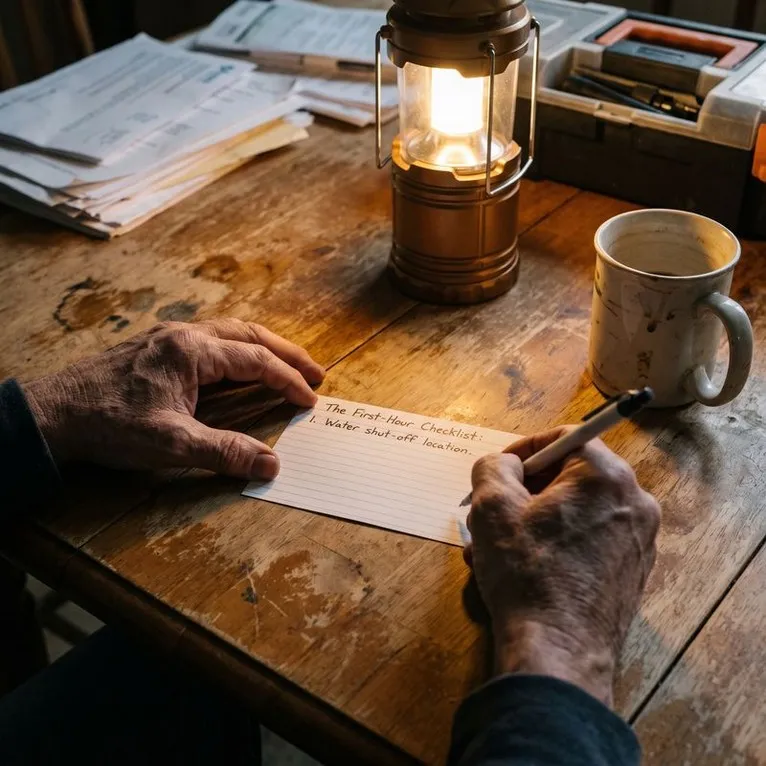
Project 61 of the Handbook turns the first 20 minutes into a laminated card: people accounted for, hazards checked, water drawn while pressure lasts, fridge and freezer shut with the outage time written on the door, lights up, radio on. A closed refrigerator keeps food cold for about 4 hours and a full freezer for about 48, per Ready.gov; our guide to how long food lasts in the fridge without power covers what to keep.
The rest of the hour activates the warm room, checks on neighbors and sends a short status report to an out-of-area contact. Older neighbors living alone deserve the first knock, and our guide to keeping elderly people warm in winter covers what to watch for. Ready.gov lists the signs of hypothermia as shivering, exhaustion, confusion, fumbling hands, memory loss, slurred speech or drowsiness. If the house cannot be kept warm, a community warming center is the right call.
Frequently asked questions
What should you do to prepare for an ice storm?
Before the season, have dead and overhanging limbs removed, drain outdoor water lines and barrels, and sleeve exposed pipes. Before the storm, gather supplies to stay home for several days without power, including water, medication, flashlights, a battery radio and batteries, and choose one small room to keep warm. Test battery CO alarms on every level.
How long can the power stay out after an ice storm?
It depends on how much ice falls and how many trees and poles come down, so there is no fixed answer. Crews have to clear fallen trees and rebuild lines before power returns, often on icy roads. Ready.gov advises having supplies to stay home for several days without power, which is a sensible planning baseline.
Is it safe to run a generator during an ice storm?
Only outdoors, at least 20 feet from any window, door or vent, and in a spot where rain and snow will not reach it, per CDC. Never run it in a garage, even with the door open, or on a porch. Connect appliances with outdoor-rated cords, and use a transfer switch or interlock installed by a licensed electrician for house circuits.
What should I do if a power line falls in my yard?
Stay away from it and keep others away, including pets. CDC says never to touch a fallen power line and to call the power company to report it. Treat every downed wire as live, and do not try to move it or cut limbs tangled in it. If someone has been shocked, do not touch them; call 911.
Sources
- The Off-Grid Handbook, Garrett Dalton, Project 72
- National Weather Service: Winter Weather Warnings, Watches and Advisories
- National Weather Service: Ice Storms
- Ready.gov: Winter Weather
- Ready.gov: Power Outages
- CDC: Safety Guidelines During and After a Winter Storm
- CDC: What to Do to Protect Yourself From Electrical Hazards
Safety guidance changes. Check the agency pages above for the current version, and follow your local code and manufacturer instructions.