How to prepare for a power outage: a checklist you can finish in one weekend
Most power outage preparedness is organization, not equipment. Here is the order to do it in, and the card that holds it together.
In this article
How to prepare for a power outage comes down to six things you set up before you need them: carbon monoxide and smoke alarms, stored water, lights, food that needs no fridge, a way to charge phones, and a plan for anyone who depends on electricity for their health. Then write a one-page first-hour card, so nobody has to think when the lights go out.
That order comes from The Off-Grid Handbook. Its closing Project 75 ranks all 75 projects by "risk retired per dollar and per hour," and Phase 1, the first weekend, comes in under $250 all-in. Project 61, the first-hour checklist, is the single page the whole book funnels into.
How to prepare for a power outage: start with organization
Power outage preparedness is mostly planning. The book's field note on Phase 1 is worth reading twice: it contains "almost no hardware and almost no money. The order is deliberate." Capability starts as organization, becomes habit, and only then becomes equipment.
Phase 1 is six projects: a carbon monoxide and smoke alarm grid, water storage, a water disinfection station, blackout lighting, the first-hour checklist and household roles. Phase 2, the first month, adds crank and pocket power, a 30-day pantry, a communications plan, sleep systems and a designated warm room.
Ready.gov's first step fits right in: take an inventory of the items you need that rely on electricity. Walk the house with a notepad. Medical devices, the refrigerator, a well pump, phones, the furnace blower and the garage door opener all belong on the list.
Power outage preparedness checklist
| Item | Why it matters |
|---|---|
| Battery-backed CO and smoke alarms on every level | Generators and fuel-burning heaters make carbon monoxide; Ready.gov asks for working CO detectors on every level |
| Water: one gallon per person per day for several days | Ready.gov's kit baseline; the book targets three days minimum and two weeks as the goal |
| A flashlight for every household member | Ready.gov's advice; lanterns for rooms, headlamps for hands-free work |
| Several days of non-perishable food and a manual can opener | Meals that need no fridge and little or no cooking |
| Appliance thermometers in the fridge and freezer | USDA's 40°F and 0°F lines turn a guess into a reading |
| Power banks and a battery or crank NOAA weather radio | Alerts, news and phone charge with no grid |
| Coolers and a stack of frozen water bottles | Ice for food now, drinking water later |
| Blankets, sleeping bags and warm coats | The CDC lists them for outages in cold weather |
| Medicines and a plan for powered medical devices | Talk to your medical provider now, per Ready.gov |
Our 72-hour kit checklist goes item by item, and power outage lighting covers lights that are safer than candles.
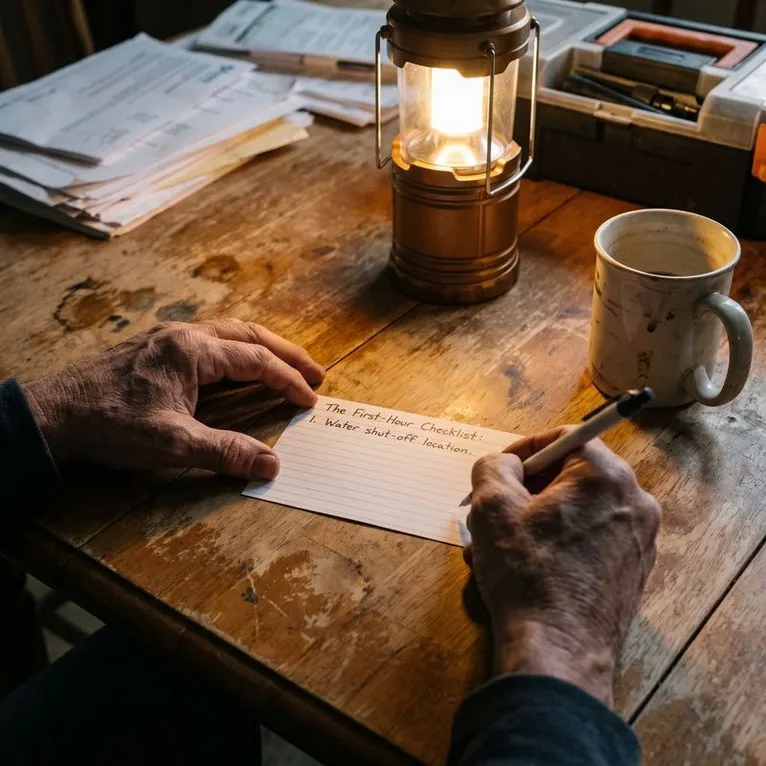
Write a first-hour card
Project 61 takes one evening and about $10. The card has three blocks.
- Minutes 0 to 20, triage: people accounted for and unhurt; hazards checked for gas smell, water, sparks and damage; water containers filled while pressure lasts; fridge and freezer doors shut, with the outage start time written on the door in marker; lights up; radio on; household status agreed.
- Minutes 20 to 60, stabilizing: the warm room set up if it is cold, backup power deployed by the safety rules, neighbors checked, and a first short report sent to an out-of-area contact.
- The first 48 hours, headers only: water discipline, menu, power budget, radio on the hour and off between, rest rotation.
The book's design rule: verbs first, one line per action, readable by flashlight. Give each line an owner by name, put a copy in the kitchen, the warm room and each car, and run it once as a drill. If the triage block takes 40 minutes, the book says, it needs shorter lines or better staging, not faster people. Keep the master copy in your household binder, and see what to do when the power goes out for the full sequence.
Food, water and medicine
USDA says to keep the refrigerator at 40°F or below and the freezer at 0°F or below. A closed fridge keeps food safe for up to 4 hours without power, and a full freezer holds about 48 hours (24 if half full). After the outage, Ready.gov says to throw away any food exposed to 40°F or higher for two hours or more.
The book's Project 43 keeps frozen water bottles in the freezer as standing policy: thermal mass every day, cooler ice in an outage, drinking water once melted. Our guides to water during a power outage and food in the fridge without power cover both in depth.
For medicine, Ready.gov advises finding out how long each one can be stored at higher temperatures, and, if the power is out for more than a day, discarding medicine that should be refrigerated unless the label says otherwise. Your pharmacist can tell you which of yours are affected.
Backup power, done safely
A generator runs outdoors only, at least 20 feet from windows, doors and vents, per the CDC, and never in a garage, even with the door open. Appliances plug into it with heavy-duty outdoor cords. House circuits connect only through a transfer switch or interlock installed by a licensed electrician; the book says there is no DIY version of that step. Our generator safety guide covers the rules.
Ready.gov is just as clear on heat: never use a gas stovetop or oven to heat your home. For quiet power indoors, a battery station or a small solar setup is the safer route, and our guide to charging a phone during a power outage starts small.
Prepare by season
Project 72 opens with a line every household should keep: "the system that must be ready in January was built in October." Its autumn block covers gutters and roof prep, water winterization, a sealing pass on drafty windows and doors, fuel stocks topped up, chimney service and a drill with a cold-season focus. Spring brings a storm-kit check before severe-weather season, and summer adds hurricane readiness where it applies.
The book's reasoning is humility about human nature: nobody insulates in January or fixes gutters in a storm. Schedule the work while it is merely a chore. If winter is the risk where you live, start with the winter storm preparedness checklist, and put the drill on the calendar for a cold evening in November.
Frequently asked questions
What should I do to prepare for a power outage?
Install battery-backed carbon monoxide and smoke alarms, store water, put a flashlight within reach of every person, stock food that needs no fridge, keep power banks charged and make a plan for anyone who uses powered medical equipment. Then write a short first-hour checklist and run it once as a drill.
What should be in a power outage kit?
Water for several days at one gallon per person per day, non-perishable food and a manual can opener, flashlights and spare batteries, a battery or crank NOAA weather radio, power banks, appliance thermometers, a cooler, blankets, medicines and copies of important phone numbers. Our 72-hour kit checklist goes item by item.
How much water should I store for a power outage?
Ready.gov's baseline is one gallon per person per day for several days, for drinking and sanitation. The Off-Grid Handbook treats three days as the minimum and two weeks as the working target. Store extra for pets, and fill containers right away if your water depends on power.
How do I keep food safe when the power goes out?
Keep the fridge and freezer closed. USDA says a closed fridge keeps food safe for up to 4 hours and a full freezer about 48 hours. Use appliance thermometers, and throw away food that has been above 40°F for two hours or more. When in doubt, throw it out.
Sources
- The Off-Grid Handbook, Garrett Dalton, Project 61
- Ready.gov: Power Outages
- Ready.gov: Build a Kit
- CDC: Protect Yourself During a Power Outage
- USDA FSIS: Keep Your Food Safe During Emergencies
- CPSC: Carbon Monoxide Information Center
Safety guidance changes. Check the agency pages above for the current version, and follow your local code and manufacturer instructions.