Generator maintenance: how often to run it and what to check
A generator that sits for a year is a gamble on the worst night of the year. Fifteen minutes a month turns it back into equipment.
In this article
Good generator maintenance comes down to one habit: run the generator once a month for about 15 minutes under load, outdoors and at least 20 feet from the house. That is the rule in Project 25 of The Off-Grid Handbook. Add fuel discipline (stabilized fuel, rotated, stored outside the living space) and service the oil, air filter and spark plug on the schedule in your owner's manual. That covers almost everything that makes generators fail when they're needed.
Penn State Extension's advice on generator upkeep is the same in spirit: consult your owner's manual or a service technician for your generator's specific requirements and service intervals.
How often should you run your generator?
Monthly. The Handbook's fifth step for generators reads: fuel discipline, stabilized fuel rotated yearly and stored outside living space; monthly 15-minute test run under load.
"Under load" is the important part. Starting the engine and letting it idle tells you it starts. Plugging in something real, like a work light, a fan or the refrigerator on an outdoor-rated cord, tells you it can do the job. It also lets you hear how the engine handles a load, and it gives every adult in the house a chance to practice the routine in daylight instead of during a storm.
A monthly test also keeps the household honest about the other parts of the system: the cords, the fuel cans and the carbon monoxide alarms.
The monthly test run, step by step
- Roll it to its spot. Outdoors, at least 20 feet from the house, exhaust pointed away from doors, windows and vents. Never in a garage, even with the door open. See why a generator can't go in the garage.
- Check the oil level and the fuel gauge before starting, as your manual directs.
- Start it and plug in a real load with an outdoor-rated cord sized to that load. Our guide to generator extension cords covers gauge and length.
- Let it run about 15 minutes. Listen for surging, stalling or new noises, and watch for leaks.
- Unplug the load, then shut it down. Let it cool before you refuel or move it. OSHA warns that generators stay hot long after they stop and that spilled fuel can ignite on hot engine parts. Utah's Be Ready program suggests waiting 20 minutes.
- Log it in the household binder: date, run time, anything odd.
If anyone feels a headache, dizziness, nausea or weakness while a generator is running, get everyone to fresh air right away, then call 911. Our guide to carbon monoxide poisoning symptoms has the full list.
Portable generator maintenance checklist
| When | Task |
|---|---|
| Monthly | 15-minute test run under load; check oil level; test CO alarms by button |
| Monthly | Inspect cords: OSHA says never use frayed or damaged extension cords |
| Before storm season | Fresh stabilized fuel; spare oil on the shelf; cords and canopy staged |
| Per the owner's manual | Oil changes, air filter, spark plug |
| At least yearly | Rotate stored fuel; full inspection; confirm the manual is in the binder |
Oil change intervals differ from engine to engine, and many manuals call for an early first change on a new engine. Penn State Extension stresses using the proper weight of oil for your engine and climate. Keep a quart of the right oil with the generator, which Utah's Be Ready program also recommends.
What to look for during a visual check
Penn State Extension suggests watching for combustible material near the exhaust and for dirt or dust buildup. Add a look at the fuel line for cracks, the pull cord or battery for wear, and the frame for anything loose.
Fuel: the part that fails most often
Old gasoline is the classic reason a generator won't start. Maine's Department of Environmental Protection advises against storing gasoline more than 30 days without a fuel stabilizer. With a stabilizer, follow the product label and rotate the fuel. The Handbook rotates stabilized fuel yearly; if the stabilizer's label gives a shorter time, use the shorter one. Our guide to how long gasoline lasts has the details.
- Store fuel outside the living space. OSHA says not to store generator fuel in your home and to keep it in approved, vented containers away from flames and heat sources, including the generator itself.
- Before storing the generator for months, Utah's Be Ready guidance is to use up the fuel in the tank or add stabilizer so it doesn't go bad and damage the engine. Follow your manual on which.
Generator maintenance between seasons
Store the generator clean, dry and covered; Penn State Extension notes that a cover reduces exposure to dust and other debris. Keep it where you can wheel it out easily, with the cords, a funnel and the manual nearby. Moisture matters even in storage: OSHA says to keep a generator dry and never to use electrical equipment that has been submerged until it has been dried out and properly evaluated.
Keep the manual with the generator or in the household binder, along with a note of the last oil change and the date the fuel was stabilized. Whoever does the next test run will know where things stand.
Check that the generator still fits the household. If you've added a freezer or a medical device since you bought it, re-run your watt-hour audit and compare the total with the generator's running watts. And if anyone has asked about plugging it into the house, the answer stays the same: house circuits only through an interlock or transfer switch installed by a licensed electrician. See generator interlock kits.
Put it on the household calendar
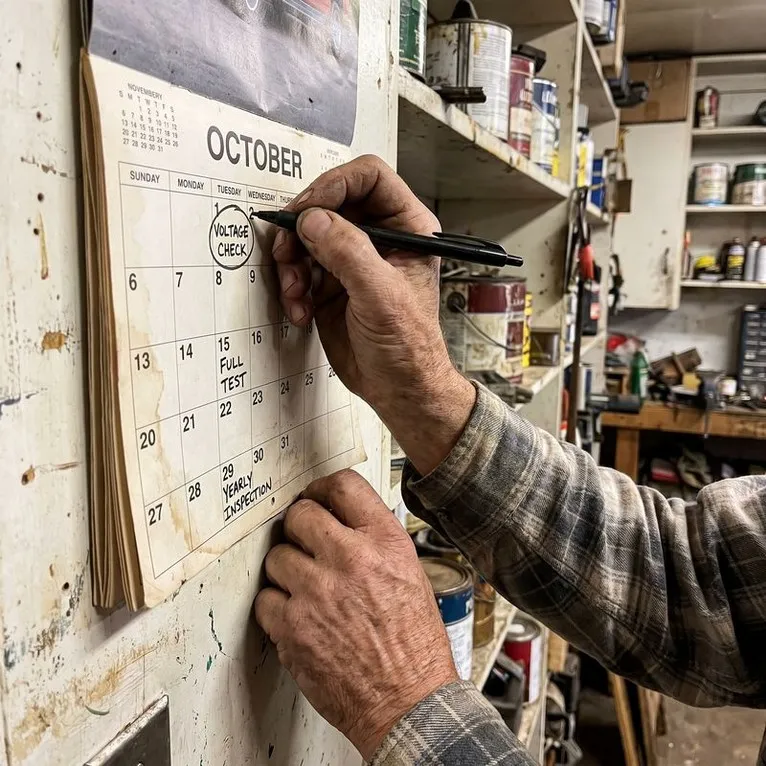
The Handbook's Project 30, the Load Test and Maintenance Cycle, ends with a standing calendar for the whole power system: monthly voltage check, quarterly full test evening, yearly fuse-board inspection and battery capacity check. The generator's monthly run fits on the same day as the battery voltage check, so one date covers both. Our guide on how to load test a battery bank covers the battery side.
As the book's field note puts it, an untested system is a hypothesis. Fifteen minutes on a calm afternoon is what turns a generator in the shed into one you can count on, and it's the right time to review the rules for running it overnight and in the rain.
Frequently asked questions
How often should you run a portable generator?
Once a month for about 15 minutes with a real load plugged in, outdoors and at least 20 feet from the house. That is the routine in The Off-Grid Handbook. It confirms the engine starts and carries a load, and it keeps the household practiced.
How often should you change the oil in a generator?
Follow your owner's manual. Intervals differ between engines, and many manuals call for an early first oil change on a new engine. Penn State Extension advises consulting the manual or a service technician for your generator's specific service intervals and using the right oil weight for your engine and climate.
Should you leave gas in a generator?
Follow your manual. Utah's Be Ready program advises using up the fuel or adding a fuel stabilizer before storing a gasoline generator for more than a few months. Maine's environmental agency advises against storing gasoline more than 30 days without a stabilizer.
How long should a generator cool before refueling?
Shut it down and let it cool first. OSHA warns that generators stay hot long after they stop and that spilled fuel can ignite on hot engine parts. Utah's Be Ready program suggests waiting 20 minutes after shutting it off.
Sources
- The Off-Grid Handbook, Garrett Dalton, Project 25
- Penn State Extension: Generator Checkup, Meaningful Maintenance for Safe Service
- OSHA Fact Sheet: Using Portable Generators Safely
- Be Ready Utah: Generator
- Maine DEP: Tips for Handling Gasoline
- CPSC: Winter Storm Safety Tips on Carbon Monoxide and Fires (December 2025)
Safety guidance changes. Check the agency pages above for the current version, and follow your local code and manufacturer instructions.