Battery backup for home without solar: what works and how big to go
You don't need panels on the roof to have backup power. A battery charged from the wall, sized to what really matters, covers most outages.
In this article
A battery backup for home without solar works the same way as one with solar: it charges from your wall outlet while the grid is up and carries your critical loads when it goes down. The simplest version is a portable power station kept charged and ready. A step up is a 12-volt LiFePO4 battery box charged by a plug-in charger. Whole-home batteries wired into the electrical panel also exist; those are installed by licensed electricians with permits. Whatever you choose, size it from your own critical load, not from the box.
Solar panels are a way to refill a battery during a long outage. They aren't required to own one.
How battery backup works without solar panels
A battery stores energy and gives it back later. Without panels, the cycle is simple: charge from the wall, store it, use it in the outage, recharge when power returns. During a long outage, you have other ways to refill it:
- The car. The Handbook's Project 28 turns a vehicle into a small charging node. See using a car as a generator.
- A generator, outdoors and at least 20 feet from the house, charging the station through an outdoor-rated cord.
- Panels added later, if you decide you want them.
The Off-Grid Handbook treats this kind of setup as normal. Project 18's battery box charges "from the Project 16 station or a mains LiFePO4 charger," and Project 27 calls commercial power stations a legitimate shortcut: battery, inverter, controller and outlets in one sealed box.
Three ways to set up battery backup for home without solar
| Option | What it is | Who sets it up |
|---|---|---|
| Portable power station | All-in-one box with AC, USB and 12 V outlets; appliances plug into it | You. About an hour in the Handbook's Project 27 |
| 12 V LiFePO4 battery box | A 50 Ah battery with fused outputs, about 600 usable watt-hours, charged by a plug-in charger | You. About two hours and $180 in the Handbook's Project 18 |
| Installed home battery | A battery system connected to the home's electrical panel | A licensed electrician, with permits and inspection |
The first two stay at the plug-in level: loads plug into the battery or its inverter directly. That is the line the Handbook draws. Its inverter project warns that inverter output is real 120-volt power and must never be wired into household wiring or an outlet, because that is backfeeding and it endangers utility line workers. Anything beyond plug-in use is licensed-electrician territory. Installed home batteries also fall under fire codes such as NFPA 855, which is one more reason they are a professional job.
The Handbook's Gear Guide makes a clear call on the first option: at 500 watt-hours and up, a commercial power station, with inverter and battery management built in, beats the parts bin on price and safety.
How big a home battery backup for a power outage?
Start with Project 17, the Watt-Hour Audit: list only critical loads, multiply each device's watts by its hours per day, and add them up. The Handbook's planning thresholds without a refrigerator:
- Household of 2: about 200 to 300 watt-hours a day.
- Household of 4: about 300 to 450 watt-hours a day.
- Household of 6: about 450 to 600 watt-hours a day.
- A modern refrigerator adds about 1,000 to 1,500 watt-hours a day. Use its measured 24-hour figure.
Project 27 sizes a power station to one to two days of critical load. A household of four using 400 watt-hours a day needs about 800 usable watt-hours for two days, with no fridge. Add the fridge and the same two days need roughly 2,800 to 3,800 watt-hours, which is a large and costly battery. Our guides on sizing a power station and how long one runs a refrigerator do the math in detail.
Check the inverter rating too. The station's continuous watts must cover the largest single thing you'll plug in, including a fridge's startup surge. And be honest about the list: the Handbook's field note on the audit says it usually delivers good news, because the loads that keep a family functioning usually fit in a box you can carry. Phones, lights, a radio and the internet router add up to far less than most people fear.
Battery backup vs generator
A battery is silent, makes no exhaust and can sit in the living room. Its limit is stored energy: when the watt-hours are used, it needs a recharge. A gasoline generator keeps going as long as there's fuel, which suits a fridge through a long outage, but it must run outdoors, at least 20 feet from the house, never in a garage, and the fuel has to be stored and rotated. Many households use both. Our comparison of a solar generator vs a gas generator lays out the trade-offs, and what size generator runs a refrigerator covers the generator side.
Keep the battery charged and safe
- Cycle it fully when it arrives, as Project 27 says, so you know it works and what it holds.
- Store it at the manufacturer's recommended level, with a quarterly top-up. Lithium batteries slowly lose charge while they sit. See how to store lithium batteries long term.
- Buy listed equipment. The NFPA advises using devices listed by a nationally recognized testing laboratory and following the manufacturer's instructions.
- Mind the temperature. The NFPA says not to charge lithium-ion batteries below 32°F or above 105°F. The Handbook's battery project adds: never charge below freezing unless the battery has low-temperature protection.
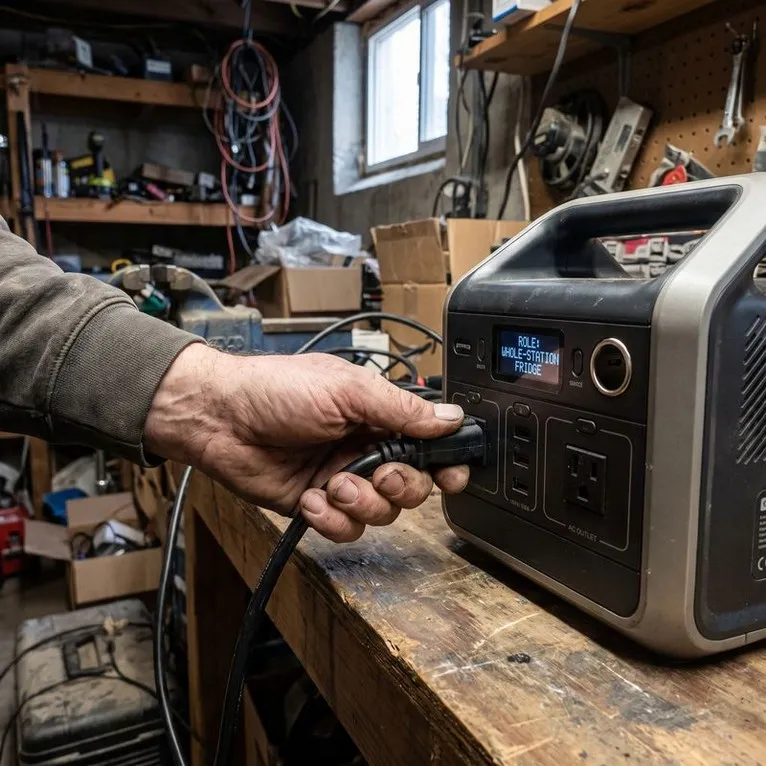
- Give it one job. Project 27's rule: a station assigned to the fridge, or a portable one for the medical device and communications. One box, one job.
If you build the 12-volt box instead, our DIY LiFePO4 battery box guide follows the Handbook's steps: master fuse on the positive terminal, every circuit fused, never bypass the battery management system.
Adding solar later
If you add panels later, the Department of Energy explains that grid-tied rooftop systems are designed to switch off when grid power cuts out, so rooftop panels alone won't keep a house running. A portable panel feeding a power station is the simpler path. Project 27's second step is to confirm the panels fall inside the station's solar input voltage window before connecting. Our solar charging station guide is a good next project.
Frequently asked questions
Can you have battery backup without solar panels?
Yes. A battery charges from a wall outlet while the grid is up and powers your critical loads during an outage. A portable power station is the simplest version. Solar panels only add a way to recharge it during a long outage.
How big a battery backup do I need for a power outage?
Measure your critical daily load in watt-hours and cover one to two days. The Off-Grid Handbook plans about 300 to 450 watt-hours a day for a household of four without a refrigerator; a modern fridge adds 1,000 to 1,500 watt-hours a day.
Can I plug a power station into a wall outlet to power my house?
No. Feeding power into a house outlet is backfeeding, and it can endanger utility line workers. Plug appliances into the battery or power station directly. Connecting a battery to house wiring is a job for a licensed electrician with the proper equipment and permits.
Is a battery backup better than a generator?
For small critical loads, often yes: it is silent, makes no exhaust and can be used indoors. A gasoline generator is better for running a refrigerator for days, but it must run outdoors at least 20 feet from the house and needs stored, rotated fuel.
Sources
- The Off-Grid Handbook, Garrett Dalton, Project 27
- Ready.gov: Power Outages
- U.S. Department of Energy: Solar and Resilience Basics
- NFPA: Lithium-Ion Battery Safety Tip Sheet
- NFPA 855: Standard for the Installation of Stationary Energy Storage Systems
- U.S. Fire Administration: Battery Fire Safety
Safety guidance changes. Check the agency pages above for the current version, and follow your local code and manufacturer instructions.