What size generator to run a refrigerator? Measure the fridge, then size for the surge
A fridge is a small load most of the day and a big one for a few seconds at a time. Size the generator for both moments.
In this article
What size generator to run a refrigerator? For most households a small portable generator does it, as long as it covers two numbers: the fridge's running watts and its startup surge. Read the running watts from the label or a plug-in meter, then make sure the generator can handle a startup draw of up to three times that figure, the Red Cross rule of thumb for motors. Whatever size you choose, the generator runs outdoors only, at least 20 feet from the house.
The Off-Grid Handbook starts every power decision with a measurement, not a guess. Its Project 17, the watt-hour audit, puts a modern fridge at 1,000 to 1,500 watt-hours a day, more than the rest of a typical critical list combined. Here is how to turn that into a generator size.
How many watts does a refrigerator use?
A refrigerator has three power numbers, and each one answers a different question.
- Running watts are what the compressor draws while it is on. This sets the generator's continuous rating.
- Starting watts are the short burst when the compressor kicks on. The Red Cross notes that some machines draw up to three times as much power when starting.
- Watt-hours per day are the total energy over 24 hours. The compressor cycles on and off, so this number decides how much fuel or battery you use, not which generator you buy.
Look for the label inside the door or on the back. If it lists only volts and amps, multiply them. The Red Cross sizing method divides watts by volts to get amps, and it works in reverse: a label reading 115 volts and 6 amps works out to about 690 watts.
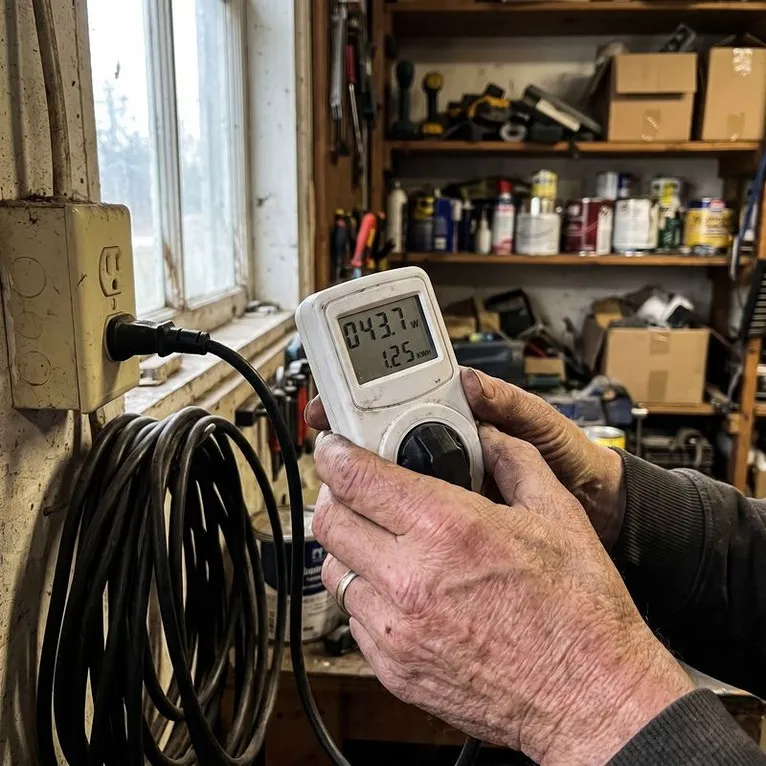
The better tool is a plug-in energy meter, about $20 according to the book. Plug the fridge into it for a full 24 hours. The display shows the real running watts, and at the end of the day you have the true daily watt-hours, which is the number Project 17 asks you to write in your household binder.
What size generator to run a refrigerator: the math
- Write down the fridge's running watts.
- Estimate the starting watts. Use the figure in the manual if it gives one, or plan on up to three times the running watts.
- Add the running watts of anything else that will be on at the same time: a few lights, a phone charger, a fan.
- Check the generator's two ratings. Its running watts must cover step 3. Its starting watts must cover everything running plus the fridge's startup burst.
A worked example with the label above: 690 running watts, a possible startup of about 2,070 watts, and 100 watts of lights and chargers. That calls for a generator rated for at least 800 running watts and roughly 2,200 starting watts. Spec sheets usually list both numbers, so compare them directly.
If you also want a freezer, a well pump or a microwave, repeat the math for each one. The Red Cross suggests staggering when appliances run to prevent overloads, and asking an electrician when your power needs are complicated.
A generator just for the refrigerator
If the fridge is the main reason you want a generator, a smaller unit is often the better buy. The field note in Project 25 puts it plainly: an inverter generator sized to the audit, not to the whole panel, runs quieter, sips fuel, and is the one the household will actually use. The book prefers the inverter type for electronics and fuel economy.
You also do not have to run it around the clock. USDA says a closed refrigerator keeps food safe for up to 4 hours without power, and a full freezer holds for about 48 hours (24 if half full). Many households run the generator in blocks, with an appliance thermometer in the fridge to confirm it stays at 40°F or below, the USDA line for safe refrigerated food.
For the full food timeline, including what to keep and what to throw out, read how long food lasts in the fridge without power.
Connect it safely: cords, not the wall outlet
The book's default is simple: appliances plug into the generator with cords. The Red Cross says to plug in directly or use a heavy-duty, outdoor-rated extension cord rated at least equal to the total connected load, free of cuts, with all three prongs. Our guide to the right generator extension cord covers gauge and length.
Never plug a generator into a wall outlet. That is backfeeding, and the Red Cross warns it puts utility workers, neighbors and your own household at risk of electrocution. If you want the fridge to run from its own outlet on a house circuit, the generator has to feed the panel through a transfer switch or interlock installed by a licensed electrician. Project 25 is blunt: there is no DIY version of this step. Our guide to interlock vs transfer switch explains the difference.
Where the generator goes
The fridge is often in a kitchen next to the garage, which makes the garage feel like the natural spot. It is not. The CDC says never to use a generator inside a home, basement or garage, or less than 20 feet from any window, door or vent. The book calls this "placement is law": outdoors only, exhaust pointed away from the house, never in a garage, even with the door open. Our article on running a generator in the garage explains why.
Put battery-powered or battery-backup carbon monoxide alarms on every level of the home. If anyone feels dizzy, weak or sick while the generator runs, get everyone to fresh air right away and call 911 from outside.
Could a battery do the job instead?
A battery power station is the quiet alternative: no fuel, no exhaust, and it can sit in the kitchen. The catch is energy. At 1,000 to 1,500 watt-hours a day, a fridge needs a large station or a way to recharge it. Our guide to how long a power station will run a refrigerator does that math, and what size solar generator you need walks through the full audit. The same surge rule applies to any inverter, as explained in what size inverter you need.
Frequently asked questions
What size generator do I need to run a refrigerator?
Check the fridge's running watts on its label or with a plug-in meter, then allow for a startup surge of up to three times that figure. Choose a generator whose running watts cover the fridge plus any small loads on at the same time, and whose starting watts cover the surge. Run it outdoors, at least 20 feet from the house.
How many watts does a refrigerator use?
It depends on the model. The label lists the running watts, or volts and amps that you multiply together. A plug-in energy meter left on for 24 hours gives the real figure. The Off-Grid Handbook puts a modern fridge at 1,000 to 1,500 watt-hours a day, because the compressor cycles on and off.
Can I plug my refrigerator into a generator with an extension cord?
Yes. The Red Cross says to plug appliances directly into the generator or use a heavy-duty, outdoor-rated extension cord rated at least equal to the total connected load, free of cuts and with all three prongs. Never plug the generator into a wall outlet, which backfeeds the house wiring and can electrocute utility workers.
Do I need to run the generator all day to keep the fridge cold?
Usually not. USDA says a closed refrigerator keeps food safe for up to 4 hours without power. Many households run the generator in blocks and keep an appliance thermometer in the fridge. If the temperature stays at 40°F or below, the food is in the safe zone.
Can I run the generator in the garage if the fridge is close by?
No. The CDC says never to use a generator inside a home, basement or garage, or less than 20 feet from any window, door or vent. An open garage door does not make it safe. Run a long, outdoor-rated cord from the generator's outdoor spot to the fridge instead.
Sources
- The Off-Grid Handbook, Garrett Dalton, Project 17
- American Red Cross: Safe Generator Use
- CDC: Protect Yourself During a Power Outage
- USDA FSIS: Keep Your Food Safe During Emergencies
- CDC: About Carbon Monoxide Poisoning
- Ready.gov: Power Outages
Safety guidance changes. Check the agency pages above for the current version, and follow your local code and manufacturer instructions.