Interlock vs transfer switch: two safe ways to put a generator on house circuits
Both do the same essential job. The difference is where they sit, how you choose circuits, and who in the house can work them in the dark.
In this article
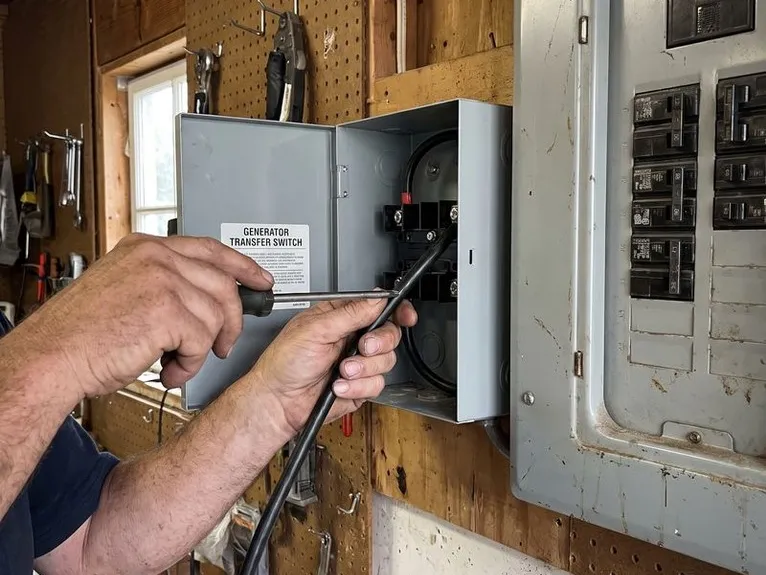
In the interlock vs transfer switch question, both answers are safe: each lets a generator power house circuits without backfeeding the utility lines. An interlock is a plate on your existing main panel that keeps the main breaker and the generator breaker from being on together. A transfer switch is separate equipment that moves selected circuits from utility power to generator power. A licensed electrician installs either one.
The Off-Grid Handbook names both in Project 25 as the only two ways a generator may feed house wiring, and it adds that there is no DIY version of this step. What you can do is understand the choice well enough to have a clear conversation with the electrician.
How an interlock works
Purdue Extension describes a generator interlock kit as a device added to the existing breaker panel so that the main breaker or a designated generator breaker can be on, but not both. The electrician adds a two-pole generator breaker, fits a plate made for that exact panel, and usually installs an outdoor inlet box for the generator cord.
In an outage, the main breaker goes off, the plate slides, and the generator breaker goes on. You then choose what runs by switching ordinary breakers in your own panel on or off. Any circuit in the panel can be used, as long as the generator can carry it.
Because it uses the panel you already have, an interlock usually involves less new equipment than a transfer switch. It does depend on one thing you cannot change: a kit has to exist for your panel's make and model.
The tradeoff is that the choice is yours every time. Someone has to know which breakers to leave off so the generator is not overloaded. We cover the kit itself in generator interlock kit.
How a manual transfer switch works
A transfer switch does the separating with its own hardware. Purdue describes two kinds for home use:
- Individual circuit transfer switch. A box wired to the main panel that carries a short list of essential circuits, about 10 in Purdue's example. Each circuit has its own switch, so you turn on only what is needed for a small generator.
- Whole-house transfer switch. Installed between the electric meter and the main breaker panel.
Standby generators, the permanent kind that start on their own, use an automatic transfer switch. Purdue notes those generators must be large enough to power everything in the house or an essential-only panel.
A manual transfer switch for a portable generator is the most common middle ground. The circuits are chosen once, during installation, and labeled on the switch. In an outage, the household works a short row of clearly marked switches instead of the whole panel.
Interlock vs transfer switch for generator use: side by side
| Interlock | Manual transfer switch | |
|---|---|---|
| What it is | A plate on the main panel that blocks the main and generator breakers from being on together | Separate equipment that moves selected circuits from utility to generator |
| Where it goes | On your existing main panel | Beside the main panel (circuit type) or between meter and panel (whole-house type) |
| How you pick circuits | At the moment, by switching breakers in the panel | Ahead of time, at installation; each circuit has its own labeled switch |
| Main requirement | A kit made for your exact panel | Room to mount and wire the switch |
| Who installs | Licensed electrician | Licensed electrician |
| Easiest for | Someone comfortable working the panel | Anyone in the house, using the labels |
Which one fits your house?
Four questions settle most cases.
- Does an interlock exist for your panel? Purdue notes there are many configurations and the kit must match your breaker box. If none fits, the choice is made for you.
- Who will run it? If the person home during a storm does not know the panel well, a short row of labeled transfer-switch circuits is easier to get right at night.
- How much flexibility do you want? An interlock lets you use any circuit that day. A transfer switch limits you to the circuits wired in, which also limits mistakes.
- Portable or standby? A permanent standby generator comes with an automatic transfer switch, and this comparison no longer applies.
Both setups usually connect to the generator the same way: through an outdoor inlet box on the wall of the house and one heavy-duty cord. Ask the electrician to place the inlet where the generator can sit at least 20 feet from doors, windows and vents with the cord still reaching it. That one placement decision affects safety for as long as you own the house.
Before any quote, write down what you need to run. The Handbook starts its power chapter with exactly this step, the watt-hour audit in Project 17, which lists only the critical loads. Prices vary with the panel, the number of circuits and local permit fees, so ask for a written quote for both options and compare them against that list.
Whatever you choose, many areas require a permit and inspection for this work. Ask the electrician who arranges it, and ask for a written switch-over sequence taped inside the panel door.
What neither one changes
Both devices stop backfeeding. Neither one makes a generator safe to run near the house. The Handbook's three absolute rules still apply: twenty feet, outdoors, CO alarms on every level. The CDC measures the 20 feet from doors, windows and vents, and the CPSC says never in a garage, basement, shed or carport. Our guide to running a generator in the garage covers placement in detail, and carbon monoxide detector placement covers the alarms.
Size comes first, too. The book's field note: an inverter generator sized to your measured load, not to the whole panel, is quieter, uses less fuel and is the one a household actually uses. If your critical loads are small, a battery power station plus an inverter may cover them with no house wiring at all; see what size inverter you need.
And if your plan is cords only, that is the book's default for good reason. Our guide to the right generator extension cord covers gauge and length.
Frequently asked questions
What is the difference between an interlock and a transfer switch?
An interlock is a plate on the main breaker panel that keeps the main breaker and the generator breaker from being on together, so you choose circuits in the panel itself. A transfer switch is separate equipment that moves a pre-selected set of circuits from utility power to generator power, each with its own labeled switch.
Is an interlock as safe as a transfer switch?
When it is made for your panel and installed by a licensed electrician, an interlock does the same essential job: it prevents the generator from backfeeding the utility lines. The real difference is convenience, since a transfer switch limits you to labeled circuits while an interlock leaves the choice to you.
What is a manual transfer switch?
It is a box wired to the main panel that lets you move selected circuits, often around ten essential ones, from utility power to a portable generator by flipping a switch for each circuit. Standby generators use automatic transfer switches instead. A licensed electrician installs either kind.
Can I install a transfer switch or interlock myself?
No. The Off-Grid Handbook states there is no DIY version of this step, and OSHA warns that improper connections can energize utility lines and electrocute workers. Hire a licensed electrician, and ask whether your area requires a permit and inspection.
Sources
- The Off-Grid Handbook, Garrett Dalton, Project 25
- Purdue Extension: Generator Interlocking Circuit Breaker Kit
- OSHA Fact Sheet: Using Portable Generators Safely
- CDC: Use a Generator Safely
- CPSC: Safety Tips to Help Families Prevent Carbon Monoxide Poisoning and Fires
Safety guidance changes. Check the agency pages above for the current version, and follow your local code and manufacturer instructions.