How to store lithium batteries long term: power stations, power banks and battery boxes
A battery bought for emergencies spends most of its life on a shelf. How it sits there decides whether it works on the night you reach for it.
In this article
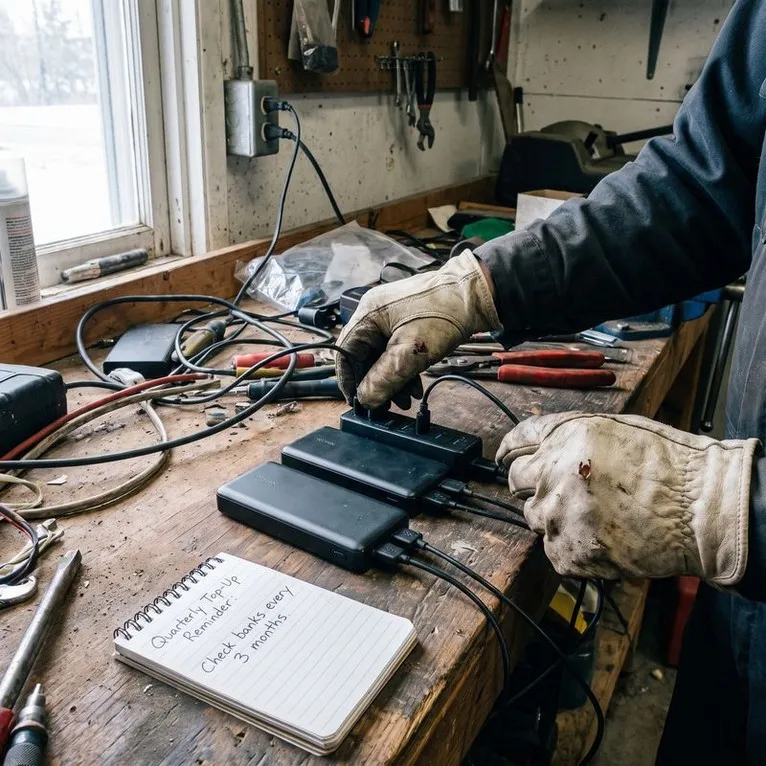
How to store lithium batteries long term comes down to four habits: leave them at the charge level the manufacturer recommends, keep them somewhere cool and dry at room temperature, keep them away from anything that can burn, and top them up on a calendar. The Off-Grid Handbook sets that calendar at every three months, because all lithium banks self-discharge. A battery left alone for a year can be empty, or worse, when the power goes out.
That goes for every lithium battery in an emergency kit: power stations, power banks, the battery in a crank radio and a 12-volt LiFePO4 box.
How to store lithium batteries long term: the short version
- Charge level: what your manual says for storage. Manuals differ, so the Handbook doesn't print one number.
- Temperature: room temperature when possible, out of direct sunlight and out of hot cars, per the NFPA and the U.S. Fire Administration.
- Place: dry and cool, away from anything that can catch fire. OSHA lists dry, cool storage among its controls.
- Calendar: a quarterly top-up and a log of purchase dates.
- Retire it at the first sign of swelling, heat, odor or leaking.
Power station storage charge level
Project 27 of the Handbook, Power Station Integration, handles storage in one line: cycle the station fully on arrival, then keep it stored at the manufacturer's recommended level with a quarterly top-up. The full cycle on arrival does two jobs. It proves the unit works while it's still easy to return, and it shows you what it really holds.
Look up the storage level in your manual and write it on a label on the station, next to the date of the last top-up. If the manual gives a range, aim for the middle. If you live where storms come with little warning, plan when you'll charge to full: the start of hurricane season, the first winter storm forecast, or both. OSHA's general rule for lithium-ion batteries applies here: follow the manufacturer's instructions for storage, use, charging and maintenance.
The habit to avoid is putting the box in a closet and forgetting it. Self-discharge keeps working while it sits, and an empty battery is no help at 2 a.m.
Power bank self discharge and the quarterly top-up
Project 23, Crank, Squeeze and Pocket Power, sets up the small batteries: a crank radio, two 10,000 mAh class power banks and a 10-watt folding USB solar charger, about $35 for the radio. Its steps cover storage plainly:
- Charge the power banks and calendar a quarterly top-up, because all lithium banks self-discharge.
- Stage them: the radio and one bank at the household's first-hour station, the second bank in the vehicle kit.
- Log purchase dates, and retire power banks at the first sign of swelling or fast self-drain.
"Fast self-drain" is a useful test. If a bank you topped up three months ago is nearly empty, it's aging. Replace it before it's the only one you have. Our guides on charging a phone in an outage and hand-crank emergency radios cover the rest of that kit.
A note on the vehicle kit
The Handbook stages a spare power bank in the car. The U.S. Fire Administration warns against keeping lithium-ion batteries in hot cars. In hot months, keep that bank in the house by the door and move it to the car when you travel, or check it often.
Where to store lithium batteries: temperature and place
The NFPA's lithium-ion tips: keep batteries at room temperature when possible, don't charge them below 32°F or above 105°F, and store them away from anything that can catch fire. The U.S. Fire Administration adds: no direct sunlight and no hot cars.
In practice, a closet shelf or a cabinet inside the house beats an attic, an uninsulated shed or a hot garage. For a LiFePO4 battery box, the Handbook's Project 18 adds a cold-weather rule: never charge below freezing unless the battery has low-temperature protection. A box stored in a cold garage should warm up indoors before it charges. Our guide to charging LiFePO4 below freezing explains why.
Store power banks and stations where you can see them, not buried in a bin. A battery you can see is one you remember to check. Keep the charging cables with each battery, in a labeled pouch as the Handbook's Project 23 does, so the top-up takes five minutes instead of a search through drawers. And keep loose batteries from touching keys, coins or each other's terminals, which is one more reason for a pouch or the original box.
Signs a stored battery should be retired
The U.S. Fire Administration and the NFPA list the same warning signs. Stop using a lithium-ion battery if you notice:
- A change in shape, such as swelling or bulging
- A change in color
- Too much heat
- An odor
- Leaking
- Odd noises
If it is safe to do so, the NFPA advises moving the device away from anything that can catch fire and calling 911. Never put a lithium-ion battery in household trash or curbside recycling. The EPA asks that used lithium-ion batteries go to a battery recycling location or a household hazardous waste collection site.
A storage routine for the household
The Handbook's Project 30 sets a standing calendar for the power system: a monthly voltage check, a quarterly full test evening and a yearly battery capacity check. Storage fits right into it:
| When | What to do |
|---|---|
| On arrival | Full cycle; label with the purchase date and the manual's storage level |
| Monthly | Glance at the battery box voltmeter. For LiFePO4, the Handbook calls about 13.0 V at rest comfortable and under 12.0 V time to charge |
| Every 3 months | Top up power banks and the power station; note any that drained fast |
| Before storm season | Charge to full; check cables and staging |
| Yearly | Capacity check; retire anything swollen or weak |
For voltage readings in more detail, see our LiFePO4 voltage chart, and for the capacity check, how to load test a battery bank. If you're building the 12-volt box yourself, the DIY LiFePO4 battery box guide covers the fuses and the voltmeter.
Frequently asked questions
What charge level should lithium batteries be stored at?
Use the storage level in the manufacturer's manual, since recommendations differ between products. The Off-Grid Handbook stores power stations at the manufacturer's recommended level and tops them up every three months, because all lithium batteries slowly self-discharge.
How often should you charge a stored power bank?
The Off-Grid Handbook calendars a quarterly top-up for power banks and power stations. If a bank is nearly empty three months after charging, it is draining fast and should be replaced.
Where is the best place to store lithium batteries?
Somewhere dry and at room temperature when possible, out of direct sunlight and out of hot cars, and away from anything that can catch fire. The NFPA advises not charging lithium-ion batteries below 32°F or above 105°F.
How do you know a lithium battery is bad?
Stop using it if you notice swelling or a change in shape, a color change, too much heat, an odor, leaking or odd noises. If it is safe, move it away from anything that can burn and call 911. Recycle old lithium batteries; never put them in the trash.
Sources
- The Off-Grid Handbook, Garrett Dalton, Project 27
- U.S. Fire Administration: Battery Fire Safety
- NFPA: Lithium-Ion Battery Safety Tip Sheet
- OSHA Fact Sheet: Lithium-ion Battery Safety
- EPA: Used Lithium-Ion Batteries
Safety guidance changes. Check the agency pages above for the current version, and follow your local code and manufacturer instructions.