How long does home canned food last? The one-year rule and what really shortens it
A sealed jar from a tested recipe doesn't spoil on a schedule. It slowly loses quality, and heat, damp and a forgotten back shelf speed that up.
In this article
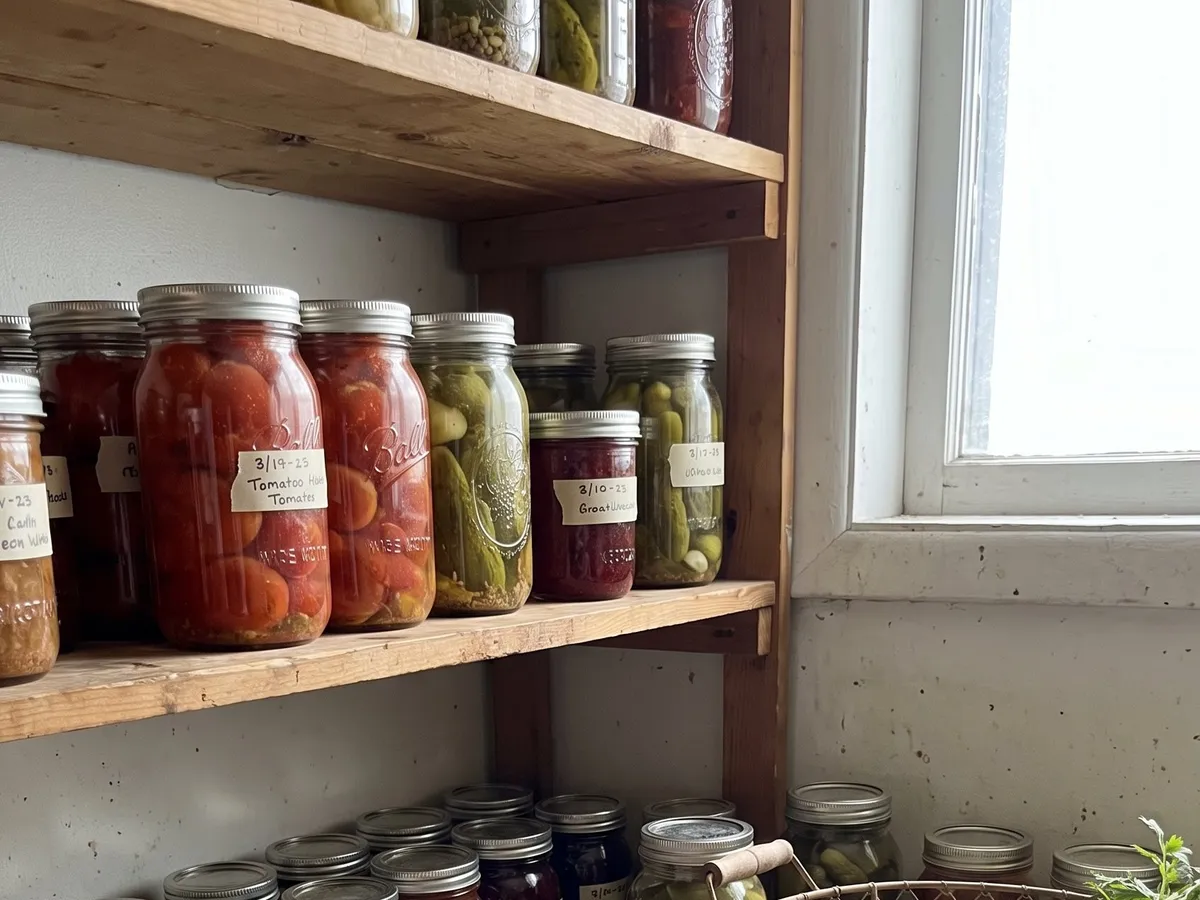
How long does home canned food last? For best quality, the National Center for Home Food Preservation (NCHFP) and the USDA say to use it within one year. Store jars in a clean, cool, dark, dry place, ideally at 50 to 70°F and never above 95°F. The one-year figure is about quality: NCHFP says properly processed food stays free of spoilage as long as the lid stays sealed and the jar is kept below 95°F. A jar of any age that shows signs of spoilage is thrown out without tasting.
The Off-Grid Handbook describes canned jars in Project 31 as holding for months on an unpowered shelf. NCHFP's working limit gives that a number: can no more than you will use within a year.
How long does home canned food last in mason jars?
Storage conditions decide how much of that year you get. NCHFP's guidance, adapted from the USDA:
| Storage condition | What happens |
|---|---|
| Cool, dark, dry, 50 to 70°F | Best quality, for about a year |
| Above 95°F, or near hot pipes, a range, a furnace, an uninsulated attic or direct sun | Food loses quality in a few weeks or months, and may spoil |
| Damp | Metal lids corrode, seals break, food can be recontaminated |
| Accidental freezing | No spoilage unless jars unseal, but food may soften |
If jars must sit where they could freeze, NCHFP suggests wrapping them in newspaper, packing them in heavy cartons and covering them with more newspaper and blankets.
Shelf life of home canned food vs store-bought cans
Commercial cans last longer on paper, because they are made under controlled factory conditions and sealed in metal rather than glass with a two-piece lid. The USDA Food Safety and Inspection Service (FSIS) gives low-acid commercial cans 2 to 5 years and high-acid cans 12 to 18 months, while it gives home-canned foods 12 months. The full commercial chart, and what the dates on cans mean, is in how long canned food lasts.
The year applies to both high-acid jars, such as jam and pickles, and pressure-canned vegetables and meats. Treat it as the target for eating your jars, not the moment they turn unsafe. A year is also one garden cycle: what you can this summer should be eaten by next summer, when the new harvest arrives.
After canning: four storage steps
- Remove the bands once jars have cooled 12 to 24 hours and sealed.
- Wash the lid and jar without disturbing the seal, then rinse and dry. NCHFP says leftover syrup or food on the outside can grow mold during storage.
- Store jars without bands. It keeps them dry and makes a broken seal easier to spot. If you stack jars, NCHFP mentions one manufacturer's advice of no more than two layers, with a firm layer between them.
- Label and date every jar. The Handbook's Project 31 field note: label with contents and month, because a shelf of anonymous jars is a memory test you will eventually fail.
If a lid did not seal, the jar is not shelf-stable. Why canning jars don't seal covers the options.
Rotation: first in, first out
A date only helps if the oldest jar gets eaten first. Project 36 of the Handbook, the FIFO rotation shelves, sets the habit: date every can and jar on arrival with a china marker, in big, readable month and year, and run a monthly two-minute audit. Anything near its date moves onto that week's menu. The book builds the shelves in about two hours for around $40; our guide to the DIY can rotation rack has the steps.
Can to your menu, too. If your household eats one jar of tomatoes a week, about 52 jars covers a year, and canning far more than that only builds a back row of aging jars. The pantry plan in the 30-day food supply list helps set those numbers.
Older jars: what to check before eating
A jar a little past a year is not automatically unsafe, but check it more carefully. NCHFP's routine:
- The lid should be tight and concave, with no bulge.
- No streaks of dried food running down the outside, no rising bubbles, no unnatural color.
- On opening, no spurting liquid, no off smell, no mold on the food or under the lid.
For home-canned low-acid foods and tomatoes, the CDC adds a step before eating: boil 10 minutes below 1,000 feet, plus 1 minute for each additional 1,000 feet. Any jar with a warning sign is discarded without tasting, following signs of botulism in canned food.
Once a jar is open
An opened jar is perishable, just like an opened can. USDA FSIS gives opened home-canned food 3 to 4 days in the refrigerator. Smaller jars help here: a pint that suits one meal leaves nothing to store.
That matters most in a power outage. Sealed jars need no electricity, which is a large part of their value in a household food supply, but leftovers do. If the refrigerator is off, open only what you will eat at one sitting, and remember the USDA limit of 2 hours above 40°F for perishable food, the core of the food danger zone rule.
What to write on the label
Contents and month are the minimum. Many canners also note the batch, so a jar on the shelf can be matched to the entry in the canning log. The Handbook's Project 32 log records the food, the recipe source, the date and the jar count, and a log like that answers most questions about an old jar without opening it.
Where to keep jars at home
The best spot is the coolest dry, dark place inside the heated part of the house: a basement shelf away from the furnace, an interior closet, a pantry on an outside wall. Avoid the garage, the attic and the cabinet over the stove.
A root cellar is cool, but it is also humid, and damp is hard on metal lids. Keep jars on the drier upper shelves, as root cellar temperature and humidity explains. The jars themselves come from water bath canning and pressure canning; a year of good storage starts with a tested recipe.
Frequently asked questions
How long does home canned food last?
NCHFP and the USDA recommend using home-canned food within one year for best quality, stored in a cool, dark, dry place at 50 to 70°F. NCHFP says properly processed jars stay free of spoilage while the seal holds and storage stays below 95°F, but quality declines over time.
Can you eat home canned food after 2 years?
The one-year guideline is about quality, not a safety cutoff, but older jars deserve a careful check. The lid must be tight and concave, with no leaks, bubbles, off color, spurting or off smell. Boil low-acid foods and tomatoes 10 minutes, plus 1 minute per 1,000 feet above 1,000, before eating. Discard any jar with a warning sign.
What is the best temperature to store home canned food?
NCHFP says 50 to 70°F for best quality, and never above 95°F. Keep jars away from hot pipes, the range, the furnace, uninsulated attics and direct sunlight, and out of damp spots, where lids can corrode and seals can break.
Should you store canning jars with the rings on?
NCHFP recommends removing the screw bands after the jars have cooled and sealed. Without bands, jars stay drier and a broken seal is easier to spot, since a band can hold a loose lid in place. Wash and dry the bands for reuse.
Sources
- The Off-Grid Handbook, Garrett Dalton, Project 31
- NCHFP: Storing Home Canned Foods
- NCHFP: Ensuring Safe Canned Foods
- NCHFP: Temperatures for Food Preservation
- USDA FSIS: Shelf-Stable Food Safety
- CDC: Home-Canned Foods
Safety guidance changes. Check the agency pages above for the current version, and follow your local code and manufacturer instructions.