Bulk, absorption and float: the charge stages on your solar controller, explained
Three words on a small screen tell you whether your battery is filling, topping off or full. Here is how to read them.
In this article
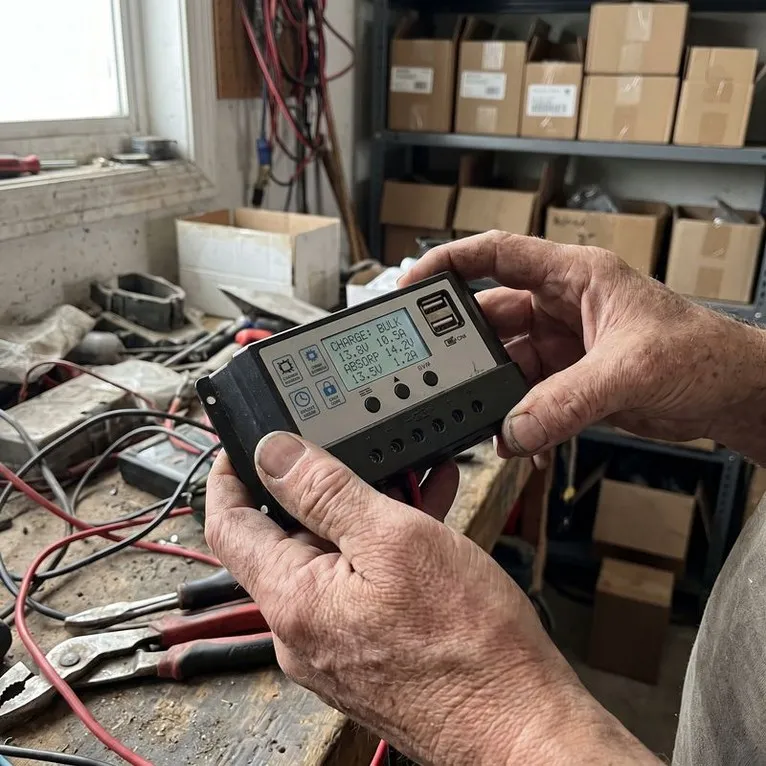
Bulk, absorption and float are the three stages a solar charge controller uses to fill a battery. In bulk, it sends all the current the panel can give while the battery voltage climbs. In absorption, it holds the voltage steady while the current tapers off as the battery tops up. In float, it drops to a lower voltage that keeps a full battery full. The bulk absorption float sequence is the normal pattern on a sunny day, and seeing all three tells you the system is working.
The Off-Grid Handbook makes this the last check in Project 20, Charge Controller: Choosing & Wiring: bulk, absorption and float should each appear on the display across a sunny day.
Bulk absorption and float explained in one table
| Stage | What the controller does | What the battery is doing |
|---|---|---|
| Bulk | Passes as much current as the panel makes | Filling fast; voltage rising |
| Absorption | Holds a set charging voltage | Topping up; current falling |
| Float | Holds a lower maintenance voltage | Full; only small top-ups |
| Equalize (some controllers) | A periodic, higher-voltage charge | Flooded lead-acid maintenance only |
The controller's whole job, as a University of Arizona Cooperative Extension guide describes it, is to prevent overcharging and undercharging the battery. The Florida Solar Energy Center (FSEC), part of the University of Central Florida, describes the same modes in its guide to batteries in solar systems: a normal or bulk charge, a finishing or float charge, and an equalizing charge.
Bulk: the fast fill
Bulk is where most of the charging happens. FSEC says bulk charging generally runs up to between 80 and 90 percent state of charge. During bulk the controller simply passes the panel's current through to the battery, and the voltage climbs as the battery fills.
In the morning, after a night of running lights or a fridge, you should see bulk. On a gray day you may see nothing else, because the panel never makes enough current to finish the job. That is normal for one day; it is a warning sign if it happens every day. A battery that never leaves bulk is a battery that never gets fully charged.
Absorption: holding the voltage
Once the battery reaches its set charging voltage, the controller stops pushing current and holds the voltage instead. The battery takes less and less current as it fills. Sandia National Laboratories calls this the constant voltage taper stage, and it ends when the current needed to hold the voltage falls below a set threshold.
The set voltage depends on the battery. FSEC gives typical charge regulation voltages for a 12-volt battery at 77°F:
| Battery type | Typical charge voltage (12 V) |
|---|---|
| Flooded lead-antimony | 14.4 to 14.8 V |
| Flooded lead-calcium | 14.0 to 14.4 V |
| Sealed (valve-regulated) lead-acid | 14.0 to 14.4 V |
Temperature changes the right number for lead-acid. FSEC explains that the voltage at which a lead-acid battery starts gassing drops as it gets warmer and rises in the cold, which is why some controllers adjust the charge voltage with a temperature sensor: to fully charge the battery in cold weather and limit overcharge in warm weather. If your controller came with a sensor, mount it on the battery, not on the wall.
FSEC stresses that these are general figures and the battery maker's values come first. That is why the Handbook's wiring order ends with set the battery chemistry profile: battery first, then panel, then pick the profile that matches the battery.
Float: keeping a full battery full
When absorption ends, the controller drops to float. FSEC gives typical float voltages of 13.5 to 13.8 volts for a 12-volt lead-acid battery, low enough to limit gassing, the bubbling that dries out flooded batteries.
FSEC also explains why a solar controller charges higher than float first. A solar battery has to recharge in the hours of sunlight, and if the controller only ever charged at float voltage, the battery would never get fully charged.
Equalizing is a separate, occasional overcharge that FSEC describes for keeping the cells of flooded lead-acid batteries consistent. It is a lead-acid procedure. Leave it off unless your battery's manual calls for it.
Bulk absorption float on LiFePO4 batteries
Lithium iron phosphate (LiFePO4) batteries charge in the same basic two steps. Sandia's description of a standard charge is a constant current bulk stage until the battery reaches its maximum voltage, then a constant voltage stage until the current drops below a set level, following the manufacturer's specifications.
The details differ from lead-acid, and the battery maker sets them: the charge voltage, how long absorption lasts, and whether to use a float stage at all and at what voltage. Pick the lithium or LiFePO4 profile on the controller, or enter the maker's numbers in a custom profile, and never run a lead-acid equalize charge on a lithium battery. Cold matters too; see charging LiFePO4 below freezing before winter.
A lithium battery's voltage also stays nearly flat through most of its charge, so a voltage reading tells you less than it would on lead-acid. Our LiFePO4 voltage chart explains how to read it.
Reading the stages on a sunny day
The Handbook's test takes one clear day. Check the display in the morning, around midday and in the afternoon:
- Bulk in the morning, absorption around midday, float by afternoon: the system is healthy.
- Bulk all day, never float: the panel may be too small for the battery and loads, the panel may be shaded, or the loads ran all day. Check the sizing in what size solar panel to charge a 12V battery.
- Float soon after sunrise: the battery was already full. Good, unless it is also running out at night, which points to lost capacity; see how to test battery capacity.
- Stages that don't match the battery's numbers: recheck the chemistry profile.
Project 20 is a one-hour job for $30 to $90 in parts, per the book. Choosing between controller types is covered in MPPT vs PWM charge controller, and the whole small system in the DIY solar charging station.
Frequently asked questions
What do bulk, absorption and float mean?
They are charge stages. Bulk sends all available current while the battery voltage rises, absorption holds a set voltage while the current tapers, and float holds a lower voltage to keep a full battery full. The Off-Grid Handbook says all three should appear across a sunny day.
What is a good float voltage for a 12-volt battery?
For lead-acid, the Florida Solar Energy Center gives typical float voltages of 13.5 to 13.8 volts. Your battery maker's figure comes first. For LiFePO4, the battery maker decides whether a float stage is used at all and at what voltage.
Does a LiFePO4 battery need a float charge?
Follow the battery's manual. Lithium batteries are charged with a constant current stage, then a constant voltage stage, to the maker's specifications. Whether to add float, and at what voltage, varies by maker. Never use a lead-acid equalize charge on a lithium battery.
Why does my charge controller never reach float?
The battery never got full that day. Common causes are a cloudy day, a panel that is too small for the battery and loads, shade on the panel, heavy daytime use, or the wrong battery profile. One day is normal; every day means something needs fixing.
Sources
- The Off-Grid Handbook, Garrett Dalton, Project 20
- Florida Solar Energy Center (UCF): Batteries and Charge Control in Stand-Alone Photovoltaic Systems
- Sandia National Laboratories: DOE Energy Storage Handbook, Chapter 16, Performance Testing
- University of Arizona Cooperative Extension: Stand Alone Photovoltaic (PV) Systems (AZ1983)
Safety guidance changes. Check the agency pages above for the current version, and follow your local code and manufacturer instructions.